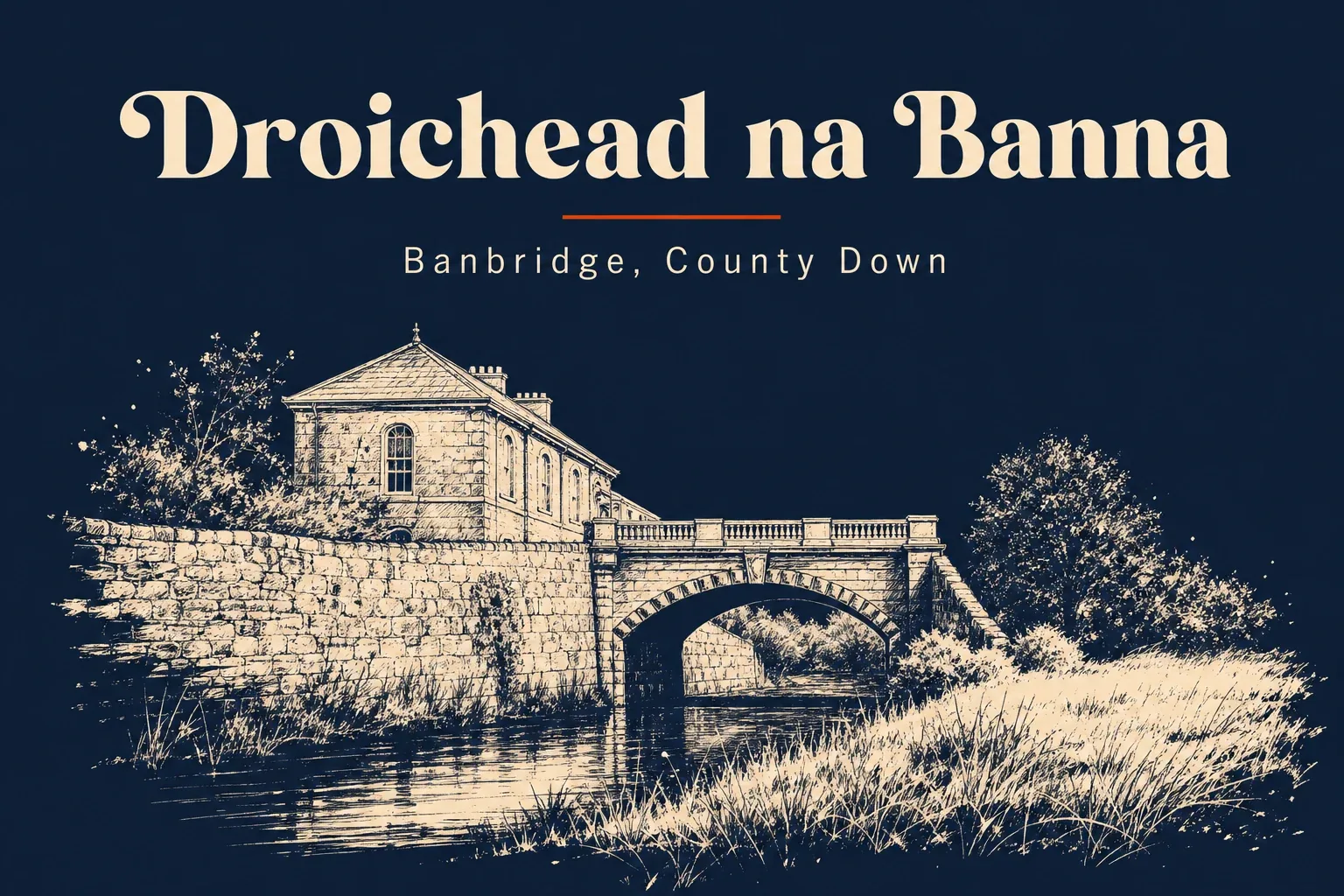
Droichead na Banna · Co. Down
A market town with a road sliced through its middle, and an Arctic explorer on the square.
Banbridge is a town on the River Bann that the main Dublin-Belfast road used to run straight through and now goes around. It was chartered as a market town in 1767, made its fortune on linen in the nineteenth century, and got bypassed by the A1 in 2003. None of those phases tidy up neatly. The Cut still divides Newry Street. The linen mills are gone or converted. The bypass took the through-traffic but also the casual stop.
The visual hook is The Cut. Mail coaches from Belfast to Dublin couldn't make the hill on Newry Street, so in 1834 the Marquess of Downshire commissioned William Dargan - the engineer who later built half the Irish railway network - to cut a trench straight through it. Four and a half metres deep, with Downshire Bridge thrown across the top so the upper and lower halves of the town stayed connected. Stand on the bridge and look down at the buses going under you. It still looks like a thing somebody decided to do on purpose.
The other thing to know is Crozier. Captain Francis Rawdon Moira Crozier, born here in 1796, captained HMS Terror and was second-in-command of the Franklin expedition. The ships sailed in 1845 looking for the Northwest Passage; nobody from the expedition ever came home. His statue went up on Church Square in 1862 - Crozier on top, four polar bears around the base, the inscription quietly noble. Recent searches in the Canadian Arctic have found both ships. The town has not stopped waiting.
Treat Banbridge as a half-day. The Cut and the bridge, Crozier on the square, the F.E. McWilliam Gallery out on the Newry Road, a coffee on Bridge Street, then on to Hillsborough or down toward Newry. The Mournes are forty minutes south. The bypass means you can leave as easily as you arrived.