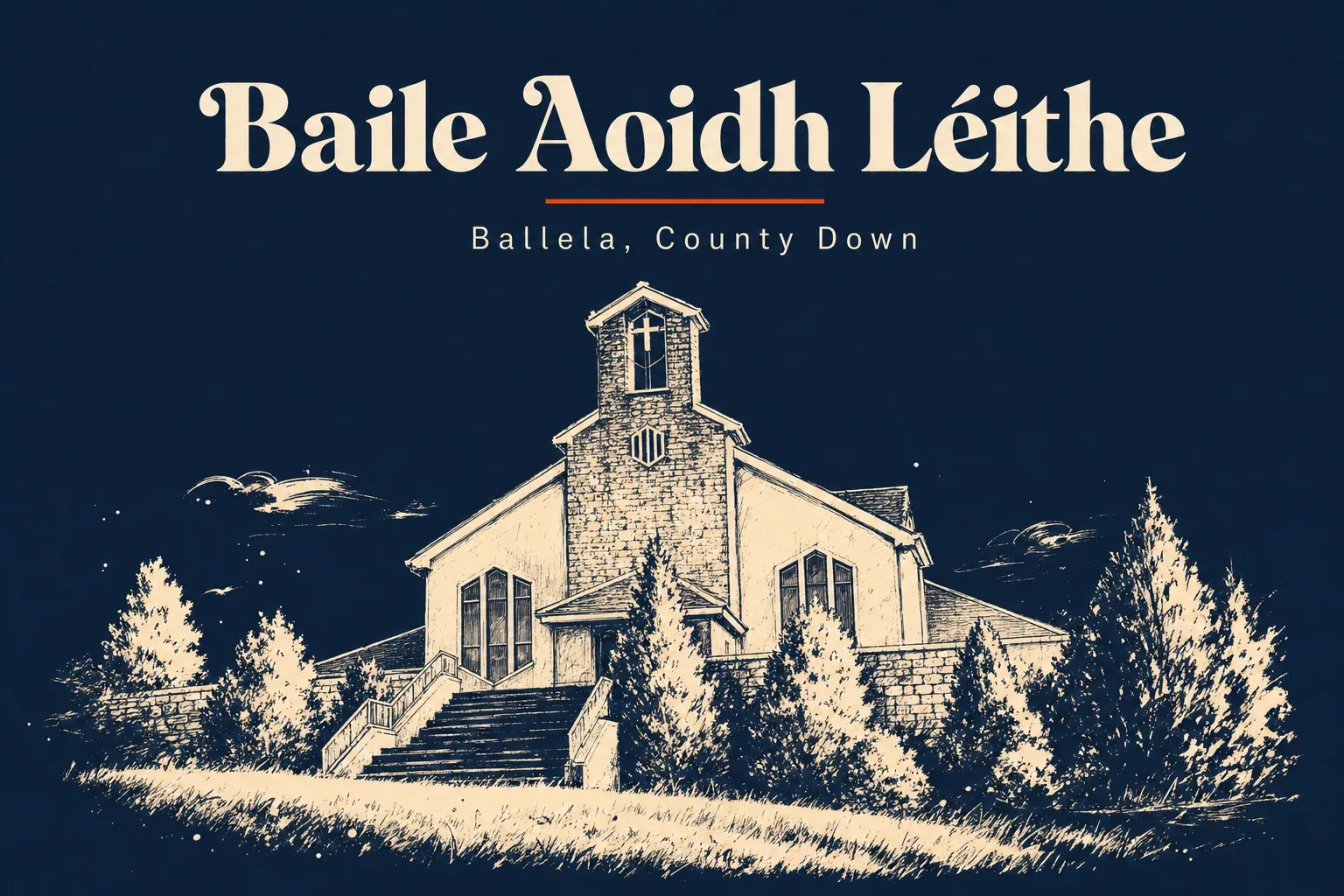
The country Ballela sits in
Aghaderg parish
Ballela is one of the villages of the civil parish of Aghaderg, the long parish that runs from Loughbrickland in the west through Ballela and out toward the back roads to Banbridge and Rathfriland. The parish was Magennis lordship country before the seventeenth century — the Gaelic chiefs whose tower at Rathfriland was knocked down in the 1640s and whose lake at Loughbrickland still carries the older name. After the plantation and the wars, the parish was divided between the Church of Ireland — whose parish church sits at Loughbrickland — and the Catholic parish, whose chapel and school are here at Ballela. The two centres are two miles apart and have been for centuries.
Sunday afternoons at the pitch
A GAA village
For a village of this size, the Gaelic football club is the social spine. The pitch on the edge of Ballela hosts parish-level club football in the Down championship, with the old south-Down rivalries — Annaclone, Tullylish, Aghaderg, Saval — still alive on the field. A senior championship Sunday empties the village into the ground. The club has had its decades of strength and its decades of rebuilding, like every parish club in south Down. The pitch is the place to find the village on a summer afternoon; the chapel is the place to find it on a Saturday evening.
Quiet by accident, not by design
Off the A1
The reason Ballela is as quiet as it is today has as much to do with the road network as with its size. The A1 dual carriageway between Belfast and Dublin runs a couple of kilometres west of the village, lifting Banbridge and Newry traffic away from the country lanes. Before the bypasses and the dual carriageway upgrades, the back roads through the parish carried more cross-country traffic than they do now. Today the lanes through Ballela are tractor lanes and school-run lanes, and the dual carriageway can be heard on a still day from a couple of fields away. The quiet is genuine; it is also recent.