County Down Ireland · Co. Down · Loughbrickland Save · Share
POSTED FROM
LOUGHBRICKLAND
CO. DOWN · IE

Loughbrickland
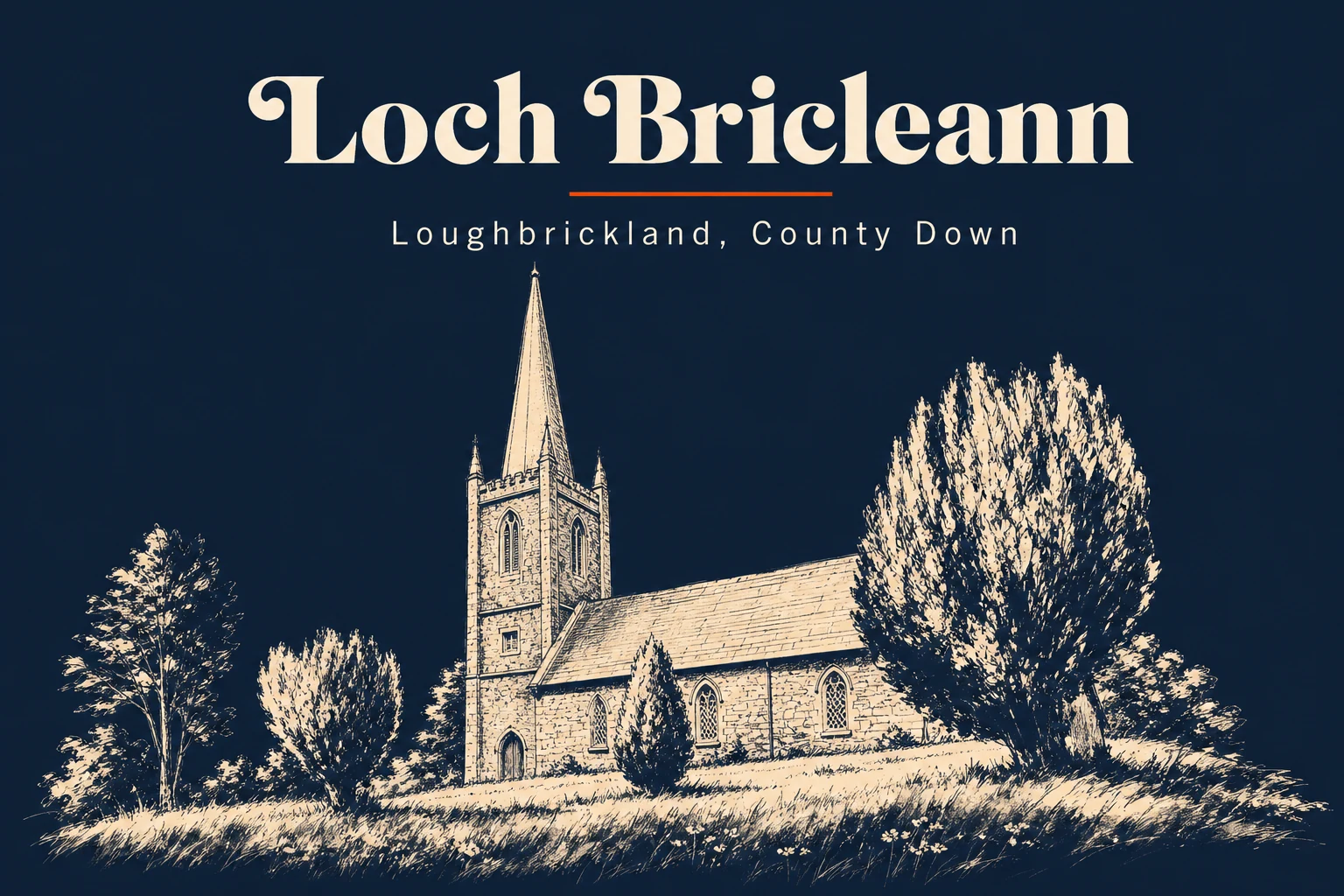
Loch Bricleann

The Ireland's Ancient East
STOP 09 / 09
Loch Bricleann · Co. Down

A small lough, a small village, and the field where William of Orange counted his army.

Loughbrickland is a one-street village built around a small lough, ten minutes north of Newry on the old Dublin road. About 700 people live here. The lough — Loch Bricleann, Bricriu's lake — is the reason there's a village at all, and the reason there was a fort here long before the village existed. There is a crannog in the middle of it that's been there since the early medieval period.

The other reason to know the name is 1690. In the last week of June that year, William of Orange marched up from Carrickfergus and pitched his entire army in the fields around the lough — somewhere between 30,000 and 36,000 men, drawn from half a dozen countries, waiting on stragglers and supplies before the push south. He rode out a few days later, met James II at the Boyne, and the rest is parade season. The encampment site is unmarked. The fields are just fields.

Today the A1 takes everyone past at 70 miles an hour and the village gets on with itself. There's one pub-restaurant, a couple of churches, a small park, and the gates of Loughbrickland House — Whyte family seat since 1704 — at the north end. Come for the lake walk and the history, not for an evening out. Sleep in Banbridge or Newry. Eat at the Seven Stars on Main Street if you're passing.
Population
~793
Walk score
Lake, Main Street and back inside half an hour
Founded
Magennis seat; planted by Sir Marmaduke Whitechurch from 1585
Coords
54.3083° N, 6.2986° W
01 / 09

At a glance.

Three things every local will eventually mention. Read these and you've already understood more than most day-trippers do.

02 / 09

The pubs.

None of these are themed Irish pubs, because they don't need to be. A few that earn the trip:

The Seven Stars

Local, sit-down food
Pub & restaurant, 4 Main Street

The pub in the village. Bar on one side, 80-seat restaurant on the other, Sunday lunch 12:30 to 2:30, dinner Tuesday to Sunday from five. Homemade brown bread and big portions are what people come back for. Not a music pub — a food pub with a bar attached.

03 / 09

Where to eat.

PlaceTypeLocal note
The Seven Stars Pub restaurant €€ The one sit-down dinner in the village. Duck and steak get the reviews, the desserts come up a lot, and the dining room is comfortable enough for a proper sit. Closed Mondays.
Banbridge, ten minutes north Note For anything beyond the Seven Stars — cafes, takeaways, the supermarket dinner — Banbridge is the real high street. Newry is twenty minutes the other way and has the bigger range.
04 / 09

Where to sleep.

PlaceTypeLocal note
Loughbrickland Courtyard Self-catering apartments Two apartments — Lisnagade (sleeps 4) and Coolnacran (sleeps 6) — in the converted coachhouse of Loughbrickland House. Won a stack of small-resort awards in the early 2020s. You sleep on the Whyte estate with the woodland walk out the back door.
Loughbrickland Gate Lodge Self-catering cottage The old gate lodge at the entrance to Loughbrickland House, also run by the Courtyard people. One cottage, on its own, beside the gates the army of 1690 walked past.
Banbridge or Newry Note No hotel in the village. For a hotel bed, Banbridge is ten minutes north on the A1; Newry is twenty minutes south. Both are dull-but-functional bases for the Mournes and south Armagh.
05 / 09

Stories & lore.

The reason to come back. The things every local will eventually tell you about, usually after the second pint.

June 1690

William of Orange counted his army here

In the last week of June 1690, William III rode south from Belfast and pitched his entire force in the fields around Loughbrickland — somewhere in the order of 36,000 men by the time the camp was full. Dutch regulars, Danes, French Huguenots, Germans, English, Scots, a smattering of others. He held a review on the open ground, waited for the rest of the army to come in, then marched on to the Boyne. The battle was 1 July (Old Style). Loughbrickland was the last quiet day the campaign had.

The name on the postmark

Bricriu's lake

Loch Bricleann means Bricriu's lake. Bricriu was a chieftain and hospitaller of the Ulster Cycle — a poet and a troublemaker, the man who hosted the feast in the saga Fled Bricrenn ('The Feast of Bricriu') and then set the warriors of Ulster at each other's throats for sport. Tradition puts his fort on the lake here. The crannog in the middle of the lough is real and early medieval; the Bricriu connection is older and mythological. Both stories sit on the same water.

1704 to today

The Whytes of Loughbrickland House

The estate came to John Whyte of Leixlip Castle in 1704 as the dowry of his wife Mary Purcell — a direct descendant of Sir Marmaduke Whitechurch, who'd been granted the land by Elizabeth I in 1585. Loughbrickland House itself was built in the early eighteenth century and largely rebuilt around 1780–90. The Whyte family still have it. By 1868 the estate ran to 1,928 acres; it's smaller now, but the woodland walks, the two ring forts and the gate lodge are all still there.

Before everyone else

The Magennises came first

Long before the Whytes, before Whitechurch, before the planters, Loughbrickland was a major seat of the Magennises of Iveagh — the Gaelic lords who ran most of this corner of Down from the late medieval period. Their castle is believed to have stood on the shores of the lough. Nothing of it survives above ground. The lake stayed; the lordship did not.

06 / 09

Things to do outside.

Wear waterproofs. Bring a sandwich. Tell someone where you're going if it's the mountain.

Loughbrickland Historic Trail Starts at the car park on Lakeview Road, goes round the lough, up Main Street, into the grounds of Loughbrickland House, past the rath, and round by the Boundary Trail through a second ring fort (Johnston's Fort) before looping back to the gate lodge. Developed by the local historical group with Heritage Lottery money. The interpretation panels are the village's history laid out in order.
~7.5 km full loopdistance
2 hourstime
Whyte's Estate Woodland Walk The shorter, woods-only version of the historic trail. Through the grounds of Loughbrickland House, past Coolnacran Rath, along the boundary, back. Easy underfoot, can be muddy. Walk it from the Courtyard if you're staying there.
1.9 / 2.5 km optionsdistance
40 min – 1 hourtime
Around the lough A flat shoreline loop on the southern edge of the village. Not waymarked as a formal trail — just a walk. The crannog is visible from the south bank in low water.
~2 kmdistance
30 mintime
07 / 09

When to go.

There is no bad time. There are different times.

Spring
Mar–May

Wood-anemone weather on the estate walks, the lough at its clearest, and nobody about.

◉ Go
Summer
Jun–Aug

Long evenings for the lake walk. The Twelfth and the build-up to it makes early July a noisy time in this part of Down — plan around it if that matters.

◉ Go
Autumn
Sep–Oct

Best season here. The woodland on the Whyte estate goes colour, the lough goes still, the Seven Stars is at its most local.

◉ Go
Winter
Nov–Feb

Short days, wet paths, not much open beyond the pub. Fine if you live nearby; thin if you came for a weekend.

◐ Mind yourself
08 / 09

What to skip.

Honestly? Don't bother.

If a local was sitting beside you, this is the bit where they'd lean in.

×
Looking for a William of Orange visitor centre

There isn't one. The encampment was 1690, the fields are still fields, and the only marker is a line in the local heritage trail leaflet. If you want a Williamite museum, that's at the Boyne site in Co. Meath.

×
Treating Loughbrickland as an evening out

It's one pub-restaurant. Eat at the Seven Stars by all means, but sleep and stay-late somewhere with more than one street.

×
The crannog by boat

There's no boat hire on the lough and no public access to the island. Look at it from the shore and read about it. That's the lot.

+

Getting there.

By car

On the A1 dual carriageway between Banbridge (10 min north) and Newry (15 min south). Belfast is 45 minutes; Dublin is 1h 45m. The 2009 junction upgrade means you exit the A1, not crawl through the village.

By bus

Translink Goldline 238 (Belfast–Newry) stops in the village. Ulsterbus services connect to Banbridge and Newry through the day.

By train

No station. The nearest is Newry (15 min by car) on the Belfast–Dublin Enterprise line.

By air

Belfast International (BFS) is 50 minutes. Belfast City (BHD) is 45 minutes. Dublin Airport is 1h 30m down the M1/A1.