County Down Ireland · Co. Down · Drumbeg Save · Share
POSTED FROM
DRUMBEG
CO. DOWN · IE

Drumbeg
Droim Beag

The Ireland's Ancient East
STOP 06 / 06
Droim Beag · Co. Down

A parish church on a bend of the Lagan, three miles south of Belfast.

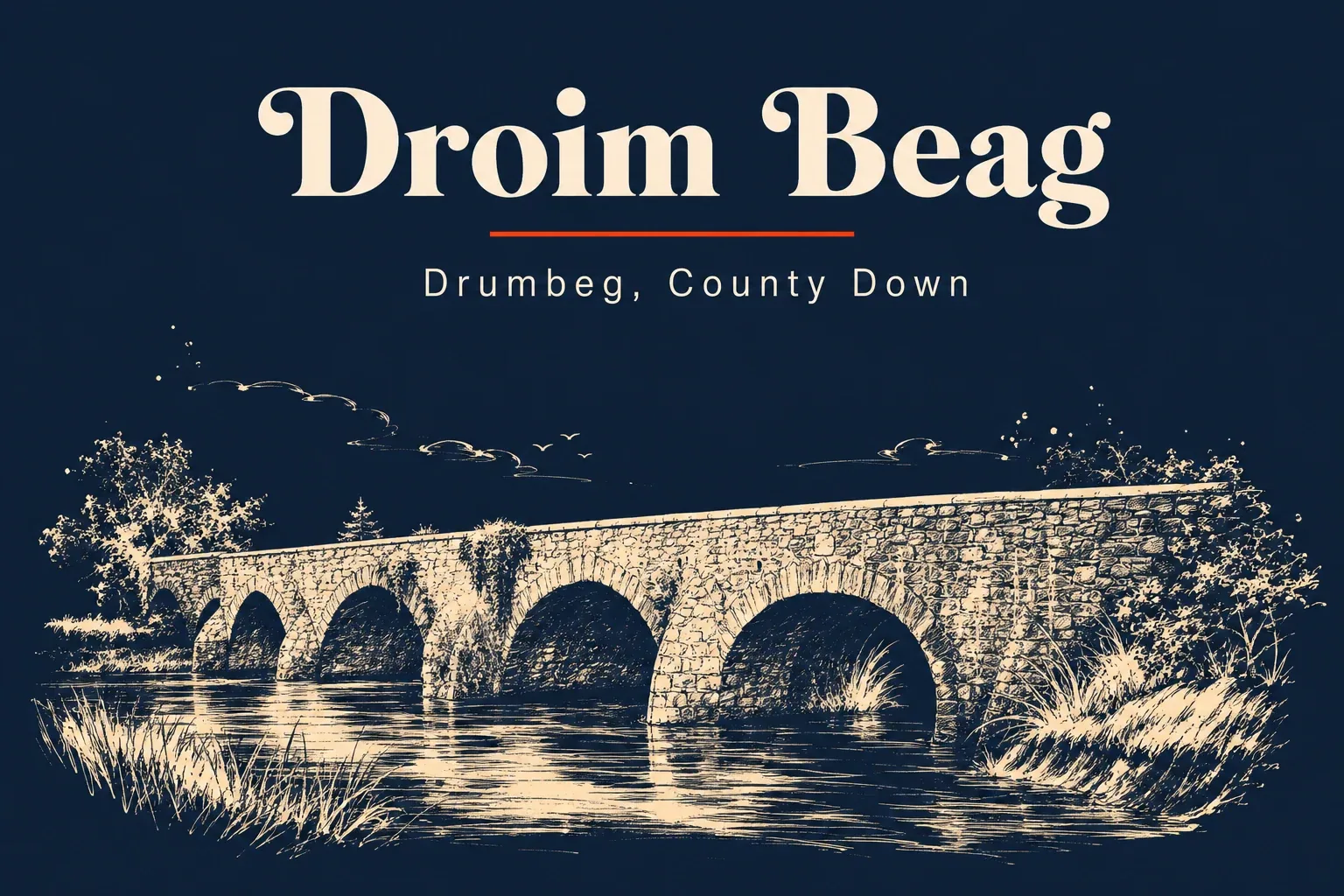
Drumbeg means little ridge — Droim Beag — and the ridge is the bank of the River Lagan, three miles south of Belfast. The village is, in the strict sense, a parish: a Church of Ireland church on a piece of high ground above the river, a graveyard around it, a clutch of houses on the roads that lead away from it, and the Lagan Towpath running below. Half a thousand people live in the immediate parish. Most of them work in Belfast or Lisburn. You can be in either in fifteen minutes by car, or on a bike along the towpath in about an hour either direction.

The church is the point. Drumbeg Parish Church — Church of Ireland — has stood on this site, in some form, since the medieval period; the present building dates to around 1798. The graveyard is older than the church and worth a slow walk: country stones, generations of the same surnames, ivy doing its work on the older corners. The original parish was large enough to merit a long history, and the parish records reach back to the seventeenth century, but the village itself is not where you come for an afternoon out. You come because you are walking the towpath, or because you have a relative in the ground, or because you live nearby.

Treat Drumbeg as a stop, not a stay. There is no high street, no pub in the village itself, no restaurant that locals would direct you to as Drumbeg's. The food and the pints are at Edenderry a little further upriver toward Drumbo, or at Hillsborough or Lisburn ten minutes off. What there is here is the church, the bend of the river, and the towpath under the trees — and on the right kind of afternoon, with the light coming through, that is genuinely enough.
Population
~500
Walk score
Church, bridge, river — three minutes between them
Founded
Parish church on this site since the medieval period; current building c. 1798
Coords
54.5283° N, 5.9650° W
01 / 06

At a glance.

Three things every local will eventually mention. Read these and you've already understood more than most day-trippers do.

02 / 06

Stories & lore.

The reason to come back. The things every local will eventually tell you about, usually after the second pint.

A late-Georgian rebuild on a much older site

The parish church

Drumbeg Parish Church belongs to the Church of Ireland diocese of Down and Dromore. The current building dates from around 1798 — a late-Georgian country church with a small steeple, sitting in a graveyard that visibly predates it. The parish itself runs back into the medieval period: a church has stood on this ridge above the Lagan for centuries, replaced and rebuilt as the centuries demanded, the burials accumulating around it all the while. It is the kind of country church that does not feature in guidebooks and does not need to: a working parish, with services on a Sunday, a graveyard you can walk through on a weekday, and a quiet that the road outside cannot quite reach.

Why there is a towpath at all

The Lagan and the linen trade

The Lagan Navigation — the canalised section of the river linking Belfast Lough to Lough Neagh — was finished in the late eighteenth century to carry coal in and linen and farm produce out. Lighters pulled by horses moved up and down it for over a century until road and rail did the work cheaper. The waterway closed to commercial traffic in 1958. What survives in Drumbeg is the towpath itself, kept and resurfaced as a walking and cycling route between Belfast and Lisburn. The lighters are gone; the embankment and the bridges are still there, and the river still does what rivers do.

A country parish inside the commuter belt

Three miles from a city

Drumbeg's particular condition is that it has been, for two centuries, a country place a very short distance from a large city. Belfast was a small port-town when the parish church was rebuilt in 1798; it was a Victorian industrial city by the time the railway reached Lisburn; it is now a metropolitan area whose suburbs reach the M1 a short walk west of the parish. The village has been absorbed by none of it. The Lagan and the church grounds and the listed buildings of the parish form a green wedge inside the commuter belt that has, more or less, stayed itself. The houses on the surrounding roads are mostly modern and mostly owned by people who work in town. The church is older than any of them.

03 / 06

Things to do outside.

Wear waterproofs. Bring a sandwich. Tell someone where you're going if it's the mountain.

Lagan Towpath through Drumbeg The towpath is the walk. Pick it up beside the river at Drumbeg and head north for the wooded stretch toward Shaw's Bridge and Minnowburn, or south through Ballyskeagh toward Lisburn. Flat, surfaced, suitable for buggies and bikes. Dog-walkers, cyclists, the occasional runner. The same path used to have horses on it pulling cargo.
Variable — 4 km north to Shaw's Bridge / 6 km south to Lisburndistance
1–2 hours either waytime
The church and the graveyard Walk up from the road to Drumbeg Parish Church, round the outside of the building, through the older end of the graveyard, back out. The stones reward a slow look. The setting — high ground, old trees, river out of sight below — is the point. Daylight only.
200 metresdistance
15 minutestime
Shaw's Bridge and Minnowburn loop Drive or walk north a few minutes to Shaw's Bridge — the seventeenth-century stone bridge over the Lagan — and take the Minnowburn loop through the National Trust woodland on the city side. Belfast Hills behind you, Lagan Valley in front. The most-walked bit of countryside in greater Belfast for a reason.
5 km loopdistance
1–1.5 hourstime
04 / 06

When to go.

There is no bad time. There are different times.

Spring
Mar–May

Bluebells in the towpath woodland north toward Minnowburn. The river full. Lambs in the fields on the Lisburn side. The best weeks of the Lagan year.

◉ Go
Summer
Jun–Aug

Long evenings on the towpath. Belfast turns out in numbers on a fine Sunday — go early or go late. The graveyard is quiet whatever the day.

◉ Go
Autumn
Sep–Oct

The leaves go on the towpath beech and the light gets soft. The locals' time of year. Wear something waterproof — the river fog drops in fast.

◉ Go
Winter
Nov–Feb

Dark by half four, the towpath boggy in patches, the graveyard slick underfoot. The church is still the church. Bring boots and accept the rest.

◐ Mind yourself
05 / 06

What to skip.

Honestly? Don't bother.

If a local was sitting beside you, this is the bit where they'd lean in.

×
Looking for a village centre

There isn't one in any high-street sense. Drumbeg is a parish church, a graveyard, a stretch of towpath and a scatter of houses on country roads. The shops are in Lisburn or on the Saintfield Road in Belfast. Come for the church and the river, not for a coffee.

×
Driving up looking for the pub

There is no pub in Drumbeg village. The nearest local that people in this corner of north Down associate with the area is at Edenderry, a few minutes upriver toward Drumbo. Hillsborough and Lisburn are ten minutes off for a proper sit-down.

×
Confusing it with the Drumbeg in County Donegal

There is another Drumbeg in west Donegal, an inlet on the Atlantic coast. Different place, six hours away, no relation. If your sat-nav is suggesting a long drive, you have the wrong one.

+

Getting there.

By car

Belfast city centre to Drumbeg is about 15 minutes — south on the A1 / Lisburn Road or via Shaw's Bridge. Lisburn is 10 minutes west via Ballyskeagh. M1 access at Sprucefield is the fastest route in from further afield.

By bus

Translink runs a Metro service on the Belfast–Lisburn corridor that passes close by, and Ulsterbus services along the Lisburn Road serve the wider parish. There is no high-frequency service into the village itself — check the timetable before you rely on it.

By train

No station in Drumbeg. The Belfast–Lisburn line is the nearest rail; Lisburn (10 minutes by car) and Belfast Lanyon Place (15 minutes) are the workable stations either side.

By air

Belfast International (BFS) is about 25 minutes by car via the M1. Belfast City (BHD) is around 25 minutes through south Belfast.