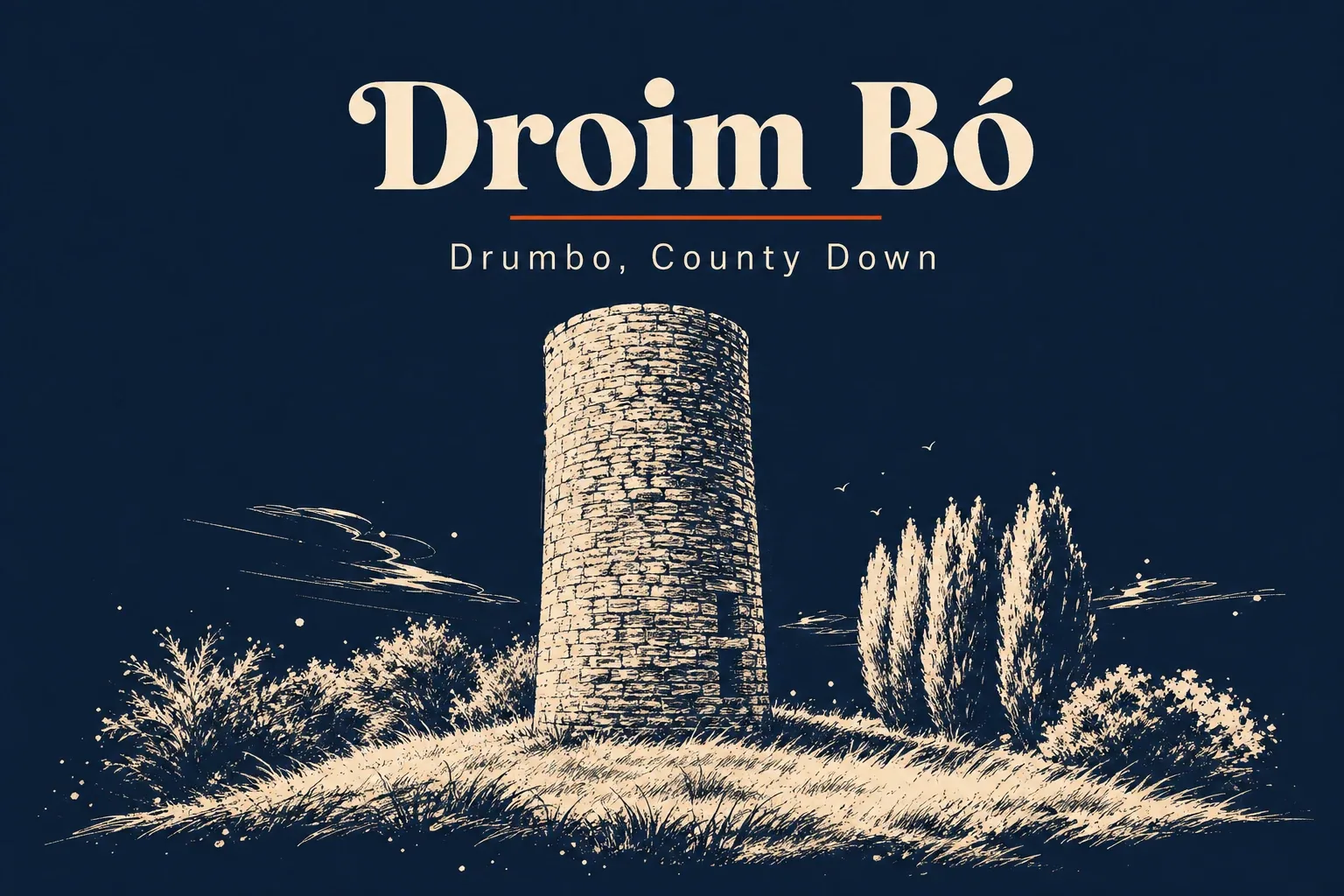
Droim Bó · Co. Down
A round tower stump in a Presbyterian graveyard, ten kilometres south of Belfast.
Drumbo means ridge of the cow - Droim Bó - and the ridge is the point. The village sits where the drumlins of north Down start to ease down into the Lagan Valley, ten kilometres south of Belfast city centre, five kilometres east of Lisburn and five kilometres west of Carryduff. From the high ground the river is laid out below you, and a thousand years ago a community of monks built a round tower here precisely because of that view: a beacon, a watchtower, somewhere to hide the books when the Vikings came up the Lagan looking for them.
The tower is still there. Truncated to about ten metres, the upper sixty feet gone, the stump in the graveyard of the Presbyterian church. It was already standing when the Miscellaneous Irish Annals recorded in 1130 that Druim Both, with its round tower, oratory and books, was plundered by Conor son of Artgal MacLochlainn. That is the village's mention in history. The early monastery vanished afterwards, the medieval parish church that replaced it left only foundations in the grass, and the current Presbyterian church was built alongside the ruins of both. In a country full of round towers, this one has fewer visitors than most - there is no car park, no visitor centre, no tea room. You drive up, you read the small sign, you stand in the graveyard for ten minutes, and you drive away.
The rest of the village is a junction with a wrought-iron pump in the middle of it, a Presbyterian church, a village hall, a playing field down Front Road, and a scatter of houses. The pub people associate with this corner of north Down - Bob Stewart's at Edenderry - is half a mile down the hill toward the Lagan. The Pheasant out at Annahilt is the dinner option, fifteen minutes south. Belfast is twenty minutes north on the A24 and Lisburn is ten west on the back roads. Drumbo is somewhere people live, not somewhere people stop. Make the tower the reason, and the rest is bonus.