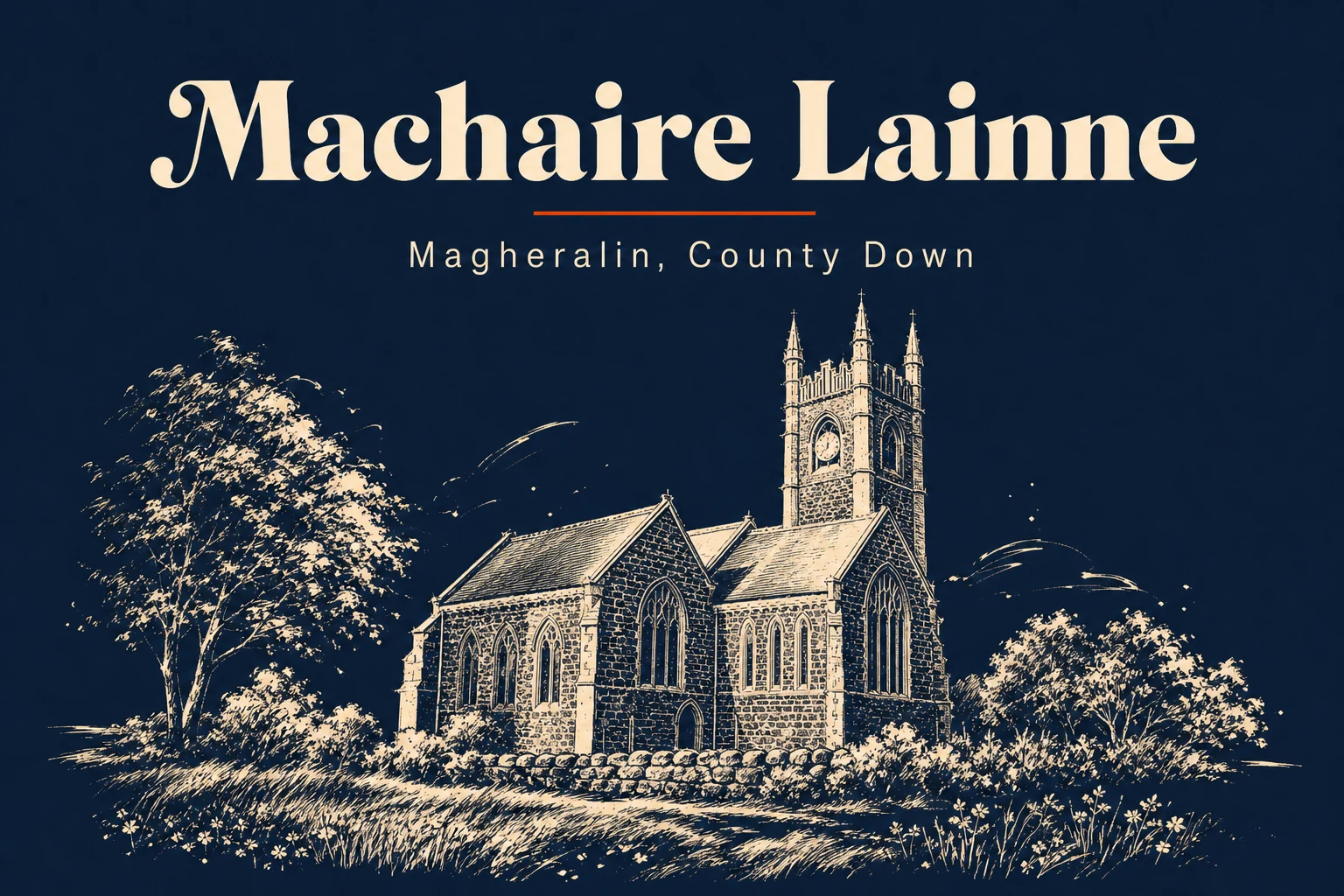
Machaire Lainne · Co. Down
The plain of the church. A monastic site since the 7th century, now a commuter village on the Lurgan road.
Magheralin is two villages laid over each other. There is the modern one - a roadside cluster of housing on the A3 between Moira and Lurgan, two thousand people, most of them driving somewhere else for a day's work. And there is the older one, on the small ridge above the Lagan, where the present Holy and Undivided Trinity church stands on a site that has been a place of worship since the 7th century. Two churches in one churchyard, a thousand years apart. That is the angle.
The Irish name is Machaire Lainne - plain of the church. The original name was older and more specific: Lann Rónáin Fhinn, the church of Ronan Finn, the saint who curses Sweeney into madness in the medieval tale Buile Shuibhne. The monastery here was founded by Mocholmoc, who died in 699. Walk the graveyard on the north side of the present church and the heavy walls you find are, by one reading, what is left of his monastery. By another reading they are the 13th-century parish church. Either way they were standing when the Normans arrived.
Be honest about what is here in 2026. The village is small, the high street is short, and most of what passes for evening life happens down the road in Moira or Lurgan. There is one notable kitchen - The Curious Fox out on Drumnabrezze Road - and a parish church worth the visit. The famous local son, Father Dolling of Portsmouth, has a whole village named after his family one kilometre east at Dollingstown. Treat Magheralin and Dollingstown as a single afternoon and you will understand both. Treat them separately and you will miss what links them.