County Down Ireland · Co. Down · Donaghcloney Save · Share
POSTED FROM
DONAGHCLONEY
CO. DOWN · IE

Donaghcloney
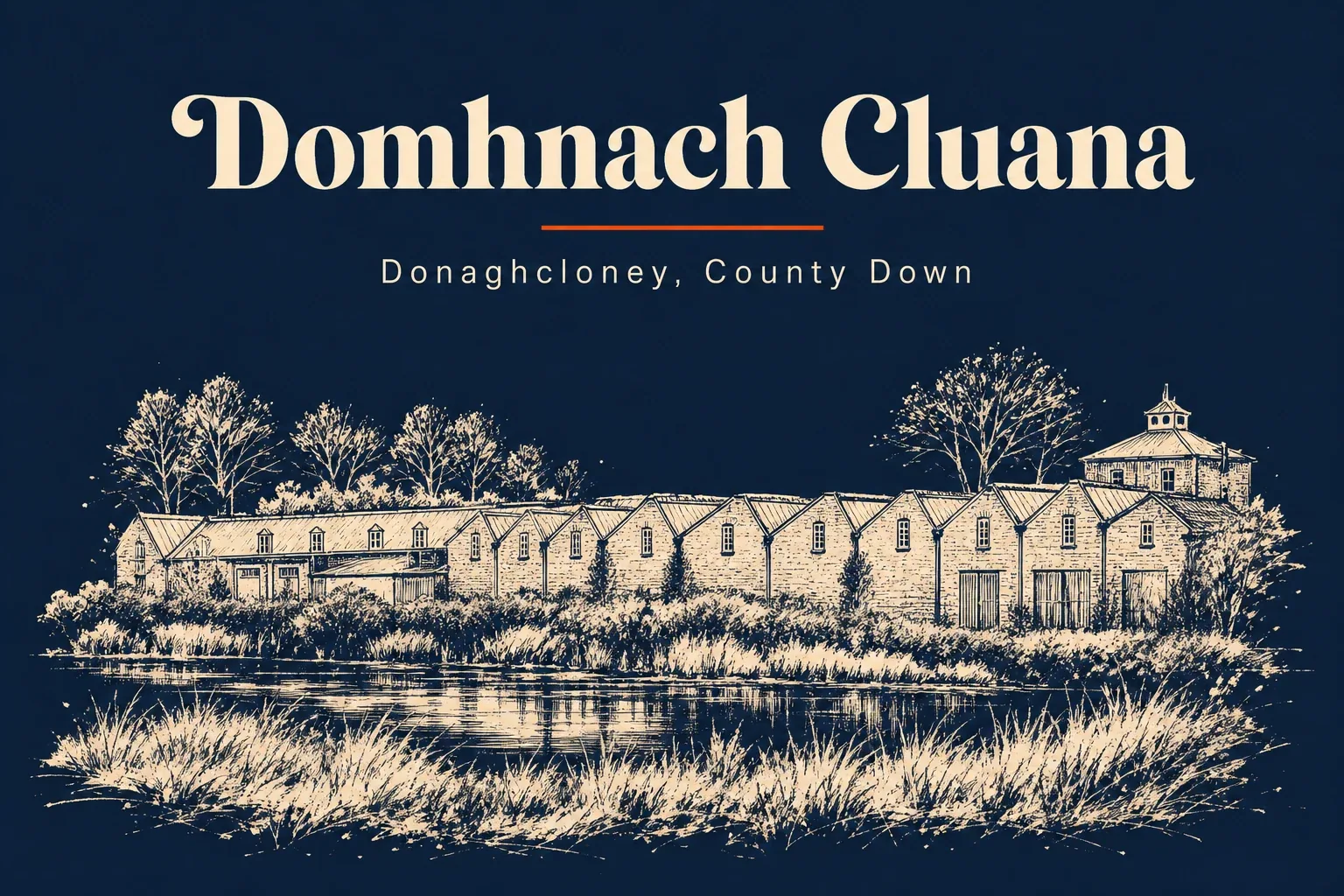
Domhnach Cluana

The Ireland's Ancient East
STOP 06 / 06
Domhnach Cluana · Co. Down

A linen village on the Lagan where the mill that wove the Titanic's tablecloths used to stand.

Donaghcloney sits on the River Lagan between Lurgan and Waringstown, a village that owes its size and its shape to one industry and one family. William Liddell founded his linen company here in 1866 and built a factory by the river that grew into the largest Jacquard weaving operation in Ireland. The Liddells put up housing for the workers, a school, a church, and a cricket pitch — the standard nineteenth-century industrialist's village, done thoroughly.

What the looms produced ended up in places that travelled. Liddell damask covered the tables of the Ritz in London. It went on the Titanic. The firm merged with William Ewart and Sons in 1973, was sold to Baird McNutt in 2001, and was closed the following year. The red-brick factory stood derelict through the 2000s, was demolished in the early 2010s, and only the chimney was kept. The new houses on the site are commuter housing for Lurgan and Lisburn now.

Be honest about Donaghcloney in 2026. It is a quiet village of around two thousand people on a bend of the Lagan, with one parish church, a cricket club that still carries the Mill name, and the chimney that still tells you what the place used to be. Come to walk the river, see the chimney, climb up to the graveyard where the old church stood. Do not come expecting a night out. Waringstown is twenty minutes' walk and Lurgan is ten minutes by car for that.
Population
1,977 (2021 census)
Walk score
Main Street, the bridge, the chimney — fifteen minutes end to end
Founded
Parish church reputedly founded by Saint Patrick, 5th century
Coords
54.4200° N, 6.2603° W
01 / 06

At a glance.

Three things every local will eventually mention. Read these and you've already understood more than most day-trippers do.

02 / 06

Stories & lore.

The reason to come back. The things every local will eventually tell you about, usually after the second pint.

The church of the meadow

Domhnach Cluana

Donaghcloney was reputedly founded by Saint Patrick on his journey from Saul to Armagh in the 5th century — a parish church set on the rise above the Lagan, on the spot the village graveyard occupies today. The Irish name, Domhnach Cluana, is simply "church of the meadow". The earliest written record of the place name appears in papal registers in 1422 as Domhnachcluana.

1689 and the long wait

The bell in the river

During the Williamite War in Ireland a clash took place at Donaghcloney between forces under Frederick Schomberg — William of Orange's senior general — and troops of James II. The parish church was damaged and the bell was thrown into the River Lagan. It lay there for more than a hundred years. When it was finally pulled out of the riverbed in the early 1800s, the inscription "I belong to Donaghcloney" was still legible. It was installed in the church at Waringstown, the next village over, where the parish is still joined.

The man who built the village around a loom

William Liddell

William Liddell founded his linen company in Donaghcloney in 1866 and built the new factory by the river that turned the village into a mill town. The company became the largest Jacquard weaving firm in Ireland. Liddell put up rows of workers' cottages, the school, the cricket pitch and contributed to the church — the textbook nineteenth-century Ulster mill village. Liddell linen went out on the Titanic and on the tables at the Ritz in London. The firm merged with William Ewart and Sons of Belfast in 1973 to form Ewart Liddell, was sold to Baird McNutt in 2001, and the Donaghcloney factory closed the year after.

What was kept and what was not

The chimney

After the mill closed in 2002 the red-brick complex stood derelict for the rest of the decade. Demolition began in the early 2010s and the bulk of the factory came down to make way for housing. The mill chimney, listed and stubborn, was kept. It is the marker on the skyline now. If you know what you are looking at, the village still reads as a mill village; if you do not, it reads as a commuter estate with a tall brick chimney in the middle of it.

Founded 1888, still going

Donaghcloney Mill Cricket Club

The Liddell family founded a cricket club for the factory workers in 1888 and it has been part of village life ever since — the Donaghcloney Mill name survived the loss of the actual mill. In 2017 the club merged with Millpark Cricket Club and reorganised under the Donaghcloney Mill name. The ground is the green heart of the village; the cricket is the social calendar from April to September.

03 / 06

Things to do outside.

Wear waterproofs. Bring a sandwich. Tell someone where you're going if it's the mountain.

Main Street to the chimney and the bridge Down Main Street, past the church, over the Lagan bridge, around the housing on the old mill site to the foot of the chimney, and back. That is the village. Reading the place from the chimney out is the point of the walk.
1.2 kmdistance
20 minutestime
The old graveyard above the Lagan Walk up to the village graveyard on the rise — the site of the original parish church reputedly founded by Saint Patrick. The Lagan is below, the village to one side. Quiet and rarely visited. Bring sturdy shoes if the grass is wet.
800 m returndistance
20 minutestime
Lagan riverbank stroll Out along the riverbank from the bridge as far as the path holds, then back. Not a signposted trail and not a destination walk — just the river the village was built on, doing what rivers do.
2 km returndistance
30 minutestime
04 / 06

When to go.

There is no bad time. There are different times.

Spring
Mar–May

Mild, quiet, the Lagan banks come back to life. Cricket pre-season starts. The light evenings make the chimney walk worth doing after work.

◉ Go
Summer
Jun–Aug

Cricket every weekend at the Mill ground. The river is at its easiest and the long evenings are the right time to read the place.

◉ Go
Autumn
Sep–Oct

Cricket winds up and there is not much else in the calendar. Pleasant for an afternoon visit; not a destination.

◐ Mind yourself
Winter
Nov–Feb

A commuter village in the dark. The church is heated on Sundays. Otherwise pass through to Waringstown or Lurgan for the evening.

◐ Mind yourself
05 / 06

What to skip.

Honestly? Don't bother.

If a local was sitting beside you, this is the bit where they'd lean in.

×
Looking for the linen industry to still be here

It is not. The mill closed in 2002 and the buildings came down in the early 2010s. The chimney and the workers' cottages are what remain. Read the village from those; do not expect a working mill or a museum.

×
Expecting an evening out in the village

There is no headline pub or restaurant. For dinner and music, Waringstown is twenty minutes on foot, Lurgan is five minutes by car, and Dromore is fifteen minutes the other way.

×
Treating Donaghcloney as a separate destination from Waringstown

The Church of Ireland parish covers both villages and always has. The old bell from Donaghcloney hangs in Waringstown. Do the two together — the chimney here, the cricket and the Jacobean church there.

×
Trying to tour the old mill site

It is a private housing estate now. The chimney is the photo, taken from the road. Do not wander between the houses looking for ruins.

+

Getting there.

By car

Just off the A26 between Lurgan and Waringstown. Belfast is 35 km (40 minutes via the M1). Lurgan is 5 km north, Waringstown 3 km south, Dromore 10 km southeast.

By bus

Translink/Ulsterbus route 56 (Lurgan–Banbridge via Waringstown) stops in the village. Roughly hourly Monday–Saturday, reduced on Sundays.

By train

Nearest stations are Lurgan and Portadown on the Belfast–Dublin Enterprise line. Both within ten minutes by car.

By air

Belfast International (BFS) is 35 km. Belfast City (BHD) is 40 km. Dublin Airport is 130 km down the M1/A1.