County Down Ireland · Co. Down · Tullylish Save · Share
POSTED FROM
TULLYLISH
CO. DOWN · IE

Tullylish
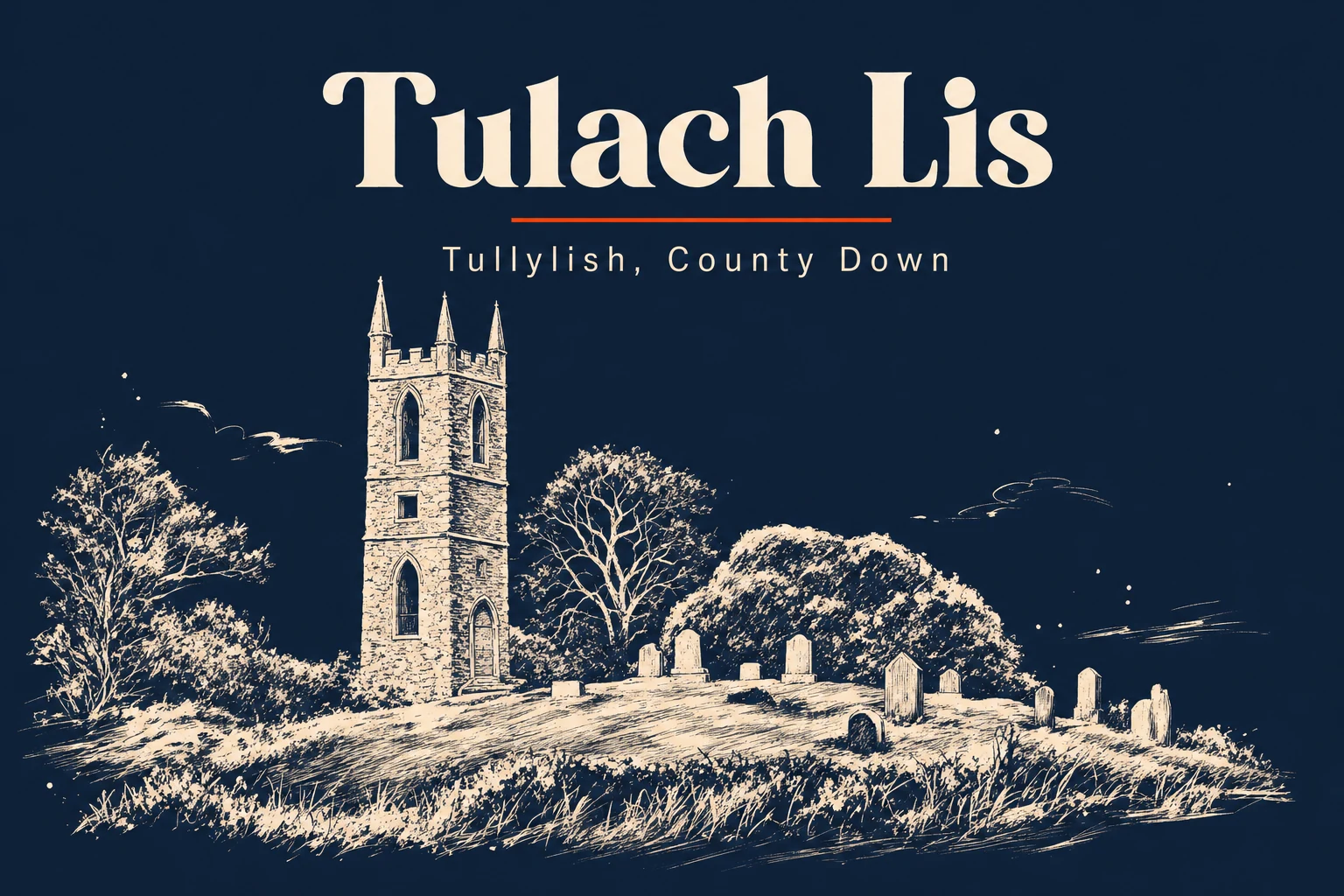
Tulach Lis

The Ireland's Ancient East
STOP 06 / 06
Tulach Lis · Co. Down

A parish village on the Upper Bann that gave its name to a whole linen district.

Tullylish is a small parish village on the Upper Bann between Gilford and Lawrencetown, the kind of place where the name on the road sign carries more weight than the houses behind it. The civil parish of Tullylish was the linen-bleaching belt of the Upper Bann in the 1700s and 1800s — bleach greens laid out along the river, beetling mills powered by side-channels off the Bann, and weavers' cottages in every townland. The mills are gone and the bleach greens are fields again; the parish name is still the one this whole stretch of country answers to.

What you find on the ground is short and quiet. A Church of Ireland parish church on the rise above the river, an old graveyard around it, a road that drops to the Bann and crosses on a narrow bridge, and a scatter of houses either side. Gilford is a couple of miles north with its standing mill shell and two pubs; Lawrencetown is a mile south where the Newry Canal towpath crosses the road. Banbridge is the market town a short drive on, with the food and the bookings and the through-traffic.

Come for half an hour. Walk up to the church, read a few stones, look down at the Bann, drive on to Gilford for the mill or to the canal towpath at Lawrencetown for an hour on foot. Tullylish is the name on the map for the place — not a destination in itself, but the parish the destination sits inside.
Population
~700 (village); the wider parish is larger
Walk score
A church, a bridge, a stretch of river — twenty minutes if you stop to read the stones
Founded
Early Christian foundation; parish church on the rise above the Bann
Coords
54.3964° N, 6.3239° W
01 / 06

At a glance.

Three things every local will eventually mention. Read these and you've already understood more than most day-trippers do.

02 / 06

Stories & lore.

The reason to come back. The things every local will eventually tell you about, usually after the second pint.

The hillock of the ringfort

Tulach Lis

The name is Irish — Tulach Lis, the small hill of the lios or ringfort. Early-medieval Ulster left ringforts in their thousands across this country; the one that named the parish stood on the rise above the Bann where the church now sits. The site of an early Christian foundation is on the same ground. The successive parish churches — medieval, post-Reformation, late-Georgian — have all kept to the hill, which is why the graveyard around the present building reads older than the walls do.

Linen before the big mills

The bleach-green country

Before Hugh Dunbar's great spinning mill went up at Gilford in 1841, the linen industry of the Upper Bann was a hand trade carried out across the surrounding parishes — flax pulled in summer, spun and woven through the winter in cottages, and finished by bleaching the cloth out on the river meadows in long strips of white. Tullylish parish was bleach-green country: small bleachworks along the Bann, beetling mills hammering the cloth flat, the weavers' webs spread on the grass for weeks at a time to whiten in the sun. The big mill at Gilford industrialised the spinning side of all that and took the work indoors. The names on the field boundaries still remember the bleach greens that were there.

Gilford, Lawrencetown and the village in between

Two neighbours, one parish

Both Gilford and Lawrencetown sit inside the civil parish of Tullylish — Gilford a planned linen-mill village laid out from 1835 around Dunbar's spinning works, Lawrencetown an older crossroads on the Bann linked into the Newry Canal trade in the eighteenth century. Tullylish village itself stayed small while its neighbours grew. The parish church is the one institution all three places have always shared, and the parish records run continuously across them. If you are tracing family in this country, the registers in Holy Trinity are where you start.

03 / 06

Things to do outside.

Wear waterproofs. Bring a sandwich. Tell someone where you're going if it's the mountain.

Tullylish church and graveyard Park near the church, walk the perimeter of the graveyard, read a few headstones. The site of the older church and the small mortuary house are inside the wall. The view down to the Bann is on the south side. Quiet at any hour; this is not a busy place.
500 m loopdistance
15–20 mintime
Down to the Bann From the village down to the bridge across the Bann and back. The river here is wider than it is at Gilford and the banks are mostly fields. No formal path on either side — keep to the road and the bridge.
1.5 km returndistance
30 mintime
Newry Canal towpath from Lawrencetown A mile south at Lawrencetown the Newry Canal towpath crosses the road, and you can walk it in either direction — north toward Scarva, south toward Poyntzpass and Newry. Flat, surfaced for cyclists, and the proper long walk of this country if you want one.
Pick your distancedistance
1 hour upwardtime
04 / 06

When to go.

There is no bad time. There are different times.

Spring
Mar–May

The graveyard looks its best with the daffodils in. The Bann is high but not flooded most years.

◉ Go
Summer
Jun–Aug

Long evenings make the church-and-river loop worth doing after work. The towpath at Lawrencetown is dry and at its easiest.

◉ Go
Autumn
Sep–Oct

Quiet country, good light on the church walls in the afternoon, leaves down by Halloween. A reliable afternoon stop on the way somewhere else.

◉ Go
Winter
Nov–Feb

The Bann floods stretches of the parish in heavy rain. The church is heated for Sunday services and not otherwise. Pass through to Banbridge for the evening.

◐ Mind yourself
05 / 06

What to skip.

Honestly? Don't bother.

If a local was sitting beside you, this is the bit where they'd lean in.

×
Expecting a village centre with pubs and a chipper

There is not one. Tullylish is a parish village in the older sense — a church, a graveyard and a scatter of houses. The pubs are in Gilford (two of them) and the proper food and beds are in Banbridge.

×
Treating Tullylish, Gilford and Lawrencetown as three separate destinations

They are one parish that the road runs through. Pick the parish church here, the mill shell at Gilford and the canal towpath at Lawrencetown and you have read the country in an afternoon.

×
Hunting for the medieval church

The present Holy Trinity is a late-Georgian successor on the same site as older parish churches. The earlier stonework is largely gone above ground. The continuity is in the graveyard, not in standing ruins.

+

Getting there.

By car

Banbridge is 10 minutes south on the B3 via Gilford. Portadown is 15 minutes west. From the M1 motorway exit at Junction 11 (Tandragee) and follow signs through Gilford — about 15 minutes.

By bus

Translink Ulsterbus Service 62 (Portadown–Banbridge via Gilford) is the nearest scheduled service; stops are in Gilford a couple of miles north. There is no village-centre bus stop in Tullylish itself worth planning around.

By train

Nearest station is Portadown (NI Railways, Belfast–Dublin Enterprise line), then bus or taxi (about 15 minutes by road).

By air

Belfast International (BFS) is 45 minutes by car. Belfast City (BHD) is 40 minutes. Dublin Airport is 1h 15m down the A1 and M1.