County Down Ireland · Co. Down · Gilford Save · Share
POSTED FROM
GILFORD
CO. DOWN · IE

Gilford
Áth Mhic Giolla

The Ireland's Ancient East
STOP 08 / 08
Áth Mhic Giolla · Co. Down

A model linen village built around one mill. The mill is gone. The village is still here.

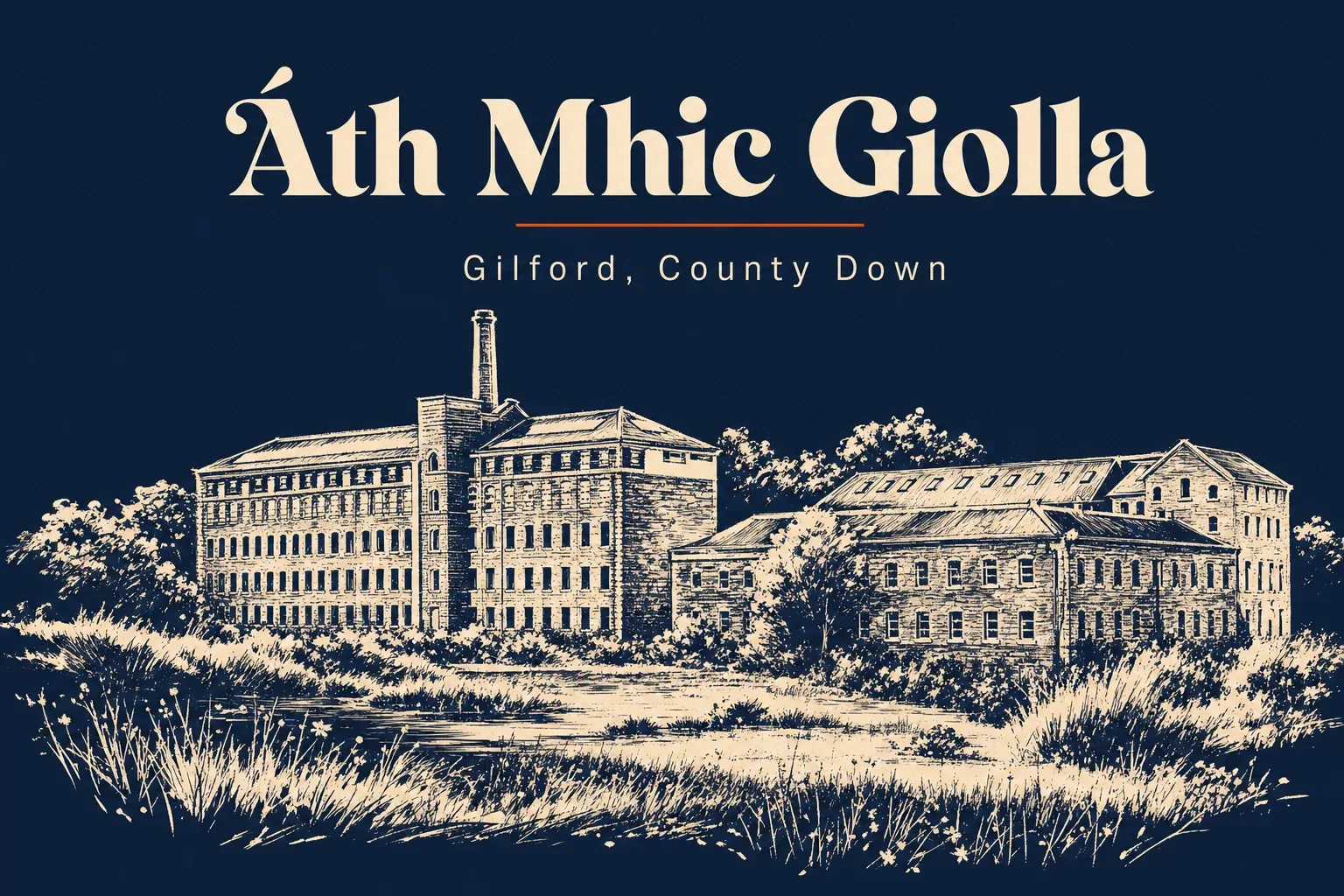
Gilford is a one-industry village that lost the industry. From 1841 to 1986 the spinning mill on the Bann was the whole point of the place — at its height the largest flax-spinning operation on the Upper Bann, employing more than 2,000 people across three shifts, and rebuilding the village around itself in terraces of mill cottages along Dunbarton Street. When the mill closed in 1986 there were 167 workers left. That number is the real history of the back half of the 20th century here.

What you see today is the bones of a model village with the engine taken out. The big rubble-blackstone mill still stands on the river, slowly being worked on for a mixed-use restoration — granted planning permission, no concrete date for opening. The workers' streets are intact. Two pubs and a couple of shops remain on Dunbarton Street. The Riverside Park walk runs along the old mill race. The Pot Belly restaurant is in a smaller converted linen mill across the Bann.

Come for an hour, not a day. Park at the bridge, walk Dunbarton Street, take the riverside path past the mill, cross over to the Pot Belly for lunch, and you have read the place. The bigger town of Banbridge is six minutes south. The proper draws — Castlewellan, the Mournes, Slieve Gullion — are further again. Gilford is a stop on the way to those, with a good story underneath it.

Population
1,957 (2021 census)
Walk score
Dunbarton Street end to end in eight minutes, all flat
Founded
Mill village laid out from 1835; spinning mill completed November 1841
Coords
54.3786° N, 6.3658° W
01 / 08

At a glance.

Three things every local will eventually mention. Read these and you've already understood more than most day-trippers do.

02 / 08

The pubs.

None of these are themed Irish pubs, because they don't need to be. A few that earn the trip:

The Gilford Inn

Locals, carvery, sport on
Village pub

At 6–10 Dunbarton Street, a few doors from the mill. Carvery, function room, sport seven days. One of the two pubs left in the village.

Laverty's

Quiet local
Roadside pub

On the Banbridge Road heading south out of the village. The other pub. Don't expect tunes — expect a pint and conversation.

03 / 08

Where to eat.

PlaceTypeLocal note
Pot Belly Restaurant Restaurant in a converted linen mill €€ On the Banbridge side of the river at 59a Banbridge Road, in a small mill building from the 1800s. Lissara duck, Glenarm salmon, Carlingford mussels — local producers, no nonsense. Booking advised at weekends. The wood-burning stove the place is named for is in the downstairs dining room.
04 / 08

Stories & lore.

The reason to come back. The things every local will eventually tell you about, usually after the second pint.

How the village got built around a flax wheel

Hugh Dunbar and the mill

Hugh Dunbar of Huntly Glen, near Banbridge, came from a Banbridge linen family. In 1834 he set his mind on a thread-spinning works on the Bann at Gilford, partnered with W. A. Stewart of Edenderry, and started trading in February 1836 out of rented premises on Mill Street. Construction of the big spinning mill began in 1837 and was completed in November 1841. Dunbar died in 1847 — within six years of his mill opening. His relatives sold their interest to John Walsh McMaster, who moved into Dunbar's recently finished Dunbarton House and named his son Hugh Dunbar McMaster. From then on the firm was Dunbar, McMaster & Co. The village around it became Dunbarton.

Houses, school, dispensary — and a mill that owned them

The model village

Dunbar McMaster & Co. didn't just build a mill — they built a self-contained industrial village around it. Over 180 terraced cottages went up in the streets we now call Dunbarton Street and the Dunbarton Bungalows. The company ran a school, a dispensary, a savings bank. By 1870 the mill employed over 2,000 hands. The pattern was repeated worldwide — when business boomed, McMaster opened a satellite mill in Greenwich, New York in 1880, also called Dunbarton Mills. The Gilford houses outlived the company by decades. Many are still occupied.

167 workers, 1986

The closure

The decline was the slow century-long decline of the Irish linen trade — undercut by cotton, by synthetics, by mills that moved closer to bigger ports. Dunbar McMaster & Co. limped on long after the heyday. The Gilford mill closed for good in 1986. At the gate that morning there were 167 workers — down from the 2,000-plus of the 1870s. The buildings stood empty for years. Fires, vandalism, scrub growth. In the 2020s a developer secured planning permission for a mixed-use restoration of the listed shell. As of this writing the work is in progress.

A Scottish-Baronial pile up the hill

Gilford Castle

Up on the rise outside the village sits Gilford Castle, a Scottish-Baronial country house designed by Glasgow architect William Spence and built in 1865 for Benjamin Dickson — a partner in Dunbar, McMaster & Co. and a man who plainly wanted to live up the hill from the mill that paid for it. The house was little used until 1914, when James Francis Wright, a Hong Kong and Manila stockbroker married to a niece of Sir Thomas Jackson of HSBC, bought it and made it home. His descendants stayed for over a century. Robert and Adrienne Moffett took over the estate in 2019 and are restoring it. Not open to the casual visitor — but if a wedding or estate tour is on, take it.

05 / 08

Things to do outside.

Wear waterproofs. Bring a sandwich. Tell someone where you're going if it's the mountain.

Gilford Riverside Park From the lower car park at Gilford Community Centre off the Stramore Road, or from Bridge Street by the bridge. Section of walkway over the remains of the old millrace. Pump track, fitness stations, a canoe trail and a viewing platform along the way. Floods in heavy rain — check before going.
845 m linear (one way)distance
20 min there-and-backtime
Mill, bridge and Dunbarton Street loop Park at the bridge. Cross to the mill, walk the riverside path along the old race, come back over the bridge, up Dunbarton Street past the workers' terraces and the Gilford Inn. The whole mill village in half an hour.
1.5 kmdistance
30 mintime
Woodlands Park & Gilford circular Combines the Riverside Park with Woodlands Park to the south. Mostly flat, mix of riverside path and quiet road. Listed on AllTrails as a Woodlands Park and Gilford Circular.
4.7 km loopdistance
1h 15mtime
06 / 08

When to go.

There is no bad time. There are different times.

Spring
Mar–May

River high but not flooded most years. The terraces look better with the trees in leaf.

◉ Go
Summer
Jun–Aug

Long evenings make the riverside walk worth doing twice. Quiet — Gilford isn't on most tourists' lists, and it shows in a good way.

◉ Go
Autumn
Sep–Oct

The Bann turns the colour of strong tea. Good light on the mill walls late afternoon.

◉ Go
Winter
Nov–Feb

The Riverside Park floods when the Bann rises — check before you go. The Pot Belly is the answer the rest of the day.

◐ Mind yourself
07 / 08

What to skip.

Honestly? Don't bother.

If a local was sitting beside you, this is the bit where they'd lean in.

×
Trying to tour the mill itself

It's a listed shell mid-restoration, not a museum. The exterior is the experience. Don't climb the fences — people have, and people have got hurt.

×
Coming hungry without a Pot Belly booking

Two pubs, one restaurant. If the Pot Belly is full at the weekend, the next decent option is in Banbridge.

×
Making Gilford a destination on its own

It's a half-hour, hour-tops stop. Pair it with Banbridge for the Cut and the F.E. McWilliam, or push on to Castlewellan for the lakes.

+

Getting there.

By car

Banbridge to Gilford is 10 minutes north on the B3. Portadown is 15 minutes west on the B10. From the M1 motorway exit at Junction 11 (Tandragee) and follow signs — 12 minutes.

By bus

Translink Ulsterbus Service 62 (Portadown–Banbridge) stops at Gilford Square. Roughly every two hours Monday to Saturday, less on Sunday. Service 50 connects Lurgan to Gilford Square as well.

By train

Nearest station is Portadown (NI Railways, Belfast–Dublin Enterprise line), then bus or taxi (15 minutes by road).

By air

Belfast International (BFS) is 45 minutes by car. Belfast City (BHD) is 40 minutes. Dublin Airport is 1h 15m.