County Down Ireland · Co. Down · Waringstown Save · Share
POSTED FROM
WARINGSTOWN
CO. DOWN · IE

Waringstown
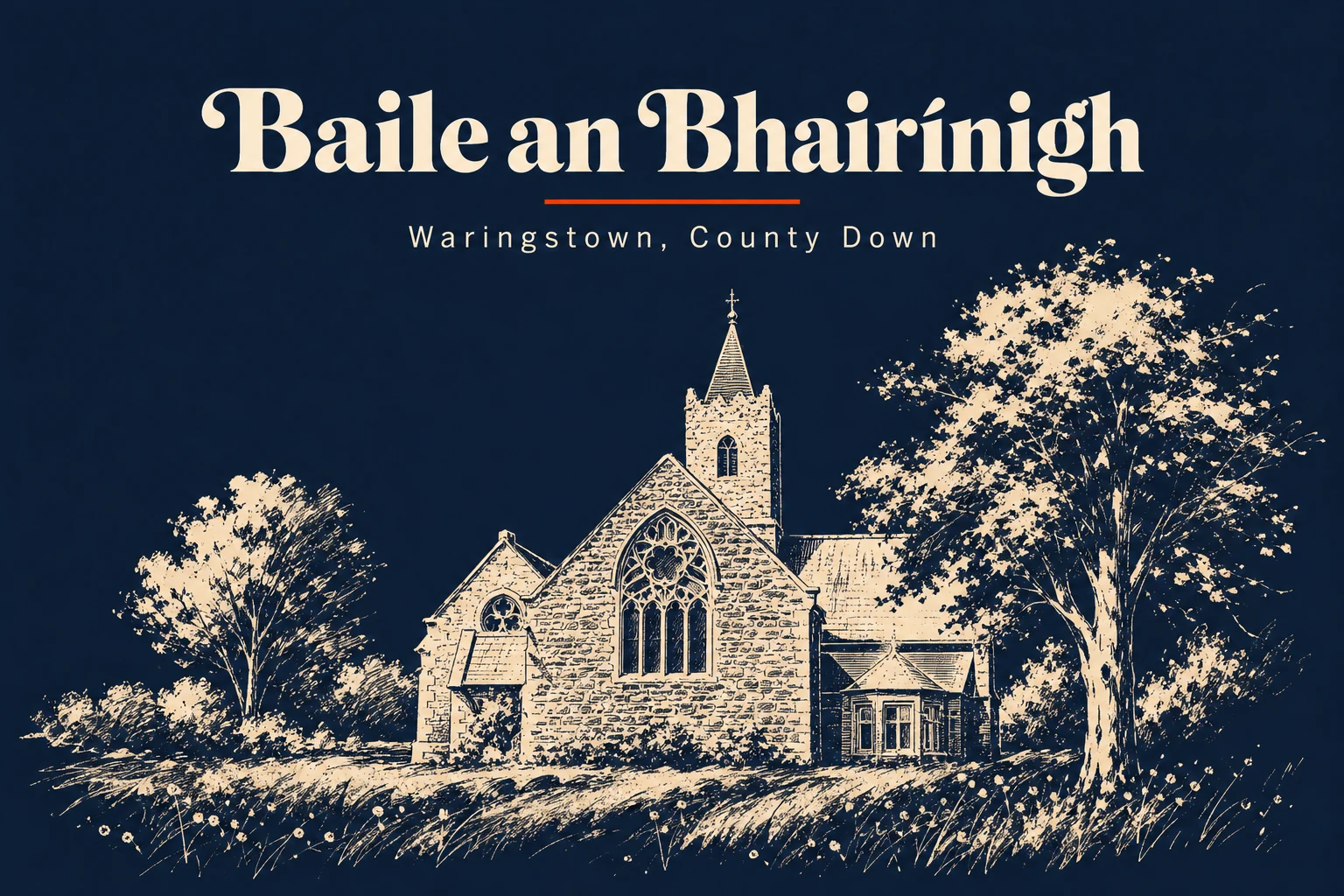
Baile an Bhairínigh

The Ireland's Ancient East
STOP 08 / 08
Baile an Bhairínigh · Co. Down

A linen weavers' village built around a 1667 mansion, a Jacobean church, and the most successful cricket club in Ulster.

Waringstown is a one-street village in north Down that owes its existence, almost entirely, to one family with one industry. William Waring bought the land in 1659, built the house in 1667, built the church in 1681, and brought his English tenants in to weave linen. His son Samuel went on a trip to Holland in 1688, came home with the technique for damask weaving, and the village had a global trade for the next two hundred years.

Walk down Main Street today and the bones are all still there. Waring House at one end, Holy Trinity at the other, a row of low Huguenot-style cottages between them that were thrown up in the 1690s for the Flemish weavers Samuel brought across. The Lawn — the cricket ground next to the church — has hosted championship sides since the 1900s. The village won Best Kept Small Town more than once for the floral displays along that same Main Street.

Be honest about what it is now, though. The looms are long gone. The new estates on the Banbridge Road are commuter housing for Lurgan and Portadown. There's one proper pub, a chipper, and a parish church that still pulls a congregation. Come for the buildings and the cricket. Don't come expecting a night out.
Population
~3,787 (2021 census)
Walk score
Main Street end-to-end in twelve minutes, all flat
Founded
Waring House built 1667; village laid out by William Waring from 1659
Coords
54.4439° N, 6.2789° W
01 / 08

At a glance.

Three things every local will eventually mention. Read these and you've already understood more than most day-trippers do.

02 / 08

The pubs.

None of these are themed Irish pubs, because they don't need to be. A few that earn the trip:

The Village Inn

Local, sport on the telly
Village pub

51 Main Street, the village's only pub. Sky Sports, rugby crowd on Thursdays, a fire and a pint. Burned out in 2018 and rebuilt — the locals call this the post-fire one.

03 / 08

Where to eat.

PlaceTypeLocal note
Country Chippy Chipper 61 Main Street, a few doors up from the Village Inn. The default Friday-evening run for half the village.
04 / 08

Stories & lore.

The reason to come back. The things every local will eventually tell you about, usually after the second pint.

The man whose name is on the door

William Waring

William Waring (1619–1703) was a Lancashire-born settler who bought up land off discharged Cromwellian soldiers and built a house and a village on it. The house went up in 1667, the church in 1681. He is buried in Holy Trinity and the family — fourteen generations on — still lives in the house.

How a trip to Holland changed a village

Samuel and the damask

Samuel Waring, William's son, went travelling in Holland and Belgium in the 1680s. He came back in 1688 with the finishing techniques for damask weaving and brought Flemish and Huguenot weavers over to teach them. The village had a reputation for the best damask and cambric in Ireland for the next two centuries. Samuel co-founded the Irish Linen Board in 1710. At one point 300 to 400 handloom weavers worked in the village.

The Boyne, 1690

Schomberg slept here

Frederick Schomberg, William of Orange's senior general, billeted his troops at Waringstown House on the march south to the Battle of the Boyne in July 1690. He was killed at the Boyne a few weeks later. The house remembers.

31 titles and a founder member

The Lawn

Waringstown Cricket Club was a founder member of the NCU Senior League in 1897 and has won it more often than anyone else — 31 outright titles plus six shared, the most recent in 2024. The pitch — known as The Lawn — sits beside Holy Trinity Church. In 1992 the club did the treble (League, Challenge Cup, Irish Cup) in a single season.

05 / 08

Things to do outside.

Wear waterproofs. Bring a sandwich. Tell someone where you're going if it's the mountain.

Main Street to Waring House and back Start at Holy Trinity, walk the length of Main Street past the Huguenot cottages and the war memorial, end at the gates of Waring House. Turn around. That is the village.
1.5 kmdistance
25 minutestime
The Lawn loop Around the cricket ground beside the church. On a match day in summer it is the only place to be. On a wet Wednesday in February it is a circle of grass behind a hedge.
1 kmdistance
15 minutestime
06 / 08

When to go.

There is no bad time. There are different times.

Spring
Mar–May

Cricket pre-season starts to build. The floral displays the village wins prizes for go in around May. Quiet, mild.

◉ Go
Summer
Jun–Aug

NCU Senior League cricket every weekend at The Lawn. The Vintage Cavalcade weekend brings a crowd. Best time to be here.

◉ Go
Autumn
Sep–Oct

Cricket season winds up. Light goes early. Nothing much else happening.

◐ Mind yourself
Winter
Nov–Feb

A commuter village in the dark. The pub is open. The church is heated. Otherwise pass through.

◐ Mind yourself
07 / 08

What to skip.

Honestly? Don't bother.

If a local was sitting beside you, this is the bit where they'd lean in.

×
Waringstown House tours

It's a private family home. Lived in. You can admire it from the road and the church gate. That's the deal.

×
Expecting a night out

One pub. No restaurants beyond the chipper. If you want dinner and music, Lurgan is ten minutes north and Banbridge is fifteen minutes south.

×
Looking for the linen industry

The looms went silent decades ago. The Huguenot cottages are still there, but they are houses, not a museum. The story is in the buildings; do not expect a visitor centre.

+

Getting there.

By car

Just off the A26 Lurgan–Banbridge road. Belfast is 35km (40 minutes via the M1). Lurgan is 6km north, Banbridge 12km south.

By bus

Translink/Ulsterbus route 56 runs Lurgan to Banbridge via Waringstown. Stop is on Main Street. Roughly hourly Monday–Saturday, less on Sundays.

By train

Nearest stations are Lurgan and Portadown on the Belfast–Dublin Enterprise line. Both 10–15 minutes by car.

By air

Belfast International (BFS) is 35km. Belfast City (BHD) is 40km. Dublin is 130km.