Magill's Farm, 1938–1948
The Kinder farm
In May 1938, Barney Hurwitz of the Belfast Hebrew Congregation and a Millisle businessman named Lawrence Gorman leased a derelict farm on the Woburn Road from its owner. They called it the Millisle Refugee Settlement Farm. Over the next decade more than 300 Jewish refugees lived there — most of them children sent out of Germany, Austria and Czechoslovakia on the Kindertransports. They ran it as a co-operative, kibbutz-style: everyone worked, everyone got a shilling a week pocket money, later a half-crown. They learnt dairy farming to prepare for a life in Palestine. After 1945, most of them learnt that their parents and siblings had been murdered in Dachau, Auschwitz, Treblinka. The farm closed in 1948. The plaque in Belfast Synagogue is the thanks they sent back.
The last one standing
Ballycopeland Windmill
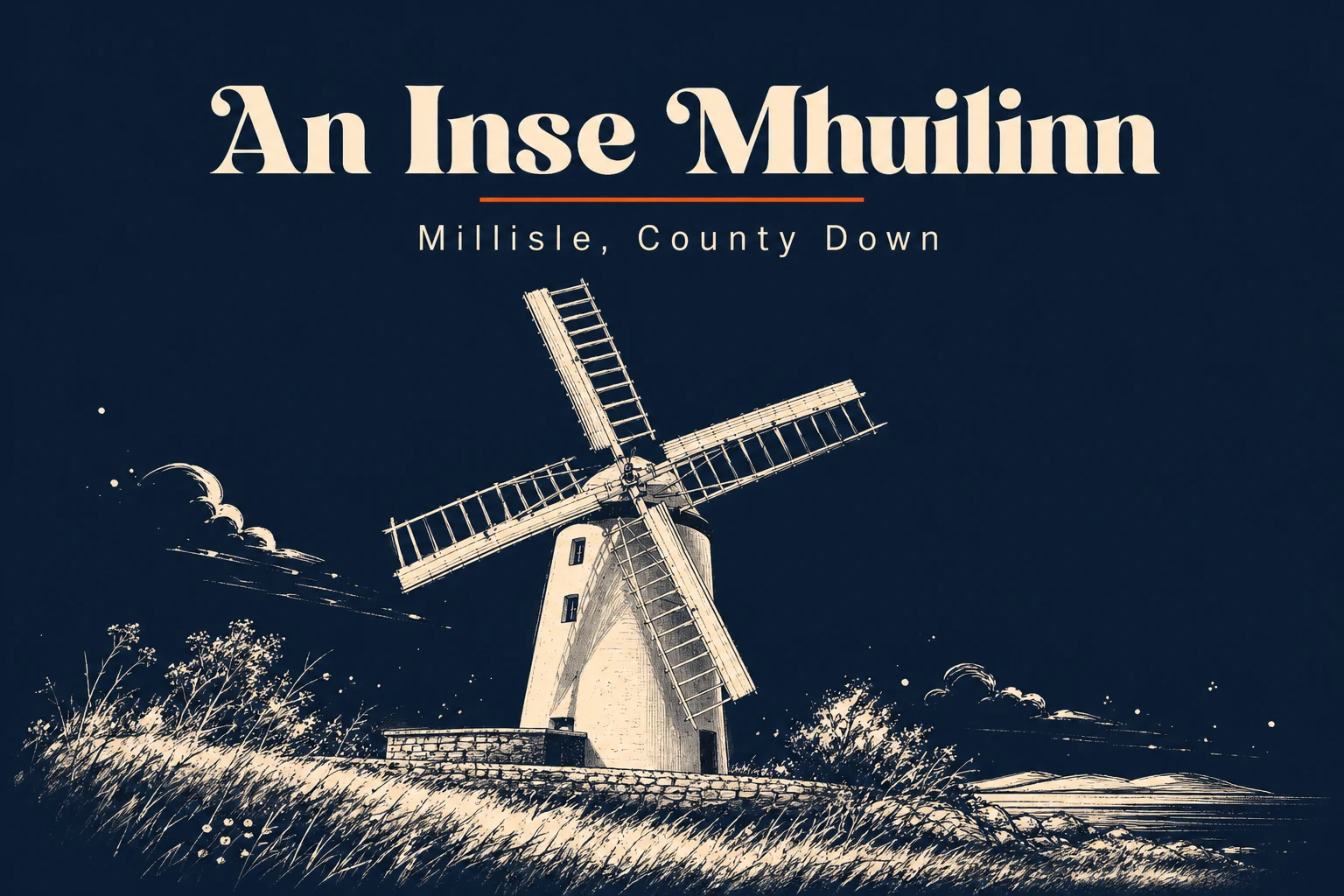
Built in the 1780s by a local millwright named George Bennett for the McGilton family, the white tower mill on the hill behind Millisle ground oats and barley until 1915. County Down once had more than a hundred working windmills. This is the only one left. It was taken into state care in 1937 and gradually restored to working order between 1950 and 1978. The cap rotates, the fantail turns the sails into the wind without anyone touching it, and on a windy day with the brake off you can hear the whole thing creak. A new visitor centre opened in 2023.
Mill island, or Scots import?
The name
Two stories. The Irish one is Baile an Mhuilinn — "townland of the mill" — referenced here in the seventeenth century, long before Ballycopeland's tower went up. The Scots one is that Plantation-era settlers brought the name with them from a hamlet called Millisle in Wigtownshire across the water. Both could be true. The village has always sat between two worlds — Irish coast, Scottish blood, English language, on a peninsula that points at Galloway and gets there in three hours by boat.