County Down Ireland · Co. Down · Carrowdore Save · Share
POSTED FROM
CARROWDORE
CO. DOWN · IE

Carrowdore
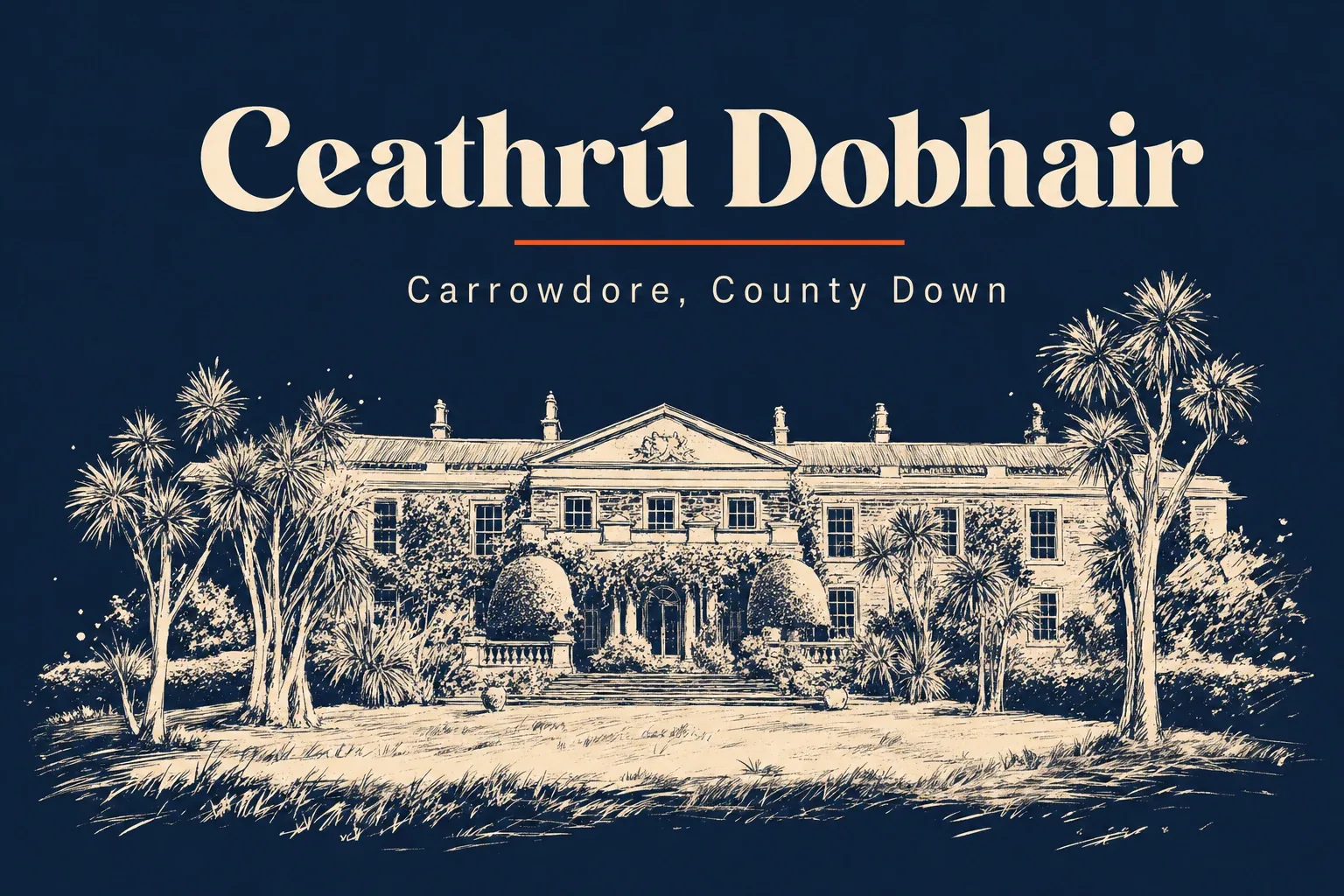
Ceathrú Dobhair

The Ireland's Ancient East
STOP 03 / 06
Ceathrú Dobhair · Co. Down

An inland Ards village with a poet in the churchyard and a road race in the road.

Carrowdore is the inland village on the Ards Peninsula — the one between Greyabbey, Donaghadee and Millisle that the tourist coaches drive past on the way to somewhere with a view. It has about a thousand people, a primary school, a secondary school, a chippy, a Spar, and a churchyard with a poet in it. That last bit is most of the reason anyone outside the peninsula has heard of the place.

The poet is Louis MacNeice, who died in London in 1963 and was brought back here for burial because his mother's people, the Cleshams, were buried in Christ Church. Two years later Derek Mahon, Seamus Heaney and Michael Longley drove out to stand at the grave, and Mahon walked away with 'In Carrowdore Churchyard' in his head — one of the great elegies in Irish English. If you only do one thing here, that's the thing. The headstone is plain. The hill above it is quiet. It earns the visit.

The other story is loud, and stopped suddenly. From 1927 to 2000 the Carrowdore 100 ran a 5.5-mile motorbike circuit on the road out toward Greyabbey. Joey Dunlop won it eight times. The final race in 2000 killed a young rider called Eddie Sinton and the meeting was never held again. Stand on the Ballyboley corner on a quiet afternoon and try to imagine the noise. Then drive on to Greyabbey and let it stay quiet.

There isn't a pub anymore — the Tavern on Main Street was knocked in 2021 and a village that used to have one now has none. Carrowdore is a place to look at and drive through, not a place to stop the night in. But look at it properly. There's more here than the road suggests.

Population
1,052 (2021)
Walk score
Main Street top to bottom in eight minutes
Founded
Carrowdore Castle, 1818-20
Coords
54.5667° N, 5.5500° W
01 / 07

At a glance.

Three things every local will eventually mention. Read these and you've already understood more than most day-trippers do.

02 / 07

Where to eat.

PlaceTypeLocal note
Halls Chip N Grill Chip shop The village chippy. Fish, chips, the usual grill items, takeaway. The kind of place that holds a village together when the pub is gone.
EuroSpar Carrowdore Shop with hot food counter The village shop. Bread, milk, sandwiches, deli, a coffee in a cup. Not glamorous, just useful — and the nearest you will get to a sit-down meal in the village itself.
03 / 07

Stories & lore.

The reason to come back. The things every local will eventually tell you about, usually after the second pint.

Why a Belfast-born poet is buried here

MacNeice in the churchyard

Louis MacNeice was born in Belfast in 1907, raised in the rectory at Carrickfergus where his father was Church of Ireland rector, educated at Marlborough and Oxford, and lived most of his adult life in London. He died there on 3 September 1963 of pneumonia caught recording radio sound effects in a cave in Yorkshire. The reason he is buried in Carrowdore, of all places, is his mother. Elizabeth 'Lily' Clesham was from Ballymaconry in Connemara, and the Clesham family plot was here at Christ Church. She was admitted to a Dublin nursing home in 1913 when Louis was five and died of tuberculosis in December 1914; he never saw her again. His ashes were laid in her grave, beside his maternal grandfather Martin Clesham. His sister Elizabeth and his second wife Hedli were later buried with them. It is a small plot for a large body of work.

The pilgrimage that made a poem

Mahon's elegy

In 1965 the young Derek Mahon, then twenty-three, drove out from Belfast to Carrowdore with Seamus Heaney and Michael Longley to visit MacNeice's grave. They were the next generation of Northern Irish poets and MacNeice was their inheritance. Mahon went home and wrote 'In Carrowdore Churchyard', which opens 'Your ashes will not stir, even on this high ground, / However the wind tugs, the headstones shake' and closes with the famous Euripidean image of a blackbird and a phrase. It is a working ars poetica disguised as a graveside lyric. If you stand at the stone with the poem on your phone, do not be surprised if the wind picks up.

A motorbike race in the road outside the village

The Carrowdore 100

From 1927 the Carrowdore 100 ran a 5.5-mile road circuit on the Greyabbey-to-Millisle Road just outside the village — closed-road racing on the actual peninsula tarmac, the way they still do it at Cookstown and Tandragee and the North West. Joey Dunlop won the meeting eight times in the 1980s and 1990s, more than anyone else. The race kept going through every change in motorcycle racing safety culture until the death of rider Eddie Sinton in 2000 brought it to an end. There is a c.1960 short documentary, 'The Carrowdore 100', on the BFI player if you want to see the village as it was when the engines were running through it.

A Huguenot family in a Norman peninsula

The Crommelins

Carrowdore Castle, behind its trees a quarter-mile west of the village, was built in 1818-20 by Nicholas de La Cherois-Crommelin. The Crommelins were French Huguenots who fled persecution to Holland in the 17th century. Louis Crommelin was personally invited by William III in 1698 to lead a colony of seventy linen-weaving families to Lisburn — the start of the Ulster linen industry. The de la Cherois brothers fought for William at the Boyne. Two refugee families, one castle, two centuries of peninsula gentry. May Crommelin, a successful Victorian novelist and travel writer, was born in the castle in 1849. Christ Church itself was built on land given by Nicholas Crommelin and paid for by Lord John George Beresford; the nave opened in 1843, the spire was added in 1859.

A school that grew out of a 1996 public meeting

Strangford Integrated College

Strangford Integrated College on the Abbey Road opened on 1 September 1997 with sixty-four pupils, six full-time staff and a school secretary. It came out of a 1996 public meeting called by All Children Together — the parents' movement that built Northern Ireland's integrated schools sector from the ground up, deliberately mixing Catholic and Protestant children in the same classrooms in a place where that was still political. Grant-maintained status came through in 1999. The college is now the largest single employer in the village and a reason a lot of young families end up here.

04 / 07

Things to do outside.

Wear waterproofs. Bring a sandwich. Tell someone where you're going if it's the mountain.

MacNeice's grave at Christ Church Park at the church gate on the Ballyfrenis Road. The Clesham/MacNeice family plot is towards the back of the churchyard. The headstone is plain. Bring a copy of Mahon's poem or one of MacNeice's own — 'Snow', 'The Sunlight on the Garden', anything from 'Autumn Journal'. Read it where it was meant to be read.
500 mdistance
20 minutes including a look aroundtime
Around the old race circuit Out the Greyabbey-Millisle Road, around the loop that the Carrowdore 100 ran from 1927 to 2000. The corners still have their racing names if you know where to ask. The road is open traffic now; treat it like an ordinary country road, not a track.
5.5 mile drive or cycledistance
30 minutes by car / 1 hour on a biketime
Carrowdore to Mount Stewart shore Drive west out of the village toward Mount Stewart on Strangford Lough — twelve minutes. The National Trust gardens, the lake walk, and the house itself eat the rest of the morning. The microclimate that grew Edith Londonderry's tender planting starts about here on the lough shore.
8 km drive then walkdistance
Half-daytime
05 / 07

When to go.

There is no bad time. There are different times.

Spring
Mar-May

Quiet. The churchyard is at its best in late April when the daffodils come up around the older stones. Mount Stewart down the road opens its gardens fully. The roads west toward the lough are bare-hedged and clear.

◉ Go
Summer
Jun-Aug

Long evenings on the peninsula. Use Carrowdore as a base for Greyabbey, Donaghadee and Mount Stewart and you get cheaper rooms than the coast and ten minutes of driving to anywhere worth being.

◉ Go
Autumn
Sep-Oct

MacNeice died on 3 September 1963 and was buried here a week later. Early September in the churchyard, with the leaves starting to turn, is the closest you will get to the day Mahon, Heaney and Longley first stood at the stone.

◉ Go
Winter
Nov-Feb

Short days, wind off the lough, not much open. The chippy and the Spar keep going. The peninsula villages around you mostly shut down. A quick visit on a bright winter afternoon works; an overnight does not.

◐ Mind yourself
06 / 07

What to skip.

Honestly? Don't bother.

If a local was sitting beside you, this is the bit where they'd lean in.

×
Looking for the Tavern on Main Street

The pub was demolished in 2021. Carrowdore is currently a no-pub village. For a pint you want the Wildfowler in Greyabbey, ten minutes south, or the seafront pubs in Donaghadee, ten minutes north.

×
Treating Carrowdore Castle as a visitor attraction

The castle is a private residence behind its own walls. You can see the chimneys from the road if you know where to look. That is the full visit. Do not drive in.

×
Booking a night here

There is no hotel and very little B&B inventory in the village itself. Stay in Donaghadee, Greyabbey or Bangor and drive in for the churchyard and the chippy. The peninsula is small; a base on the coast costs no time at all.

×
Standing in the road to feel the Carrowdore 100

The race is gone, the road is live, and the corners that killed riders are still the corners they were. Drive the loop slowly once. Do not stand in it.

+

Getting there.

By car

Belfast to Carrowdore is 35-40 minutes via the A20 to Newtownards and then the B172 east. Newtownards is 8 minutes west; Donaghadee 10 minutes north; Greyabbey 8 minutes south.

By bus

Translink route 7 (Newtownards-Donaghadee via Carrowdore) and route 9 variants serve the village from Newtownards. Roughly hourly on weekdays, less on Sundays. Newtownards is the interchange for onward Belfast services.

By train

No train. Nearest station is Bangor (20 minutes by road) or Belfast for longer connections.

By air

Belfast City (BHD) is 30 minutes by car. Belfast International (BFS) is an hour.