County Down Ireland · Co. Down · Greyabbey Save · Share
POSTED FROM
GREYABBEY
CO. DOWN · IE

Greyabbey
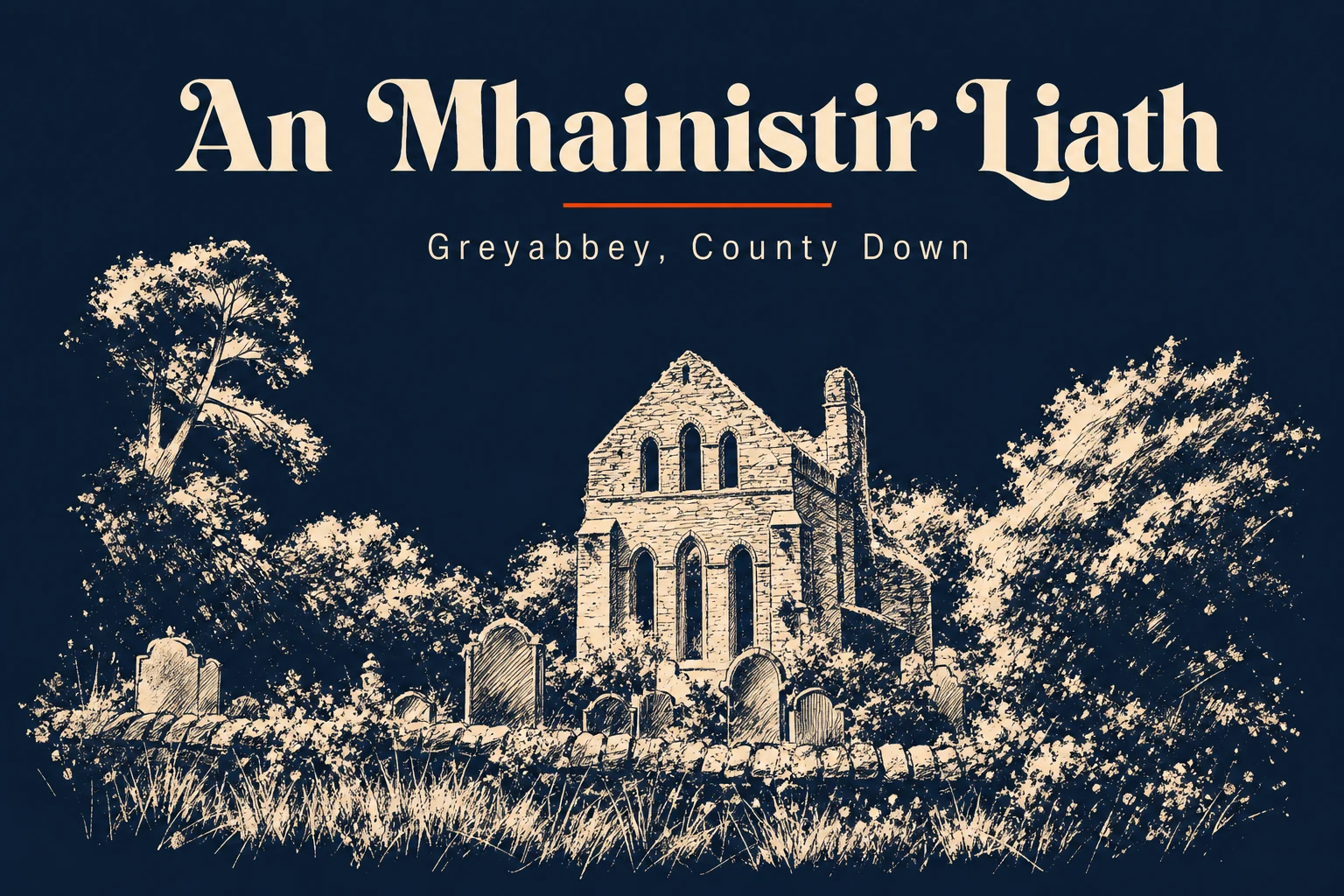
An Mhainistir Liath

The Ireland's Ancient East
STOP 04 / 06
An Mhainistir Liath · Co. Down

An abbey, an antique trade, and a great house next door — all in a village of under a thousand.

Greyabbey is one of those Ards Peninsula villages where the name is the headline. The Cistercians built here in 1193, the foundress was a Manx-Norse princess called Affreca, and the abbey she left behind is still standing roofless behind a gate at the end of the village. You can walk in. There is no ticket booth. That alone tells you what kind of place this is.

The second thing to know is the antique shops. They cluster along Main Street and through an arched gateway into Hoops Courtyard, and depending on how generous you are with the definition there are anywhere from a dozen to seventeen of them. Most open Wednesday to Saturday. Half of them close at lunchtime. Plan accordingly or be one of those tourists peering through windows on a Monday wondering where everyone is.

The third thing is Mount Stewart, the great Londonderry house, a mile up the road on the lough shore. It is the reason a lot of people come to the village at all, and then find the village. The gardens are the headline — Edith Londonderry's 1920s confection of Italian, Spanish and Irish themes, all kept alive by the warm air coming off Strangford Lough. Give it a half-day. Eat in the village afterwards.

Greyabbey is a postcard-pretty place, and that is both the appeal and the limit of it. You will see it in an afternoon. You will not need a second day. But you will probably leave wishing you had timed things slightly better — the shop you wanted shut, the abbey grass wet, the tide out at Strangford when you wanted it in. Come on a Saturday in May. Bring boots.
Population
879 (2021)
Walk score
Top of Main Street to abbey gate in ten minutes
Founded
Cistercian abbey, 1193
Coords
54.5353° N, 5.5600° W
01 / 09

At a glance.

Three things every local will eventually mention. Read these and you've already understood more than most day-trippers do.

02 / 09

The pubs.

None of these are themed Irish pubs, because they don't need to be. A few that earn the trip:

The Wildfowler Inn

Locals, food-led
Country pub & restaurant

1 Main Street, refurbished in 2009 and the village's main eating-and-drinking room since. Stone floors, beams, fish from Portavogie when it's running. Taste of Ulster approved. The pub end is genuine; the restaurant end is the reason most people are here.

03 / 09

Where to eat.

PlaceTypeLocal note
The Wildfowler Inn Pub kitchen €€ See pubs. The kitchen does seafood from the Portavogie boats and a Sunday lunch the village turns up for. Book on weekends.
Harrisons of Greyabbey Farm shop, cafe & garden centre €€ On the edge of the village. Cafe inside a working garden centre and farm shop. Lunch, scones, cake of the day. The kind of place mothers-in-law are very happy with and that turns out to be much better than it sounds.
Alchemy Cafe & weekend bistro €€ Cafe by day, bistro Friday and Saturday nights. Breakfast and lunch with the local-produce religion, homemade cake all day. The village coffee stop.
04 / 09

Where to sleep.

PlaceTypeLocal note
Shoreline at Mount Stewart B&B On the lough shore between the village and the Mount Stewart gate — a 25-minute walk to the house museum. Three rooms, water views, breakfast you'd come back for.
05 / 09

Stories & lore.

The reason to come back. The things every local will eventually tell you about, usually after the second pint.

How the abbey got here

Affreca's vow

Affreca of the Isles — daughter of Godred, King of Man, and wife of the Anglo-Norman warlord John de Courcy — founded Grey Abbey in 1193 in thanks for a safe sea crossing. She brought monks from Holm Cultram in Cumbria. The lancet arches she paid for are among the earliest Gothic in Ireland and the earliest surviving in what is now Northern Ireland. The abbey was dissolved in 1541 and burnt out by Brian O'Neill's men in 1572, and the walls have been roofless ever since.

The minister they hanged

James Porter

James Porter was the Presbyterian minister of Greyabbey from 1787 and one of the sharpest pens behind the United Irishmen's newspaper, the Northern Star — his satire 'Billy Bluff and Squire Firebrand' did real damage to the local gentry. He was arrested in June 1798 on the thin charge of having been present when rebels read an intercepted military despatch. The court-martial at Newtownards convicted him anyway. They hanged him on 2 July 1798 on a green knoll within sight of both his meeting-house and his own front door. His wife was with him at the gallows. He is buried in the abbey churchyard in the village.

How the gardens at Mount Stewart got their faces

Edith and the Dodo Terrace

Edith Chaplin, 7th Marchioness of Londonderry, came to Mount Stewart in the 1910s and spent the next forty years turning the grounds into one of the great gardens of the British Isles — Italian, Spanish, sunken and shamrock parterres, all built around the unlikely warm microclimate of Strangford Lough. The Dodo Terrace, with its stone menagerie of frogs, monkeys and dodos, is a private joke about her wartime political dining club, the Ark, where every member had an animal nickname. Winston Churchill was a Warlock. Edith herself was Circe.

A village that runs on other people’s attics

The seventeen shops

Sometime in the 1980s a few dealers set up in old cottages along Main Street, and other dealers followed because dealers always do, and Greyabbey acquired the only honest claim of its kind in Ireland: the densest cluster of antique shops in any village in the country. Hoops Courtyard, reached through an arched gateway off the main street, is the heart of it. The shops open and close on their own logic. The collective hours are Wednesday to Saturday. Sundays and Mondays the village goes quiet again.

06 / 09

Things to do outside.

Wear waterproofs. Bring a sandwich. Tell someone where you're going if it's the mountain.

Grey Abbey ruin walk In the gate beside the parish church, around the cloister, into the nave. The herb garden behind the east end is a quiet replant of what the monks would have grown. Free. Open in daylight hours.
1 km loopdistance
30 minutestime
Mount Stewart gardens One mile north of the village. The formal gardens — Italian, Spanish, Mairi, Shamrock — are the headline. The lake walk is longer and quieter. The Temple of the Winds is shut at time of writing after storm damage; check before you go.
3-5 km depending on routedistance
Half daytime
Strangford Lough shore from the village Out the back of the village to the lough shore and along toward Mount Stewart. Wading birds in winter, mud at low tide, big skies year-round. Boots, not trainers.
4 km returndistance
1 hourtime
07 / 09

When to go.

There is no bad time. There are different times.

Spring
Mar-May

Mount Stewart gardens open up, the daffodils on the abbey lawn are a thing, the antique shops are awake again after winter. May is the sweet spot.

◉ Go
Summer
Jun-Aug

Long evenings, busy Mount Stewart, the Wildfowler doing a brisk trade. The Classic Bike and Car Show takes over the village hall on its August weekend. Book a Mount Stewart slot ahead.

◉ Go
Autumn
Sep-Oct

Quieter. The gardens turn. Strangford Lough fills with overwintering geese arriving from Iceland. Sessions of antique-hunting feel less like a scrum.

◉ Go
Winter
Nov-Feb

Half the shops close, Mount Stewart goes to weekends-only for the house, and the village can feel deserted. The abbey ruin in low winter sun is the best version of itself, mind.

◐ Mind yourself
08 / 09

What to skip.

Honestly? Don't bother.

If a local was sitting beside you, this is the bit where they'd lean in.

×
Driving up on a Sunday or Monday for the antique shops

Most of them are shut. Wednesday to Saturday is the working week here. The Old Courthouse, The Eclectic House, Greba Jewellers — all closed start of the week.

×
Trying to do Greyabbey and Mount Stewart in an hour each

Mount Stewart eats a half-day if you do the gardens properly. The village wants an hour for the abbey, an hour for the shops, an hour for lunch. Combining them in a morning means you do neither well.

×
Walking to Castle Espie from here

It looks close on the map. It's on the wrong side of Strangford Lough. The drive is forty minutes around the top via Comber. Worth doing — just not as a side-trip from Greyabbey.

×
Looking for the Temple of the Winds right now

Closed for storm-damage repairs after Storm Eowyn took chunks out of it. Mount Stewart will tell you when it reopens; check the National Trust site before you make a special trip.

+

Getting there.

By car

Belfast to Greyabbey is 45 minutes on the A20 via Newtownards. From Bangor, half an hour. Mount Stewart is signposted one mile before you reach the village if you are coming from the north.

By bus

Translink route 9 / 9A (Belfast - Newtownards - Portaferry) stops in the village. Roughly hourly Mon-Sat, less on Sundays. Newtownards to Greyabbey is about 15 minutes; Belfast about an hour.

By train

No train. Nearest station is Bangor (35 minutes by road) or Belfast for longer connections.

By air

Belfast City (BHD) is 30 minutes by car. Belfast International (BFS) is an hour.