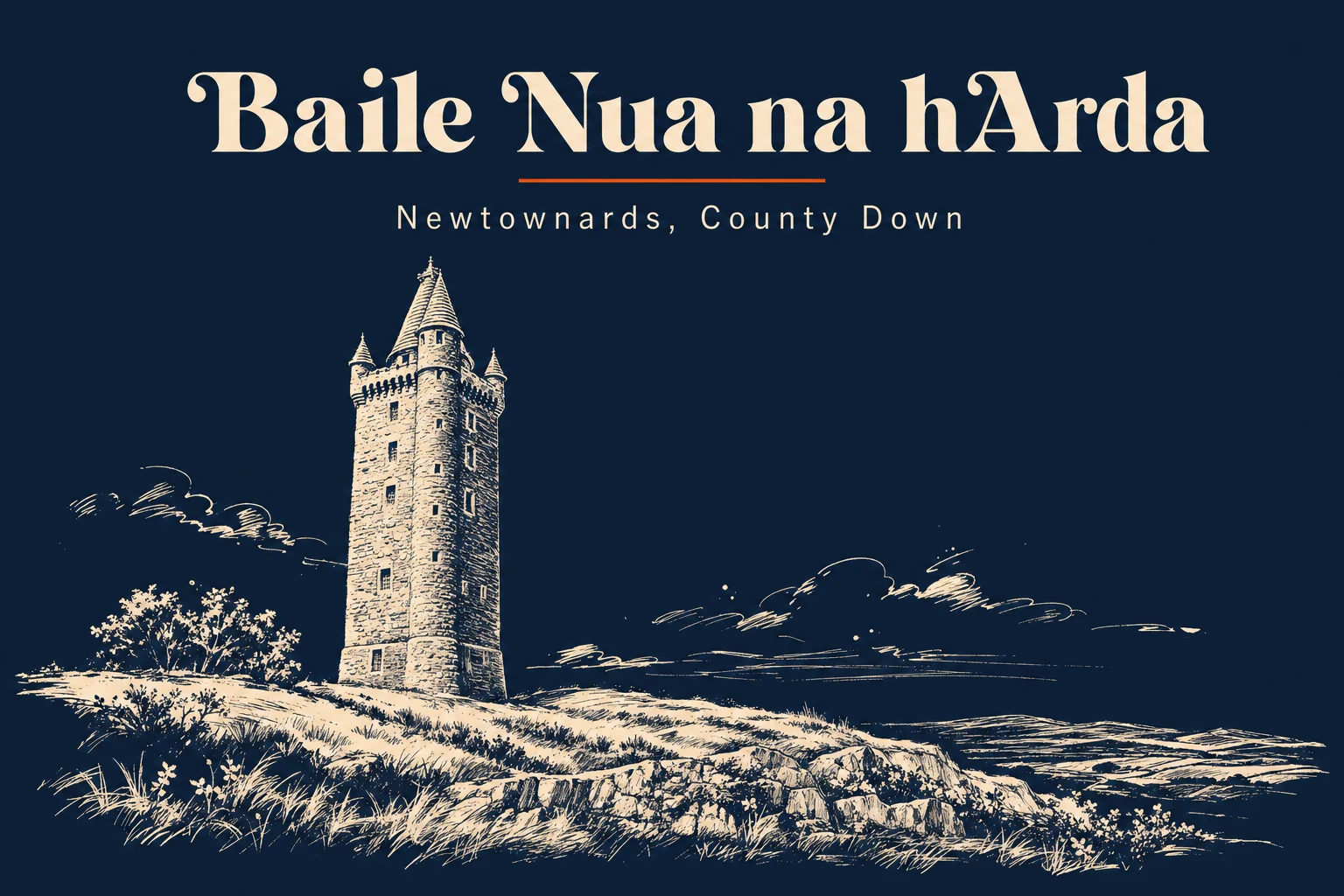
Baile Nua na hArda · Co. Down
Working market town at the head of Strangford Lough, with a folly on the hill that runs the skyline.
Newtownards is a working town, not a postcard. Twenty-nine thousand people, a ring road of retail parks, the Ards Shopping Centre at one end and a Wetherspoons in a converted Victorian house on the main street. Belfast commutes in and out by the 5 bus. If you came looking for thatched cottages on the Ards Peninsula, you went past the turn.
But the skyline is the giveaway. Scrabo Tower sits a hundred and thirty-five feet up on a basalt-capped hill above the town, and from anywhere west of the Comber road it tells you exactly where you are. The tower is a folly - built by public subscription in 1857 to commemorate the 3rd Marquess of Londonderry, designed by Charles Lanyon and his partner W. H. Lynn, ruined the contractor halfway through and got finished anyway. The walk up is the thing. So is the view down.
The deep history is older than the town. Saint Finnian founded Movilla Abbey on a hill overlooking Strangford Lough in 540 AD - a peer of Comgall at Bangor, a teacher of Columba, the man whose surreptitious psalter copy started the row that ended in Iona. The Vikings sacked Movilla in the ninth century. The Normans rebuilt it as Augustinian. Henry VIII shut it in the 1540s. The cemetery is still there, off the Movilla Road, with a few standing walls and a lot of old stones. It's not signposted the way the tower is. That's part of the appeal.
Stay a night if you're working the Ards Peninsula. Newtownards is the gateway town - every road south to Greyabbey, Kircubbin, Portaferry runs through here, and the bus to Donaghadee leaves from the same station as the one to Belfast. Eat in Conway Square on a Saturday morning, climb Scrabo before lunch, then drive south down the lough. That's the day.