County Down Ireland · Co. Down · Comber Save · Share
POSTED FROM
COMBER
CO. DOWN · IE

Comber
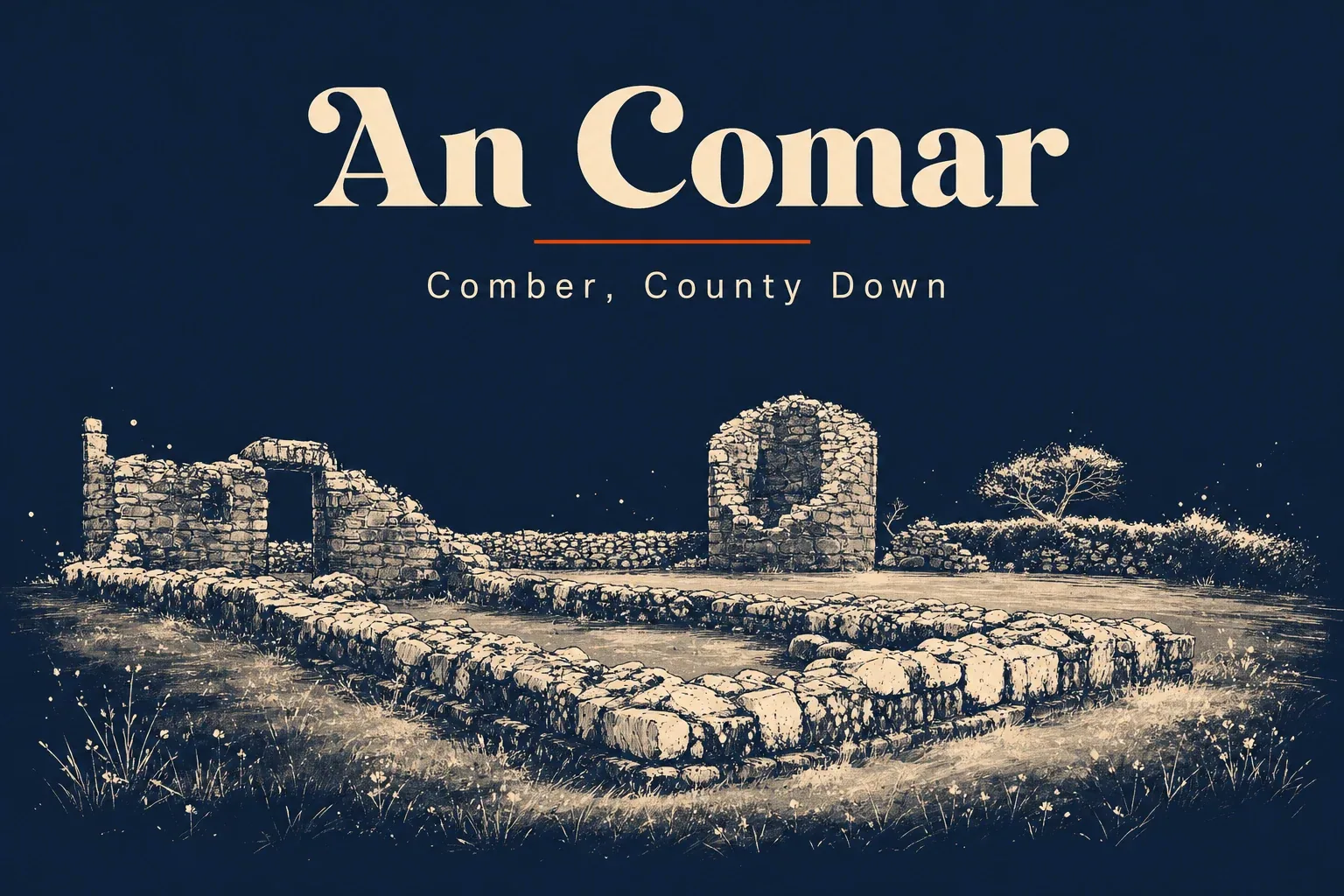
An Comar

The Ireland's Ancient East
STOP 08 / 08
An Comar · Co. Down

A market town at the top of Strangford Lough — potatoes, Titanic, a soldier on a plinth.

Comber sits at the head of Strangford Lough where the A22 from Belfast meets the road south to Downpatrick. It is a working market town of nine and a half thousand people, with a square, a column, a Presbyterian church, a Cistercian abbey buried under the modern street pattern, and a set of mudflats that the brent geese arrive on every autumn from the Arctic. None of that is incidental. The town reads as the gateway to the Ards Peninsula because that is exactly what it has always been.

Two things put Comber on a wider map. The first is a potato. Comber Earlies — the new-season spuds dug from the parish between May and July — got Protected Geographical Indication status in 2012, which is the EU's way of saying the place and the thing are the same thing. The second is a man. Thomas Andrews, the naval architect who designed RMS Titanic and went down with her, was born at Ardara House on the edge of town in 1873. The Andrews Memorial Hall on Castle Street is the family's gift back. The town treats both quietly — there's a plaque, there's a festival, there's no theme park.

Old Comber Whiskey was made here from 1825 until the distilleries closed in 1953. Echlinville, ten miles east on the Ards, revived the brand from 2021 and is producing single pot still under the Comber name again. The town itself doesn't pretend to be a distillery town any more, but the name has come back into the world. Combine that with the Greenway, the wetlands at Castle Espie, and a square arranged around a soldier on a column, and Comber is a fuller day than the bypass suggests.
Population
~9,600
Walk score
Square to Greenway trailhead in ten minutes
Founded
Cistercian abbey c. 1199; market town from the Plantation
Coords
54.5450° N, 5.7497° W
01 / 08

At a glance.

Three things every local will eventually mention. Read these and you've already understood more than most day-trippers do.

02 / 08

The pubs.

None of these are themed Irish pubs, because they don't need to be. A few that earn the trip:

McBrides on the Square

Community local
Pub & restaurant

On the Square. Off-licence to one side, upstairs restaurant, downstairs bar. The flagship community pub for the town and gets used like one.

First & Last

Local, end-of-town
Traditional bar

Out on the Killinchy end of town. Listed on the CAMRA pub database. The name does what it says — first one in if you're coming from the lough, last one out if you're heading there.

03 / 08

Where to eat.

PlaceTypeLocal note
No.14 at The Georgian House Restaurant €€ On the Square in a Georgian townhouse. Breakfast, lunch and dinner Tuesday to Saturday. The room is the room — high ceilings, sash windows, the town walking past outside.
McBrides on the Square Pub dining €€ The upstairs restaurant at the pub does the proper sit-down version of pub food. Local producers do most of the talking.
04 / 08

Stories & lore.

The reason to come back. The things every local will eventually tell you about, usually after the second pint.

Ardara House, 1873

Thomas Andrews

Thomas Andrews Jr was born at Ardara House in Comber on 7 February 1873, the son of a linen merchant and a Pirrie — his uncle William ran Harland and Wolff. He went into the yard at sixteen, designed Olympic and Titanic, and went down with the second one on 15 April 1912. His body was never identified. The town built the Andrews Memorial Hall on Castle Street in his memory; his daughter Elizabeth broke ground in October 1913 and his widow opened it in January 1915. The plaque inside was carved by Rosamond Praeger.

'One shot more for the honour of Down'

Rollo Gillespie

Robert Rollo Gillespie was born in Comber in 1766, fought the French in the West Indies, put down the Vellore Mutiny in 1806, took on the Sultan in Sumatra, and was killed leading the charge at the Gurkha fort of Kalunga, Dehradun, on 31 October 1814. His last words are on the column in the Square. The military historian Sir John Fortescue called him 'the bravest man ever to wear a red coat'. Whether that is true or not, the 55-foot Grecian column in the middle of his home town went up in 1845 and thirty thousand people came to see it unveiled. The town is built around him still.

A potato with PGI status

Comber Earlies

The light, sandy soils on the lough side of the town produce a new-season potato that the EU recognised in 2012 as a Protected Geographical Indication. Only spuds grown around Comber and harvested between early May and late July can carry the name. The Comber Earlies Food Festival runs on the last Saturday in June, in the Leisure Centre car park — Anna Haugh and Rachel Allen have headlined recent years. The Growers' Co-op and the Regeneration Partnership run it with the council. It is genuinely about the spud.

Lost 1953, revived 2021

Old Comber Whiskey

Comber Distilleries — established 1825 — were one of the dozens of Irish pot still operations that vanished in the lean middle decades of the 20th century. They stopped in 1953 and the brand went onto the long list of ghosts. Echlinville Distillery on the Ards Peninsula bought the rights and revived Old Comber with limited single pot still releases from 2021. The 200th anniversary bottlings in 2025 brought the name back into wider circulation. The original site in Comber is gone; the whiskey is back.

05 / 08

Things to do outside.

Wear waterproofs. Bring a sandwich. Tell someone where you're going if it's the mountain.

Comber Greenway The old Belfast-Comber railway line, retired 1950, surfaced and reopened in November 2008. Flat, traffic-free, Stormont and Scrabo on the eastern horizon. Most people cycle one way and bus the other. Trail starts at the old station site behind the Square.
11 km one-way (Comber to Belfast)distance
2 h 45 min on foot, 45 min by biketime
WWT Castle Espie Wildfowl and Wetlands Trust reserve on the inner reaches of Strangford Lough. Holds the largest collection of ducks, geese and swans in Ireland and is the first landfall in the EU for the entire Nearctic population of pale-bellied brent geese — they start arriving in late August. Open daily 10–5.
Three miles south on the Ballydrain Roaddistance
Half a daytime
Comber Square loop Square, the column, down Castle Street past the Andrews Memorial Hall, around by the old Mill on the millrace, back up through the churchyard. Reads the whole town.
1.5 kmdistance
25 mintime
06 / 08

When to go.

There is no bad time. There are different times.

Spring
Mar–May

The Earlies start coming out of the ground in May. Brent geese are still in. Light is long, midges are not.

◉ Go
Summer
Jun–Aug

The Food Festival lands on the last Saturday of June and is the day to be in town. July and August are quiet — locals are at the lough.

◉ Go
Autumn
Sep–Oct

Geese back from the Arctic, Greenway empty mid-week, restaurants returning to their winter rhythm. The best time to walk to Castle Espie.

◉ Go
Winter
Nov–Feb

Commuter town reverts to commuter town. The Square is dark by half four. Castle Espie still open daily; the rest depends on the weather.

◐ Mind yourself
07 / 08

What to skip.

Honestly? Don't bother.

If a local was sitting beside you, this is the bit where they'd lean in.

×
Comber as a stop on the way to Newcastle or Downpatrick

The bypass takes you past the town without noticing it. The Square, the column and the Greenway trailhead are five minutes off the dual carriageway. Get off it.

×
A Titanic pilgrimage that is just a plaque

The plaque in the Andrews Memorial Hall is excellent. If you want the full Andrews story, do that and the Titanic Belfast museum the same day — they are a half-hour apart and the two pieces fit together properly.

×
Buying Comber Earlies in October

They are a new-season potato. May to late July. After that they are just potatoes. If a shop is selling 'Comber Earlies' in winter, they are selling you something else.

×
Driving the Greenway end-to-end then driving back

It is a one-way trail. Cycle to Belfast, lock up at Dee Street, get the train or bus back to Comber. Doing it as a there-and-back doubles the distance and halves the point.

+

Getting there.

By car

Belfast to Comber is 25 minutes on the A22 — straight out past Dundonald. Newtownards is five miles north, Downpatrick 16 miles south on the same road.

By bus

Translink Ulsterbus services run Belfast–Comber–Newtownards and Belfast–Comber–Downpatrick through the day. Stops on the Square.

By train

No train. The Belfast-and-County-Down line that ran through Comber closed in 1950 — the trackbed is now the Greenway. Nearest station is Belfast.

By air

Belfast City (BHD) is 20 minutes by car. Belfast International (BFS) is an hour.