County Down Ireland · Co. Down · Downpatrick Save · Share
POSTED FROM
DOWNPATRICK
CO. DOWN · IE

Downpatrick
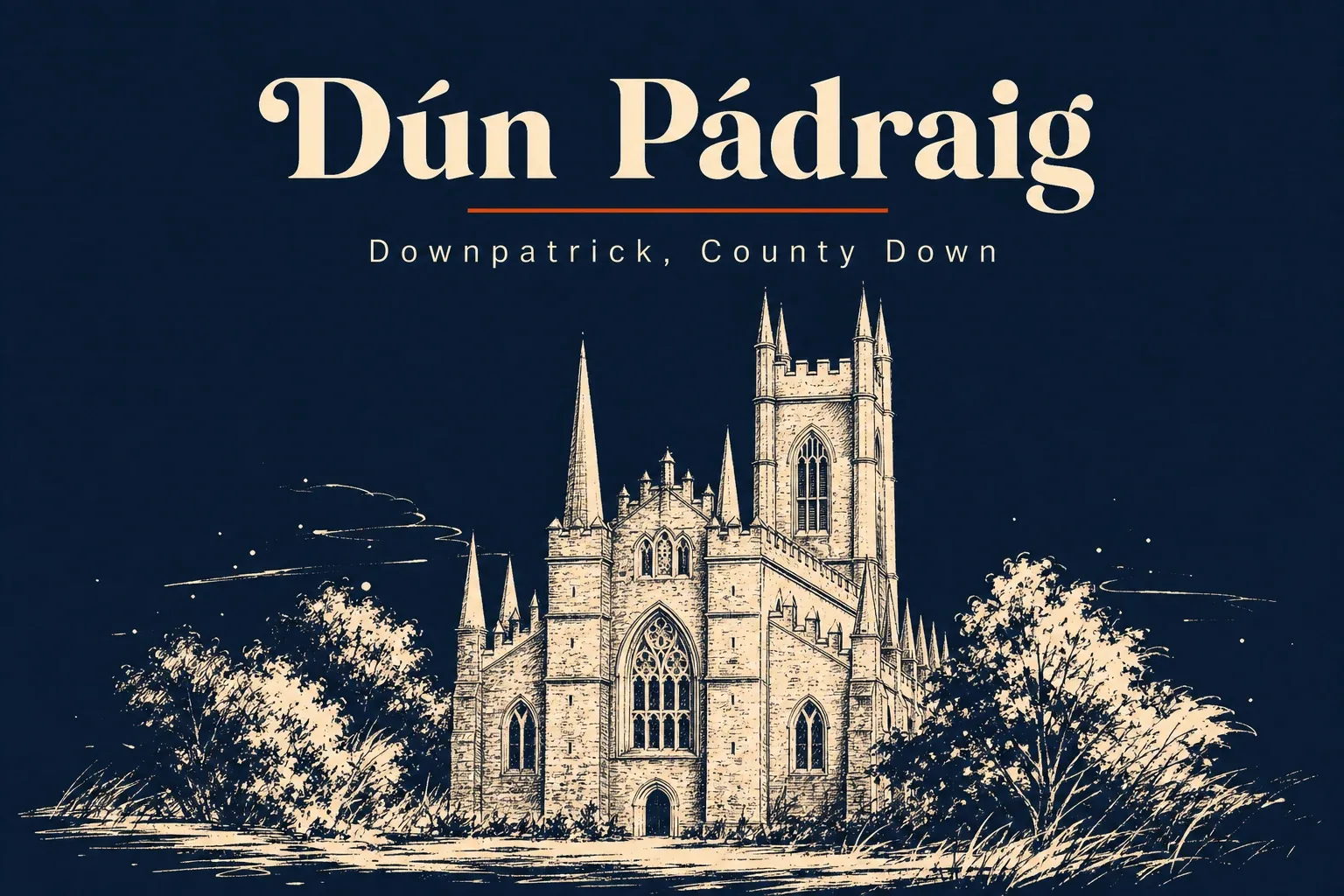
Dún Pádraig

The Mourne, Gullion & Strangford
STOP 02 / 06
Dún Pádraig · Co. Down

The county town that gave the county its name. Patrick may or may not be under the slab.

Downpatrick is a working market town built around a hill, an old gaol, and a long argument about where Saint Patrick is buried. The hill carries Down Cathedral — the Cathedral Church of the Holy and Undivided Trinity — and the slab in the graveyard that says PATRIC. Armagh has a counter-claim. Glastonbury has a counter-claim. The slab itself was put down in 1900 because Victorian pilgrims were carting the soil away. None of that is in the brochure. All of it is what makes the place interesting.

The town gives the county its name. Dún Pádraig — Patrick's fort — sits on a drumlin above the Quoile floodplain, and the floodplain still floods, and the streets still climb. The county museum is in the 18th-century gaol on English Street. Denvir's, the inn at the bottom of the same street, has been pouring since 1642. Inch Abbey sits across the river — Cistercians from 1180, Robb Stark's camp at Riverrun for the Game of Thrones lot, take your pick. The Saint Patrick Centre below the cathedral does the official version of the Patrick story, voiced by Ciarán Hinds, refreshed in 2023.

Don't expect a polished cathedral city. The Cathedral is small. The town is honest. The food is fine rather than famous. The point is to walk English Street from the gaol to the hill, take in the slab and the view down to Strangford Lough, drop back down to Denvir's for a pint, and then drive ten minutes to Saul, where Patrick is supposed to have built his first church in a barn in 432. Two thousand years of contested story in one afternoon. That's the trip.
Population
11,545 (2021 census)
Walk score
English Street to the Hill of Down in eight minutes, uphill
Founded
Dún da Lethglas — Iron Age, burned 1040 and 1069
Coords
54.3287° N, 5.7156° W
01 / 09

At a glance.

Three things every local will eventually mention. Read these and you've already understood more than most day-trippers do.

02 / 09

The pubs.

None of these are themed Irish pubs, because they don't need to be. A few that earn the trip:

Denvir's of Downpatrick

Old beams, turf-fire energy
Coaching inn, established 1642

14 English Street. The oldest surviving coaching inn in Ireland — grade A listed, established by John and Ann McGreevy in 1642. Snug bar with a 17th-century open fireplace, restaurant, six rooms upstairs in the original inn plus more in the Mews. Live music on selected nights, including trad. The default first pint in town.

Murphy's Bar & Restaurant

Locals, classic pub fare
Town pub & food

Steady town local doing classic pub food in a relaxed room. Not trying to be anything it isn't. The kind of place a wet Wednesday afternoon disappears into.

Brendan's Bar & Restaurant

Mixed crowd, weekend busy
Pub & restaurant

Long-standing town pub with a sit-down restaurant attached. Reliable for a feed and a pint without ceremony. Busier at weekends; quieter midweek.

The Cable Bar

Local pints, local talk
Town bar

Town local. No frills. The conversation is the entertainment. Good if you want to hear an actual Downpatrick accent rather than a Belfast one.

03 / 09

Where to eat.

PlaceTypeLocal note
The Saint Patrick Centre Cafe Visitor-centre cafe Ground floor of the Saint Patrick Centre on Lower Market Street, below the Hill of Down. Daytime only. Soup, sandwiches, traybakes. Convenient if you've done the exhibition; not a destination on its own.
Denvir's Restaurant Hotel restaurant €€ 14 English Street. Hearty local food in the dining room of the 1642 coaching inn — steaks, fish, the Sunday carvery. Not refined; substantial. Eat by the open fireplace if you can grab the snug.
Hanlons Restaurant €€ Town-centre sit-down restaurant, popular for evening dinner and lunch trade. Mid-range menu, local ingredients where possible. Book ahead at the weekend.
il Forno Italian €€ Wood-fired pizza and pasta in the town centre. The Italian default — not chasing stars, just a reliable plate of carbonara after a wet day on the Hill.
Doc's Fish & Chips Chipper The chipper. Fresh fish, proper chips, takeaway. Eat them on a bench up by the cathedral wall and you've had a perfectly Downpatrick evening.
McCarthy's Sandwich & Coffee Bar Cafe Daytime cafe — proper coffee, decent sandwiches, traybakes the length of your forearm. Where the gaol-and-museum crowd refuels at noon.
04 / 09

Where to sleep.

PlaceTypeLocal note
Denvir's of Downpatrick Coaching inn 14 English Street. Six restored rooms in the original 1642 inn plus newer rooms in the Mews residence. Stay here if you want to sleep above a snug bar with a 17th-century fireplace and walk to the cathedral in three minutes. Grade A listed; book direct.
Burrendale Hotel (Newcastle) Country hotel & spa If the town beds are full, drive twenty minutes south to Newcastle for a country hotel with a pool and the Mournes rising behind you. Doubles as a spa weekend. A different kind of trip but a workable plan B.
A house out toward Strangford Self-catering Drive fifteen minutes east to Strangford village or the Lecale shoreline and the prices ease, the silence after dark is total, and the morning light off the Lough is the picture you came for. Trust us.
05 / 09

Stories & lore.

The reason to come back. The things every local will eventually tell you about, usually after the second pint.

Patrick's contested grave

The slab is from 1900

The granite slab in the cathedral churchyard with PATRIC carved on it — the one in every photograph — was set down in 1900. The Mourne granite came from the Mournes; the inscription was added because Victorian pilgrims had been chipping pieces off the ground itself. The actual location of Patrick's grave is one of three claims: Down has him, Armagh has him, Glastonbury has him. The medieval story tells it best — in 1196 John de Courcy reputedly translated the bones of Patrick, Brigid and Colmcille into the cathedral together. The bones are not there now. Nothing is, that you can see. The hill is the thing.

Sabhall Phádraig — Patrick's barn

Saul, the first church

Three kilometres east of the town stands Saul Church. Patrick is supposed to have landed at the mouth of the Slaney from Strangford Lough in 432, been given a barn by the local chieftain Dichu, and preached his first sermon in Ireland from inside it. Sabhall Phádraig — Patrick's barn — became Saul. The current church on the site is from 1932, built in Mourne granite for the 1500th anniversary, with a small round tower. It is empty most of the time. Walk up the hill behind it for the statue and the view back to the cathedral on the Hill of Down.

Cistercians, 1180; Game of Thrones, 2011

Inch Abbey and Robb Stark

John de Courcy founded Inch Abbey in 1180 as an act of repentance for sacking the older Erinagh Abbey three years earlier. He brought Cistercian monks over from Furness in Lancashire and gave them 850 acres on the north bank of the Quoile. The community held until the Dissolution in 1541, when Henry VIII's men granted the lot to the Earl of Kildare. Eight hundred years on, the Game of Thrones crew turned up and used the ruined nave as Robb Stark's camp at Riverrun — the scene where the Northern bannermen kneel and shout 'The King in the North.' The abbey is across the river from the town, signposted off the Belfast Road. Free.

Downpatrick Racecourse, since 1685

The oldest racecourse in Ireland

A mile out the road, on the Ballydugan side, is Downpatrick Racecourse — the oldest racecourse in Ireland, with the first recorded meeting under the charter of James II in 1685. The Byerley Turk, one of the three foundation stallions of the modern thoroughbred, is reputed to have raced here in 1690 before carrying Colonel Robert Byerley to the Battle of the Boyne. The feature race today is the Ulster National Handicap Chase, run as the Ulster Grand National.

An unfinished motte

The Mound of Down

On the marshy floodplain north of the town, on its own drumlin, sits the Mound of Down — also called Dundalethglas, English Mount, or Rathkeltair. An egg-shaped earthwork enclosure with a steep crescent-shaped mound in the south end. The enclosure is Iron Age and Early Christian — the town of Dún da Lethglas burned here in 1040 and again in 1069. The crescent in the middle is a Norman motte that John de Courcy started in 1177 and abandoned within eighteen months when he moved his main base up to Carrickfergus. It has been sitting unfinished for 850 years. You can walk up it for nothing. The view is the cathedral on its hill, and the river curling in the marsh below.

06 / 09

Things to do outside.

Wear waterproofs. Bring a sandwich. Tell someone where you're going if it's the mountain.

English Street and the Hill of Down The town walk. Start at the gaol — now Down County Museum — at the bottom of English Street. Climb the street past the Georgian houses to the Cathedral on the hill. Slab in the churchyard. View south to Strangford Lough. Drop back down past Denvir's. Free; do it slowly.
1.5 km loopdistance
45 mintime
Inch Abbey from the town Out across the Quoile bridge and along the river to the abbey ruins on the north bank. The Cistercian nave is the Game of Thrones bit; the cloister is just bones in the grass. Bring a coat — the river does not care.
5 km returndistance
1.5 hourstime
Saul Church and the Patrick statue Three kilometres east of town. Park at Saul Church — the 1932 round-tower replica on the site of Patrick's first church. Walk up the hill behind it to the Statue of Saint Patrick on Slieve Patrick: a granite figure put up in 1932 for the same anniversary. The view is the whole Lecale peninsula and the Mournes south of it.
2 km loopdistance
1 hourtime
The Mound of Down Park at the signed lay-by north of town off the Belfast Road. Walk out across the boardwalk over the marsh, climb the unfinished motte, come back down. Wet underfoot most of the year. Bring boots. The cathedral is the picture from the top.
1 km returndistance
30 mintime
Quoile Pondage nature reserve Two kilometres downstream from the town. The Quoile barrier in 1957 turned the tidal river into a freshwater pondage; the result is a wetland reserve with hides, herons, and a flat path. A different walk to the cathedral hill. Sometimes you want flat.
4 km loopdistance
1.5 hourstime
07 / 09

When to go.

There is no bad time. There are different times.

Spring
Mar–May

Saint Patrick's Day on 17 March is the busiest day of the year — parade from the Downshire Estate at 1:30pm, stage at Saint Patrick's Square, artisan market at Grove Car Park, park-and-ride from the Racecourse. Book accommodation by January or stay in Newcastle or Belfast and bus in. The rest of spring is excellent: the Quoile reserve waking up, lambs around Saul, the cathedral hill at its best.

◐ Mind yourself
Summer
Jun–Aug

Long evenings on the cathedral hill. The Downpatrick & County Down Railway runs steam-hauled trains weekends mid-June to mid-September with extras around bank holidays. The town is busy but not saturated; coach traffic is more for Inch Abbey than for the town centre.

◉ Go
Autumn
Sep–Oct

Crisp air, low light off the Lough, short queues at the Saint Patrick Centre and the Cathedral, racing fixtures most months. The locals' season.

◉ Go
Winter
Nov–Feb

The heritage railway runs special steam services in December for Christmas. Outside that, the town is quiet, the cathedral is cold, and Inch Abbey can be ankle-deep in mud. Denvir's snug with the open fire earns its keep.

◐ Mind yourself
08 / 09

What to skip.

Honestly? Don't bother.

If a local was sitting beside you, this is the bit where they'd lean in.

×
Treating the granite slab as Patrick's actual grave

It was put down in 1900 to stop souvenir-hunters. The location of Patrick's burial is contested between Down, Armagh and Glastonbury, and even the local medieval account has him moved into the cathedral with Brigid and Colmcille in 1196. Read the slab as a memorial, not a coffin lid.

×
Doing the Saint Patrick Centre and the Cathedral as a tick-box

Both are small. Twenty minutes each. The point is the layered story across the town — the gaol on English Street, the inn from 1642, the abbey across the river, the barn at Saul, the unfinished motte on the marsh. Spend the half-day on the layers, not the headlines.

×
Driving in for Saint Patrick's Day without a plan

Roads close from late morning, the town fills up, and parking near the cathedral is gone by ten. Use the park-and-ride from the Racecourse or get the 215 bus from Belfast. Better still, stay overnight and let the day come to you.

×
Looking for a polished cathedral city

It isn't one. Down Cathedral is small and Church of Ireland; the town below is a working market and council seat with a chipper, a museum, an old gaol and a coaching inn. That's the charm. It is not Lichfield. It is not even Armagh. Calibrate.

×
Skipping Saul because it's outside the town

Saul is the actual point of the whole Patrick story locally — the spot where he supposedly landed and built the first church. The town is the burial story; Saul is the arrival story. Three kilometres east. Don't leave it out.

+

Getting there.

By car

Belfast to Downpatrick is roughly 45 minutes on the A24 / A7 — about 33 km. Newcastle is 25 minutes south on the A2. Newry is an hour west via Castlewellan. Park at Market Street or behind the Saint Patrick Centre.

By bus

Translink Ulsterbus 215 from Belfast Europa, every 30 minutes weekdays, around hourly at weekends. Journey is around 55 minutes. The bus station is on Market Street, three minutes' walk from the Saint Patrick Centre and the foot of the cathedral hill.

By train

No train. The line that gave the Downpatrick & County Down Railway its name closed in 1950 — the heritage railway is the surviving stub. Nearest mainline station is Belfast Lanyon Place; bus from there.

By air

Belfast City (BHD) is around 35 km, about 40 minutes. Belfast International (BFS) is around 60 km, about 1 hour. Dublin is 2 hours by car.