County Down Ireland · Co. Down · Ardglass Save · Share
POSTED FROM
ARDGLASS
CO. DOWN · IE

Ardglass
Ard Ghlais

The Ireland's Ancient East
STOP 08 / 08
Ard Ghlais · Co. Down

Seven medieval tower houses in a village of seventeen hundred. Then a working trawler comes in.

Ardglass is a small fishing village with the bones of a much bigger town. In the 15th century this was the busiest port in Ulster — an Anglo-Norman trading hub close enough to the Isle of Man and the English ports to matter, far enough up the Irish Sea to need defending. The merchants built tower houses around the harbour the way merchants elsewhere built warehouses. Six or seven of them, depending who you ask. Four are still standing. One is a golf clubhouse. One is a museum that opens when it opens. The rest you walk past and forget for a second that they are 600 years old.

The fishing never quite went. Ardglass is one of three working fishing harbours in Northern Ireland, and thirty-plus trawlers still call it home. Herring made the place famous twice — once in the medieval boom, once in the 19th-century industrial boom when William Ogilvie rebuilt the harbour and the Scottish fleet came down for the season. The fish has changed. The boats have changed. The smell at the working end of the pier has not.

Then there is the village itself, which is mostly one long curve of houses around the bay, a couple of pubs, a chipper, an Italian that has been there fifty years, a brewery on High Street, and a quietness that surprises you given the size of the history. Van Morrison stopped here for mussels and potted herrings in Coney Island and put it in the song. That is roughly the size of Ardglass — small, specific, and casually loaded.

Population
~1,760
Walk score
Harbour to High Street in 8 minutes
Founded
Anglo-Norman port, 12th century
Coords
54.2606° N, 5.6063° W
01 / 08

At a glance.

Three things every local will eventually mention. Read these and you've already understood more than most day-trippers do.

02 / 08

The pubs.

None of these are themed Irish pubs, because they don't need to be. A few that earn the trip:

Curran's Bar & Seafood Steakhouse

Country pub with food
Pub & restaurant, since 1791

Built in 1791 alongside St Mary's Church across the road. Same family through generations. Restored stables form the bar, the old bottling room is part of the dining room. Walled beer garden out the back. Locally landed prawns shelled on the premises.

Aldo's

Family-run since the 70s
Italian restaurant & bar

Family-run for more than fifty years. Light Italian — pasta, fresh fish off the boats, the lasagne that is always on the menu. Next door to Margaret's Cottage B&B.

03 / 08

Where to eat.

PlaceTypeLocal note
Curran's Seafood Steakhouse Pub restaurant €€ The seafood platter is the thing — clams, smoked mackerel, mussels, crab cakes, prawns, dressed crab, langoustine, wheaten bread. Steaks are local dry-hung Prime Irish. Potatoes come from a named farmer up the road.
Aldo's Italian €€ Half a century of lasagne. Pasta, fresh fish, home-made desserts. The kind of village Italian that survives because it deserves to.
Lecale Brewery Microbrewery, taproom hours Independent microbrewery at 5 High Street, started by local Michael Howland in 2018. White Knight Lager, Legbiter Ale, Three Saints Stout. Check ahead — small operation, hours move.
04 / 08

Stories & lore.

The reason to come back. The things every local will eventually tell you about, usually after the second pint.

Why a village of 1,700 has a medieval skyline

The seven castles

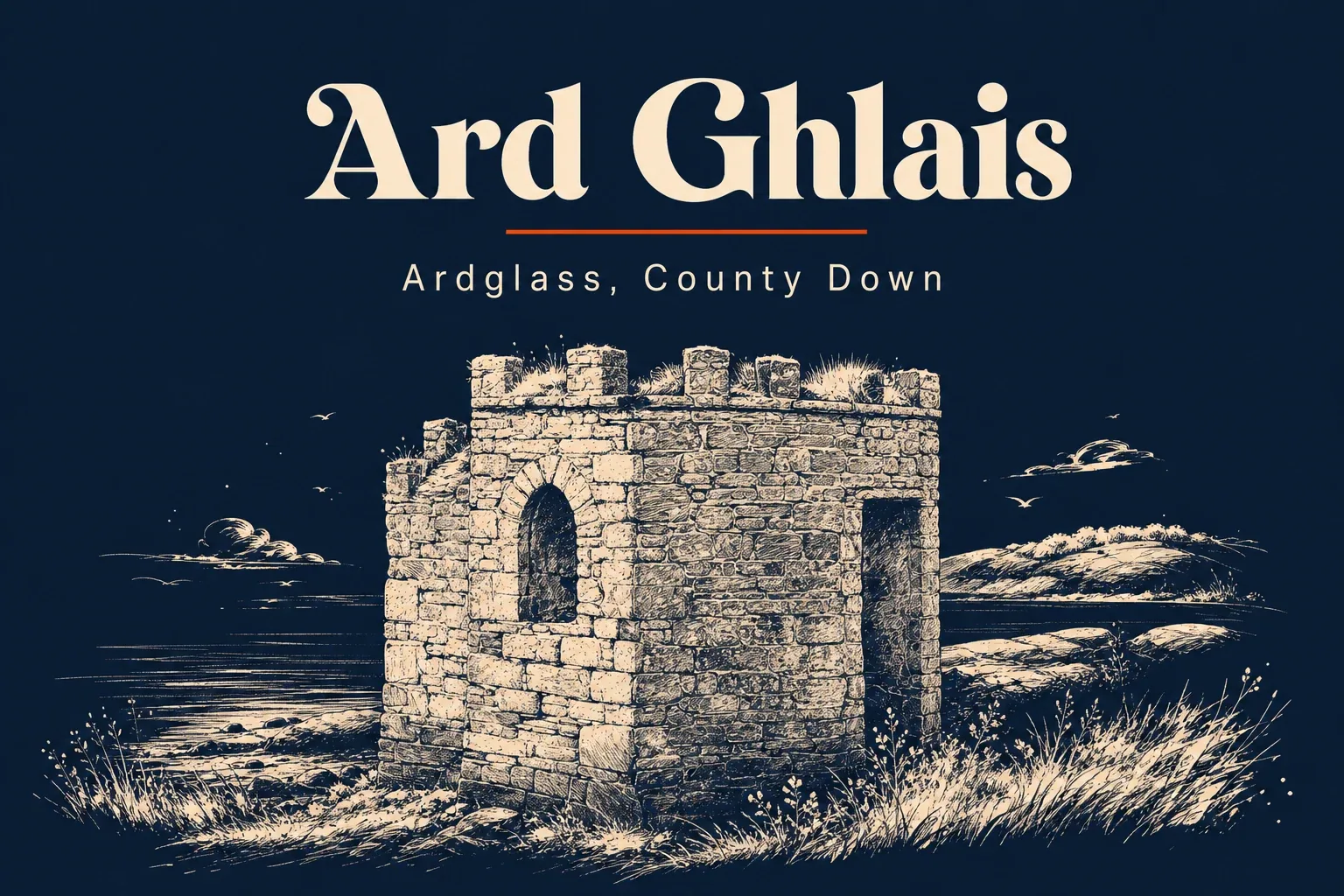
In the 15th century Ardglass was the busiest port in Ulster, and the Anglo-Norman merchants who ran it built fortified tower houses around the harbour to defend their goods and themselves. Six or seven went up. Four survive: Jordan's Castle (the most intact, four storeys with twin projecting turrets, held by Simon Jordan against the O'Neills for three years until relieved in 1601), Ardglass Castle (a fortified warehouse begun no later than 1405, now the golf clubhouse), Cowd Castle (a small two-storey ruin in front of Ardglass Castle), and Margaret's Castle. King's Castle sits above the village. Most are not open. You look at them from the road. That is the visit.

The siege of 1598–1601

Jordan's three years

Simon Jordan held Jordan's Castle through a three-year siege by the O'Neills during the Nine Years' War, refusing to surrender until Lord Deputy Mountjoy fought his way down through Lecale and relieved him in June 1601. The castle is the most imposing of the Ardglass towers and the one you can sometimes get inside. It is in state care. Opening hours are seasonal and modest.

The 1812 rebuild

Ogilvie's harbour

The medieval port silted and faded by the 17th century. William Ogilvie took it in hand in 1812, built the tidal North Dock and a new pier, and Ardglass became the most prosperous fishing port in the north of Ireland through the 19th century. The first lighthouse fell into the sea on 27 November 1838 in a great storm that also took the end of the pier with it. The harbour you walk today is largely Ogilvie's shape, with later patching.

Van Morrison's mussels and potted herrings

Coney Island

Coney Island is a row of houses on the shore between Ardglass and Killough — not actually an island, despite the name. Van Morrison's 1989 song "Coney Island" traces a drive through Lecale with his mother: Downpatrick, St John's Point, Strangford Lough, Killyleagh, then stopping off at Ardglass for mussels and potted herrings. It is the most affectionate any famous person has ever been about the place. The spot itself is a beach and a few cottages. Drive there and you will understand both the song and why he only mentioned it the once.

Two booms, both gone

The herring

Ardglass herring was a brand name in the medieval period — caught off the Isle of Man banks, salted in barrels on the quay, shipped to England and the continent. The 19th-century herring boom brought the Scottish fleet down for the season and the village population briefly doubled with gutters and packers. The herring fishery is still active, but ring and drift nets gave way to specialist pelagic trawlers. The fish goes to processors elsewhere. The boats still come home here.

05 / 08

Things to do outside.

Wear waterproofs. Bring a sandwich. Tell someone where you're going if it's the mountain.

St Patrick's Coastal Camino (Ballyhornan to Ardglass) Guided coastal walk run by the St Patrick Centre in Downpatrick — beaches and clifftops from Ballyhornan, past St Patrick's Well, on to the ruined Ardtole Church, ending in Ardglass. Lunch at the golf club in the castle. Booking required.
About 8 kmdistance
2.5–3 hourstime
Ardglass to Coney Island South-west out the A2 to the Coney Island hamlet and the strand. Flat, easy, more about the view of the Mournes across the bay than the destination. Bring a flask.
5 km returndistance
1.5 hourstime
Harbour and tower-house loop Down to the quay, around past Jordan's Castle and the marina, up Kildare Street past King's Castle, back through the village. Five towers seen in twenty minutes. Most are locked. The looking is the thing.
2 kmdistance
30–40 mintime
Ardglass Golf Course cliff path Public footpath skirts the seaward edge of the links. Cliffs, gannets, the Isle of Man on a clear day. Mind the golfers; the seventh tee plays out over the rocks.
Course-length strolldistance
1 hourtime
06 / 08

When to go.

There is no bad time. There are different times.

Spring
Mar–May

Quiet, gorse out on the headland, the trawlers working hard before the summer slowdown. Castles look their best in raking light.

◉ Go
Summer
Jun–Aug

Marina is full, the golf club is busy, the village has a holiday tilt without ever feeling overrun. Long evenings on the pier.

◉ Go
Autumn
Sep–Oct

Best of the year for the coast — big skies, storms rolling in, the fishing fleet back to its proper business. Curran's is at its warmest.

◉ Go
Winter
Nov–Feb

The village goes quiet. Aldo's and Curran's carry the place. Jordan's Castle is closed. The wind off the harbour is a serious wind.

◐ Mind yourself
07 / 08

What to skip.

Honestly? Don't bother.

If a local was sitting beside you, this is the bit where they'd lean in.

×
Expecting to tour all the tower houses

Most are locked, in private hands, or roofless ruins behind railings. Jordan's opens seasonally and irregularly. The rest are skyline, not interior. Plan a walk-past, not a tour.

×
The working end of the quay if you are squeamish about fish

It is a real fishing port. There are nets, gulls, ice melt, and a smell. The pretty end is the marina; the honest end is the trawler pier. Both are worth seeing; only one is photogenic.

×
Driving the B1 fast

It is a coast road, not a commute. Coaches, tractors, a cyclist on a Sunday — the seven miles from Downpatrick will take twenty minutes if you let them.

×
Coney Island expecting Brooklyn

It is a row of cottages and a beach. The song is the song. The place is quieter than the song.

+

Getting there.

By car

Belfast to Ardglass is 1h 10m via the A24 and A7 through Downpatrick. From Downpatrick it is 11 km south-east on the B1 — about 15 minutes.

By bus

Translink runs a Downpatrick–Ardglass service several times a day. Belfast comes in via the 215 to Downpatrick, change there. Allow 1h 45m from Belfast on the bus.

By train

No train. Nearest is Belfast (Lanyon Place or Great Victoria Street), then bus to Downpatrick, then bus or taxi.

By air

Belfast City (BHD) is 50 km. Belfast International (BFS) is 70 km. Dublin is 2h 15m by road.