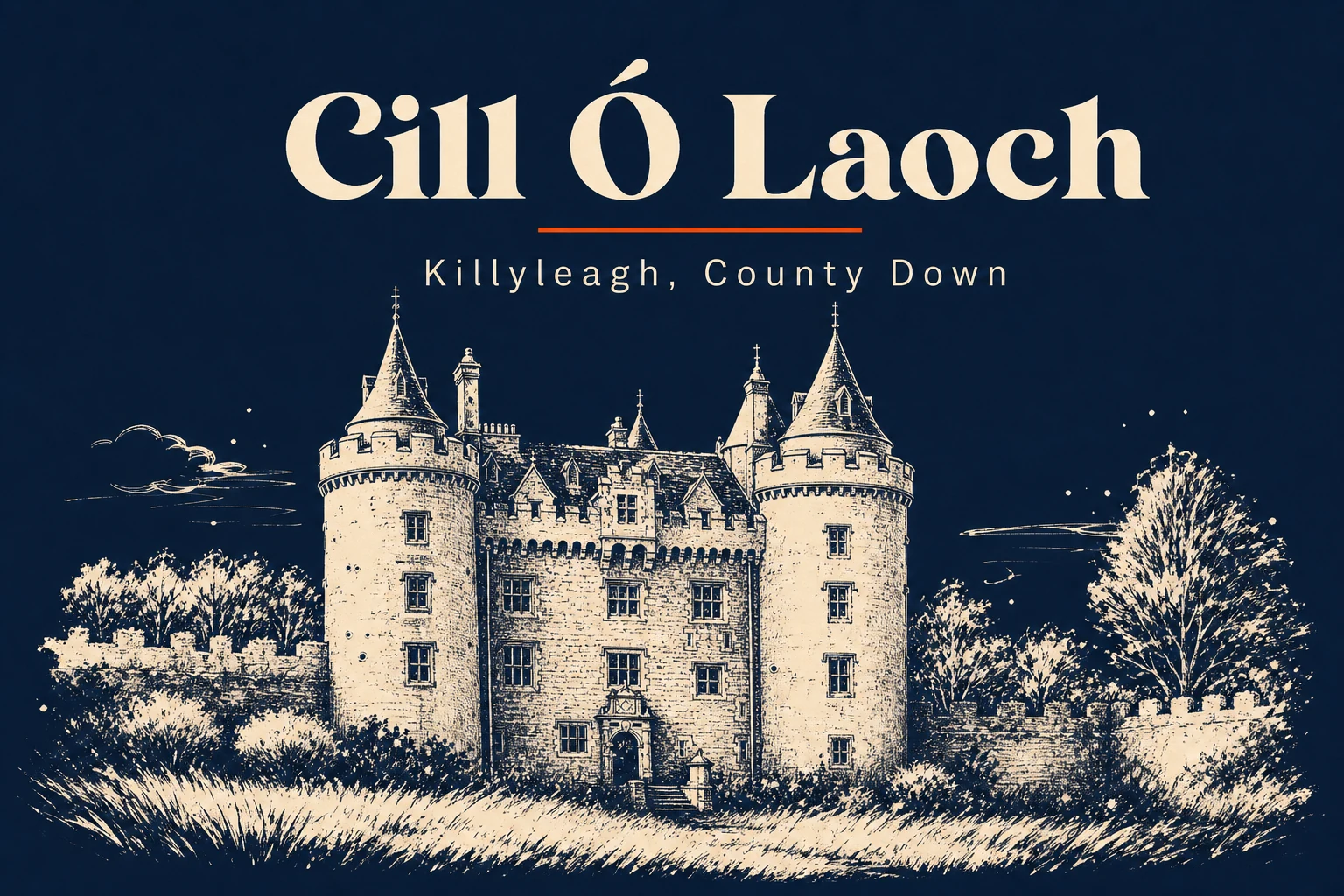
Cill Ó Laoch · Co. Down
A fairytale castle still lived in, and a harbour that still works underneath it.
Killyleagh is a Strangford Lough village built around a castle that is still somebody's house. The Hamilton family came in the early 17th century and they are still here, four hundred years and twelve generations later, with two conical towers at the top of the High Street and a pair of self-catering apartments built into the bawn wall. You can stand at the castle gates. You cannot, on a normal Wednesday, go in. That is part of the deal.
It is a working village underneath the fairytale. The harbour has boats in it. The Yacht Club has four hundred members and a serious racing calendar. The deli on the High Street - Picnic - is one of the best places to eat in this corner of Down, and the Dufferin Arms a hundred yards uphill has been pouring pints in two tiny snugs for longer than anyone remembers. Add the Sir Hans Sloane Centre and Delamont Country Park five minutes down the road, and you have a half-day that is not pretending to be anything it isn't.
The trick is knowing the limits. The castle does not open to the public. The Hans Sloane Chocolate Festival happens every other September and not in between. The Smugglers Table - the destination restaurant - closed at the end of 2025. What is left is honest: a deli, a pub, a harbour, a stone, and the strangest collector's story Ireland produced in the eighteenth century. Come for an afternoon. Stay for a night if the towers are free.