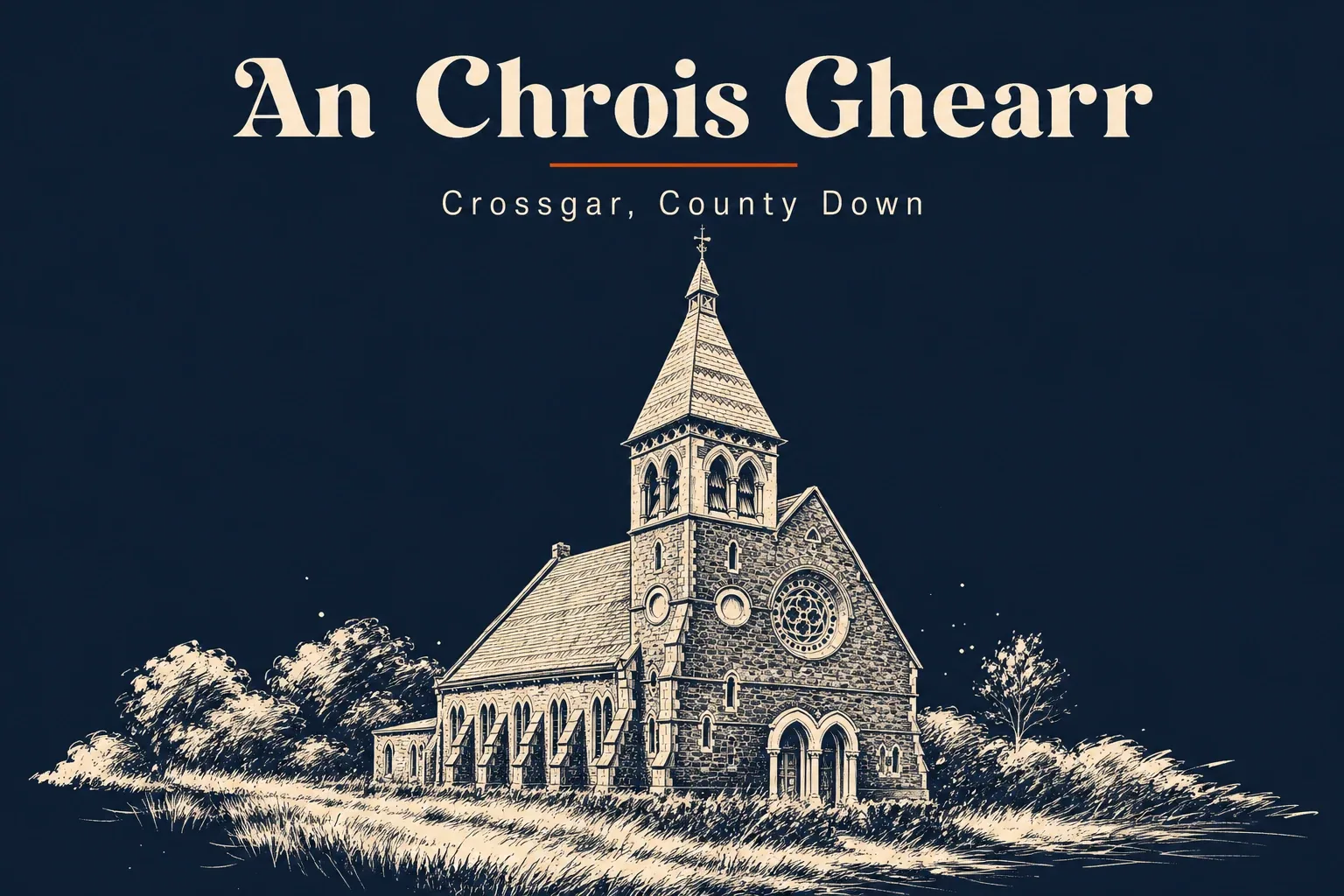
An Chrois Ghearr · Co. Down
A long street, a square, two old bars, and a Passionist monastery in the woods.
Crossgar is a crossroads with a village wrapped around it. Before 1777 there was a bridge, a Presbyterian church, and Quinn's pub at the junction - nothing else. Edward Ruthven inherited the townland that year, built Crossgar House up the road, and the place started to grow. A Downpatrick merchant called William Thompson bought the house in the 1820s and laid out the village proper with a market house in the square. That is more or less what you are still looking at.
It is a working village, not a tourist village. The A7 runs through it, the buses to Belfast and Downpatrick stop hourly, the GAA club fields a team, the golf club out on the Derryboye Road has nine holes and a stream that ruins the second and the seventh. The two pubs on the square will pour you a pint. The diner on Downpatrick Street does a fry. There is no music scene to speak of, no harbour, no castle.
What it does have, oddly, is the woods. Crossgar House became a Passionist monastery in 1948, and the order opened the grounds and the retreat centre to the public. Tobar Mhuire - Mary's Well - is fifteen minutes' walk from the square and feels like a different country. A walled garden, a viewpoint over the Mournes, mass on a Sunday if you want it, silence if you don't. That is the reason to stop here. The rest is just the village getting on with itself.