County Down Ireland · Co. Down · Shrigley Save · Share
POSTED FROM
SHRIGLEY
CO. DOWN · IE

Shrigley
Sruthghlaí

The Ireland's Ancient East
STOP 04 / 06
Sruthghlaí · Co. Down

A model mill village built by one man, knocked back by the loom and the war, and still here.

Shrigley is a mile north-west of Killyleagh on the Crossgar road and is, in the full sense of the term, a model industrial village. John Martin laid it out in 1824 — a six-storey cotton mill, workers' housing, a school, a village hall, a Co-op shop that took mill tokens for groceries, a green. The name came over with him from Pott Shrigley in Cheshire. The mill, within a dozen years, had more power looms running than any other factory in Ireland. The village had something close to a thousand people in it. Then it burned down in 1845 and Martin rebuilt it for flax. Then he died, and the next century happened to it.

The closing whistle blew on Hallowe'en night 1930 and nine years of severe hardship followed — the kind that gets remembered in a small village forever. What pulled Shrigley out of it was the strangest thing. In the late 1930s Alfred and Isaac Utitz and Walter Weiniger, Czech Jews fleeing what was coming, set up United Chrome Tanners on the mill site. The work permits they raised for staff doubled as visas for Jewish families trying to get out of central Europe. Ninety people were working there by November 1939. Five hundred by the 1970s. A Queen's Award for Export. Holocaust survivors managing a leather works in a County Down crossroads. The local paper still writes about it.

The Victorian workers' cottages came down in the 1968–72 redevelopment — 154 new houses and two shops in their place, built in a kind of late-sixties suburban style that does not quite know what to do with the clock tower at its heart. The tannery itself eventually closed too. What is left now is a quiet residential village of roughly six hundred people, a green that was nearly sold by the council in 2024 before the residents stopped them, and a Victorian monument at the crossroads that is the most interesting thing for a mile in any direction. The pub, the restaurant and the deli are all up the road in Killyleagh. The story, for once, is entirely here.
Population
~600
Walk score
A crossroads, a clock tower and a green — five minutes
Founded
Mill village laid out 1824 by John Martin
Coords
54.4108° N, 5.6639° W
01 / 06

At a glance.

Three things every local will eventually mention. Read these and you've already understood more than most day-trippers do.

02 / 06

Stories & lore.

The reason to come back. The things every local will eventually tell you about, usually after the second pint.

Pott Shrigley, Cheshire, 1824

John Martin and the model village

Martin was a Belfast cotton manufacturer who took the name of his family's home village in Cheshire and gave it to the land he bought above the Dibney River. He built a six-storey mill in 1824 and laid out the village around it in the early-industrial model: planned housing, a school, a village hall, recreational ground, a Co-op shop where workers spent the tokens they were paid in. By 1836 the mill had more power looms than any other factory in Ireland. The mill burned down in 1845, the year the Famine began, and Martin's son rebuilt it for flax spinning rather than cotton. The family stayed paternalistic landlords for two generations.

Public subscription, 1871

The clock tower

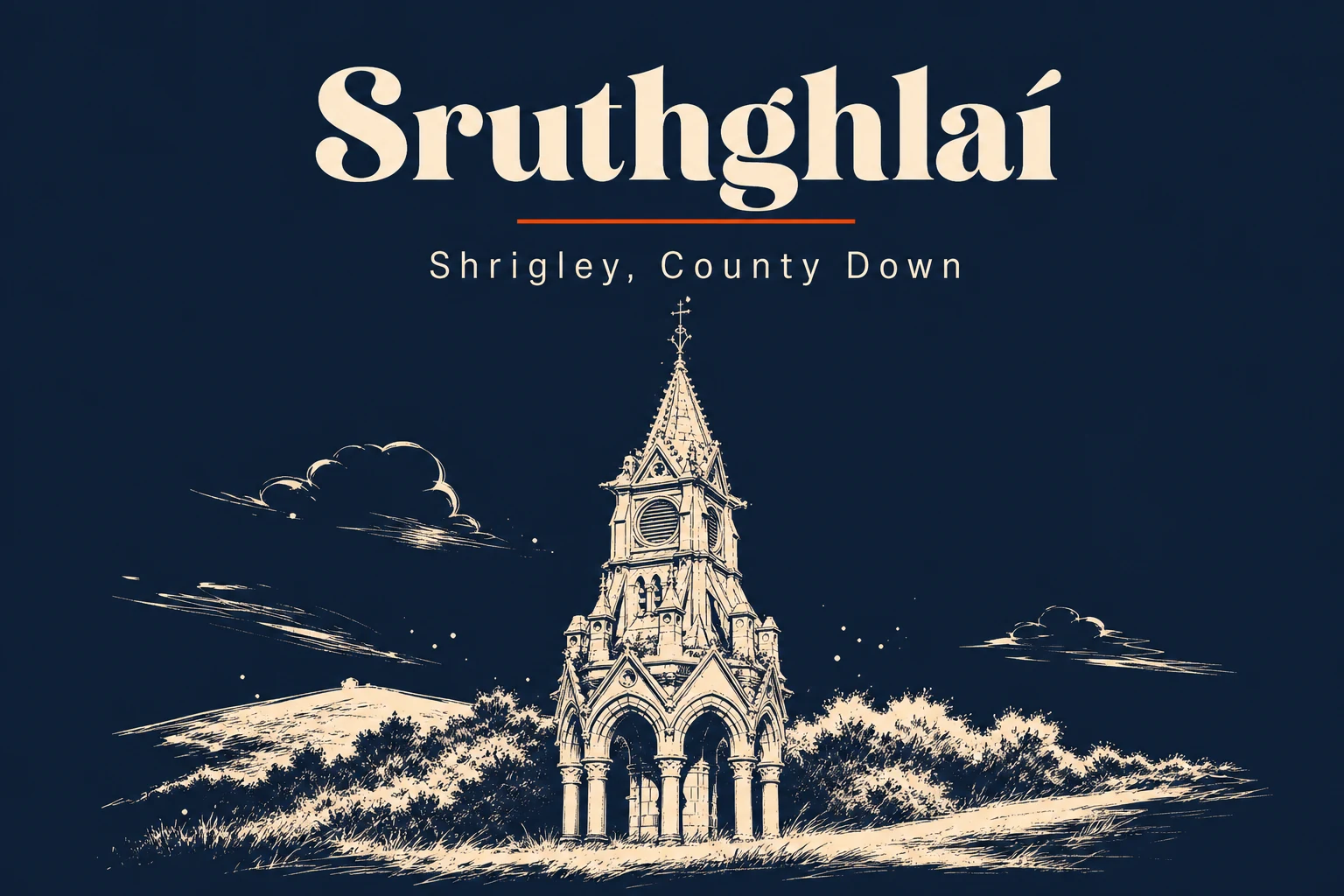
While Martin was still alive, the district decided to commemorate him. A design competition was held in 1870 for a clock tower and drinking fountain at the crossroads outside the mill gate. The winning High Victorian design was executed in 1871 — an octagonal arcade of round-headed arches around a central shaft, the drinking fountain inside, a square tower above supported by flying buttresses, triple pointed openings on each face, large circular oculi holding the four clock faces. It is the only listed structure of any consequence for a mile and it has outlived the mill, the cottages, the tannery and the founder by a long way.

The whistle and the nine years

Hallowe'en night, 1930

The flax spinning mill closed on Hallowe'en night 1930. Wages stopped overnight. There was no other employer for miles. What followed is remembered in the village as nine years of severe hardship and outright hunger — a slow-motion famine on the Down coast in the 1930s that has almost no presence in the national story. People emigrated. The Martin Co-op shop closed. The school's numbers fell. The village, for the best part of a decade, was a planned settlement with no plan.

A leather works and a rescue mission

United Chrome Tanners

Alfred and Isaac Utitz, with Walter Weiniger, were Czech Jews who saw the way the 1930s were going and got out. They set up United Chrome Tanners on the Shrigley mill site in the late 1930s — and the work permits they raised for staff doubled as a way to get other Jewish families out of central Europe. Nicholas Vermes, one of the last Hungarian Jews to escape, made a six-day trek across occupied Europe on the strength of a Shrigley work permit. Mr Horenovsky, another Czech Jew, was the first managing director. By November 1939, ninety people worked at the tannery. By the early 1970s it was over five hundred and the company held a Queen's Award for Export. There is a plaque in the village.

The Kindertransport farm on the Ards

Millisle, twenty miles north

The Shrigley tannery was not the only refuge of its kind on this coast. From 1938 to 1948 a working farm at Millisle, twenty miles north on the Ards Peninsula, housed several hundred Jewish children evacuated from Germany and Austria on the Kindertransport, together with adult refugees and older members of religious Zionist youth groups. The two stories — the tannery here and the farm up there — are usually told separately. They were happening in the same county, in the same years, for the same reason.

What got knocked down

The 1968 redevelopment

Between 1968 and 1972, the Downpatrick Area Plan replaced the entire early-industrial village. The Victorian workers' cottages came down. The Co-op shop went. In their place: 154 new houses and two shops, built in the suburban style of the time, arranged around the streets where Martin's cottages had been. The clock tower stayed. The green stayed. The mill chimney did not. What you walk through today is almost entirely 1970s housing with a Victorian monument in the middle of it, and you have to know what was there to feel what is missing.

A council sale, a community campaign

The green, 2024

In 2024, Newry, Mourne and Down Council listed the village green as surplus to requirements and moved to sell it. The Shrigley Community Group ran a campaign, the residents turned out, and the sale was unanimously dropped. A councillor pointed out — possibly to the council's surprise — that a deed of covenant required the land to be retained as open recreational space in any case. The green that Martin's plan laid out in 1824 is, for now, still the village's.

03 / 06

Things to do outside.

Wear waterproofs. Bring a sandwich. Tell someone where you're going if it's the mountain.

Shrigley to Killyleagh Out the Crossgar road past the clock tower, down to the gates of Killyleagh Castle and on to the harbour. The walk between the two villages — one mile, mostly downhill — is the proper way to do Shrigley. The pint and the deli are at the other end.
1.6 km one waydistance
20 mintime
The clock tower loop Around the crossroads, the green and the site of the old mill. There is no mill to see — the chimney is long gone — but the footprint and the tower are still here, and the housing that replaced the cottages is the story in itself.
500 mdistance
10 mintime
Delamont Country Park Two miles south on the A22. Two hundred acres on the Strangford Lough shore, five waymarked trails, and the Strangford Stone — the tallest megalith in these islands, ten metres of Mourne granite raised in 1999. The Long Walk is the full circuit.
7 km loopdistance
2 hourstime
04 / 06

When to go.

There is no bad time. There are different times.

Spring
Mar–May

Quiet, bright, the lough waking up a mile down the road. The walk into Killyleagh in late April is the reason to come this side of the county.

◉ Go
Summer
Jun–Aug

Long evenings, the green in use, Killyleagh harbour busy. Nothing in Shrigley itself is loud, which is the point.

◉ Go
Autumn
Sep–Oct

The right season for the closing-whistle story. Hallowe'en in Shrigley has its own weight — the mill closed on the night of the 31st October 1930, and the village has not forgotten.

◉ Go
Winter
Nov–Feb

Short days, no shops to speak of, no pub. Bring a hat, walk the loop, then go up to Killyleagh for the fire in the Dufferin Arms.

◐ Mind yourself
05 / 06

What to skip.

Honestly? Don't bother.

If a local was sitting beside you, this is the bit where they'd lean in.

×
Looking for a pub or restaurant in Shrigley

There isn't one. The two pubs and the deli and the cafe are all in Killyleagh, a mile down the Crossgar road. The redevelopment of 1968–72 gave the village 154 houses and two shops, and the shops are local convenience, not destinations. Walk to Killyleagh; everyone does.

×
Looking for the mill

The mill is gone. The flax spinning mill that succeeded the cotton mill closed in 1930, and the buildings have been demolished and built over. The clock tower at the crossroads is what remains, with the green and the footprint of the old works. Read the plaque, look at the tower, walk the loop.

×
Confusing Shrigley with Pott Shrigley

Pott Shrigley is in Cheshire, England. The Martins brought the name across in 1824 when they laid out the village here. The two places have been writing to each other on and off ever since. They are not the same place.

+

Getting there.

By car

Belfast to Shrigley is 40 minutes on the A22 via Comber and Killyleagh. Turn off at Killyleagh onto the Crossgar road; Shrigley is a mile up. Park on the green or at the clock tower.

By bus

Translink Ulsterbus 11 (Belfast–Killyleagh–Downpatrick) runs into Killyleagh several times a day. From the Killyleagh stop, walk the mile up the Crossgar road, or arrange a lift.

By train

No train. Belfast Lanyon Place is the nearest station; bus or taxi from there.

By air

Belfast City (BHD) is 40 minutes by car. Belfast International (BFS) is just over an hour.