County Down Ireland · Co. Down · Saul Save · Share
POSTED FROM
SAUL
CO. DOWN · IE

Saul
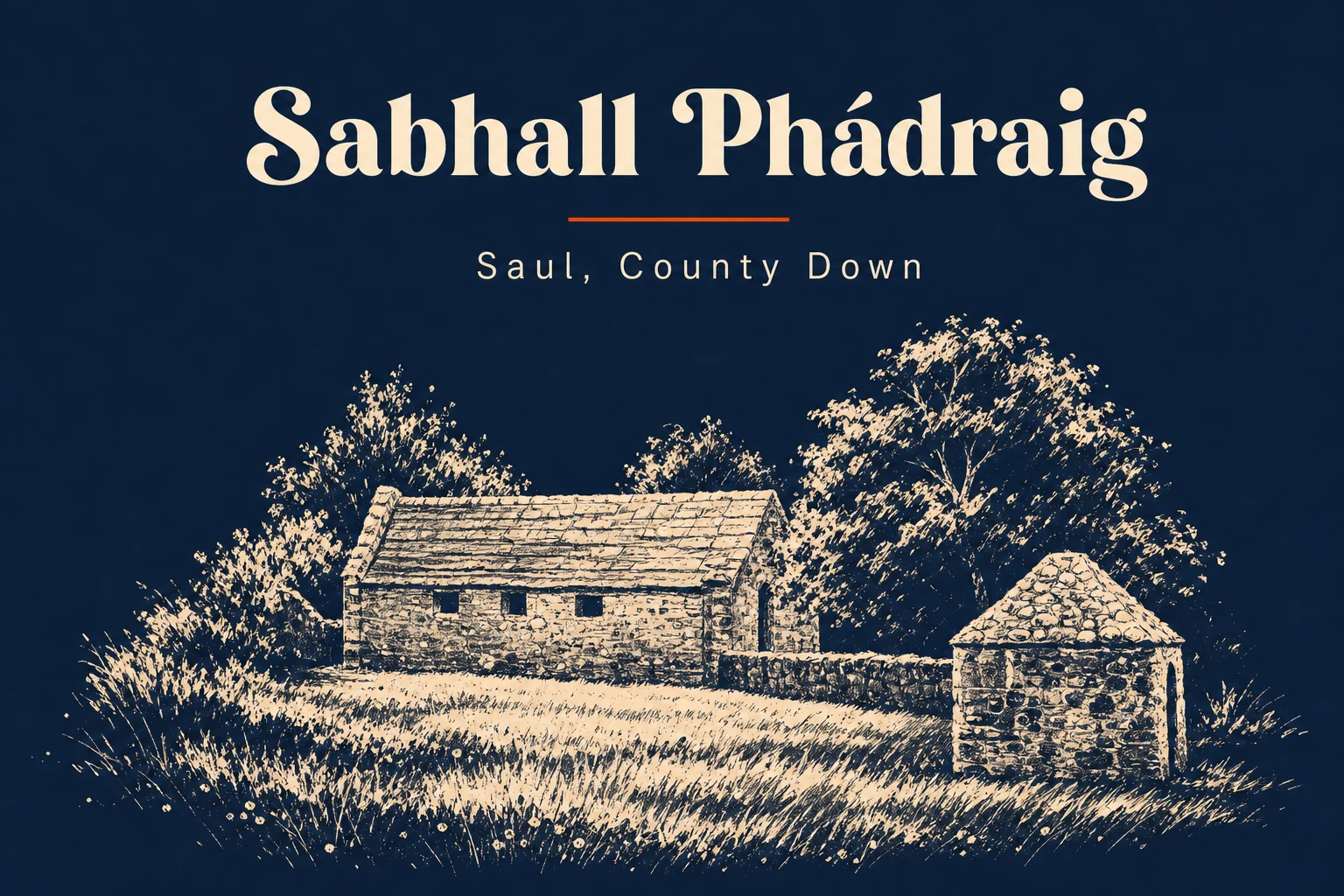
Sabhall Phádraig

The Ireland's Ancient East
STOP 03 / 06
Sabhall Phádraig · Co. Down

Where Patrick landed, where Patrick preached, where Patrick died. A barn became Ireland.

Saul is a hamlet. A crossroads, a church, a hill, a pub, and a few rows of new estates creeping out from Downpatrick two miles west. Drive through it without slowing and you'll think you've missed it. You have. The point of Saul is what happened here once, not what's here now.

What happened: in AD 432, by tradition, a Romano-British missionary called Patrick was swept into Strangford Lough by the tides, came ashore at the mouth of the Slaney River, and was given a barn by the local chieftain Dichu to preach in. The Irish word for barn is sabhall. The village has been called that ever since. Patrick is said to have died here on 17 March 461, and was carried two miles west to be buried in Downpatrick. The cathedral there has the grave. Saul has the start.

Two buildings carry the weight. The Memorial Church — Henry Seaver, 1932, Mourne granite, replica round tower — was put up for the 1500th anniversary and looks older than it is on purpose. The statue on Slieve Patrick, unveiled 1938, is the world's tallest Patrick. The walk up takes twenty minutes from the church gate. Bring a coat; the hill is exposed.

Don't make a day of it. Make a morning. Pair Saul with Down Cathedral and Struell Wells along the Saint Patrick's Way pilgrim path, and you've got the saint's whole County Down chapter in one loop. The first Sunday of June is the annual pilgrimage and the village fills — every other day, it's you and the wind.
Population
Hamlet — a few hundred in the parish
Pubs
1and counting
Walk score
Crossroads, church, statue — twenty minutes end to end
Founded
Patrick landed AD 432
Coords
54.3389° N, 5.6814° W
01 / 07

At a glance.

Three things every local will eventually mention. Read these and you've already understood more than most day-trippers do.

02 / 07

The pubs.

None of these are themed Irish pubs, because they don't need to be. A few that earn the trip:

Paddy's Barn

Locals, food-led
Country pub & restaurant

The only pub in the parish. Formerly the Saul Tavern and the Countryside Inn before that — a pub has stood on this site since 1911, when Thomas McNamara opened the first one. Bar food, Sunday carvery, a fire in winter. Don't expect a session; expect a feed.

03 / 07

Stories & lore.

The reason to come back. The things every local will eventually tell you about, usually after the second pint.

AD 432, the Slaney mouth

The landing

Patrick had been a slave in Antrim as a teenager. He escaped to Britain, took holy orders, and came back as a missionary in 432. The tide through the Strangford Narrows runs at six knots; it pulled his boat north and put him ashore at the mouth of the Slaney, below where Saul now sits. The local chieftain Dichu Mac Trichim — the first Irishman Patrick converted, by tradition — gave him a barn for services. The village has been Sabhall Phádraig ever since.

17 March 461

The death

Patrick is said to have died at Saul on 17 March 461, after almost thirty years of missionary work across the north. His body was carried two miles west to Downpatrick and buried beside the cathedral, where a slab of Mourne granite marks the spot today. The date became the feast day. The country took the day off forever after.

Why everything here is 1930s

The 1500th

Both of Saul's landmarks date from the same anniversary push. The Memorial Church went up in 1932, on the 1500th anniversary of the landing — Henry Seaver designed it in deliberate early-Irish style, Mourne granite, a replica round tower at the gable end. The statue on Slieve Patrick was conceived the same year and unveiled in 1938 after five years of fundraising. Both were intended to make the site legible again after a thousand years of being almost forgotten outside the parish.

Saint Patrick's Way

The pilgrim path

The 27-kilometre Saint Patrick's Way links Downpatrick, Inch Abbey, Saul, Struell Wells and Down Cathedral in a long loop through the Lecale countryside. You can walk the whole thing in a long day or do the Saul-to-Struell section in an hour and a half. The first Sunday of June is the annual pilgrimage from Downpatrick up to Slieve Patrick — busloads, hymns, an open-air mass at the statue. The other 51 weekends, the path is yours.

04 / 07

Things to do outside.

Wear waterproofs. Bring a sandwich. Tell someone where you're going if it's the mountain.

Slieve Patrick Park at Saul Church. A gentle, well-signed path leads up the hill to the statue. The pedestal has bronze panels with scenes from Patrick's life. From the summit you see Strangford Lough, the Mournes on a clear day, and the whole Lecale lowland. Boots not required; trainers fine in dry weather.
1.5 km returndistance
40 min round triptime
Saul Church loop Around the Memorial Church grounds and the replica round tower. The 12th-century churchyard fragments are signed. Open dawn to dusk, free.
500 mdistance
15 mintime
Saint Patrick's Way — Saul to Struell Wells The pilgrim path drops east from Saul along country lanes to Struell Wells — a hollow with four ancient wells, a ruined church, and two stone bathhouses fed by an underground stream. Pre-Christian site, Christianised early, drew pilgrims into the 1840s. Quiet now. Worth the walk.
4 km one waydistance
1.5 hourstime
Down Cathedral via the Quoile The other direction of the pilgrim path — west from Saul along the Quoile river up to Down Cathedral, where Patrick is buried beside Brigid and Columba (allegedly). The granite slab on the grave was laid in 1900 to stop souvenir-hunters chipping the hill away.
5 km one waydistance
1.5 hourstime
05 / 07

When to go.

There is no bad time. There are different times.

Spring
Mar–May

St Patrick's Day brings a service at the Memorial Church. The first Sunday of June is the annual pilgrimage up Slieve Patrick — busloads from across the diocese, an open-air mass at the statue. Both are worth catching if you can.

◉ Go
Summer
Jun–Aug

Long evenings, dry paths up the hill, and the church grounds are at their best. Combine with Castle Ward and the Strangford ferry for a full Lecale day.

◉ Go
Autumn
Sep–Oct

The pilgrims are gone, the light is low, and the statue catches it from the west. The best season to have the place to yourself.

◉ Go
Winter
Nov–Feb

The hill is exposed and gets the worst of the Strangford weather. The path can be slippery. Bring a coat that means it.

◐ Mind yourself
06 / 07

What to skip.

Honestly? Don't bother.

If a local was sitting beside you, this is the bit where they'd lean in.

×
Treating Saul as a destination on its own

It's twenty minutes of looking. Pair it with Down Cathedral, Struell Wells, or Castle Ward — make a half-day of the Patrick story, not a single stop.

×
Driving up the hill

The path from the church car park is fifteen minutes uphill on foot. There is no road to the summit. Park at the bottom and walk.

×
Expecting a session in the pub

Paddy's Barn is a food pub for locals and Sunday-lunch crowds. If you're after trad, Downpatrick is two miles west.

×
Showing up on the first Sunday of June without a plan

The annual pilgrimage brings thousands. Parking is gone by ten. Either join it properly or come a different week.

+

Getting there.

By car

Saul is 3 km east of Downpatrick on the B1 — signed for Strangford. Belfast is 50 minutes via the A24. Free parking at the church and at the foot of Slieve Patrick.

By bus

No direct bus to Saul. Translink 215 and 16 run Belfast–Downpatrick; from the bus station it's a 40-minute walk or a short taxi.

By train

No train. The nearest line is the Belfast–Bangor service, well to the north. Drive or bus.

By air

Belfast City (BHD) is 45 minutes by car. Belfast International (BFS) is 70 minutes. Dublin Airport is 1h 40m down the M1.