County Down Ireland · Co. Down · Raholp Save · Share
POSTED FROM
RAHOLP
CO. DOWN · IE

Raholp
Ráth Cholpa

The Ireland's Ancient East
STOP 04 / 06
Ráth Cholpa · Co. Down

The man who gave Patrick the last sacrament is buried in the field next door.

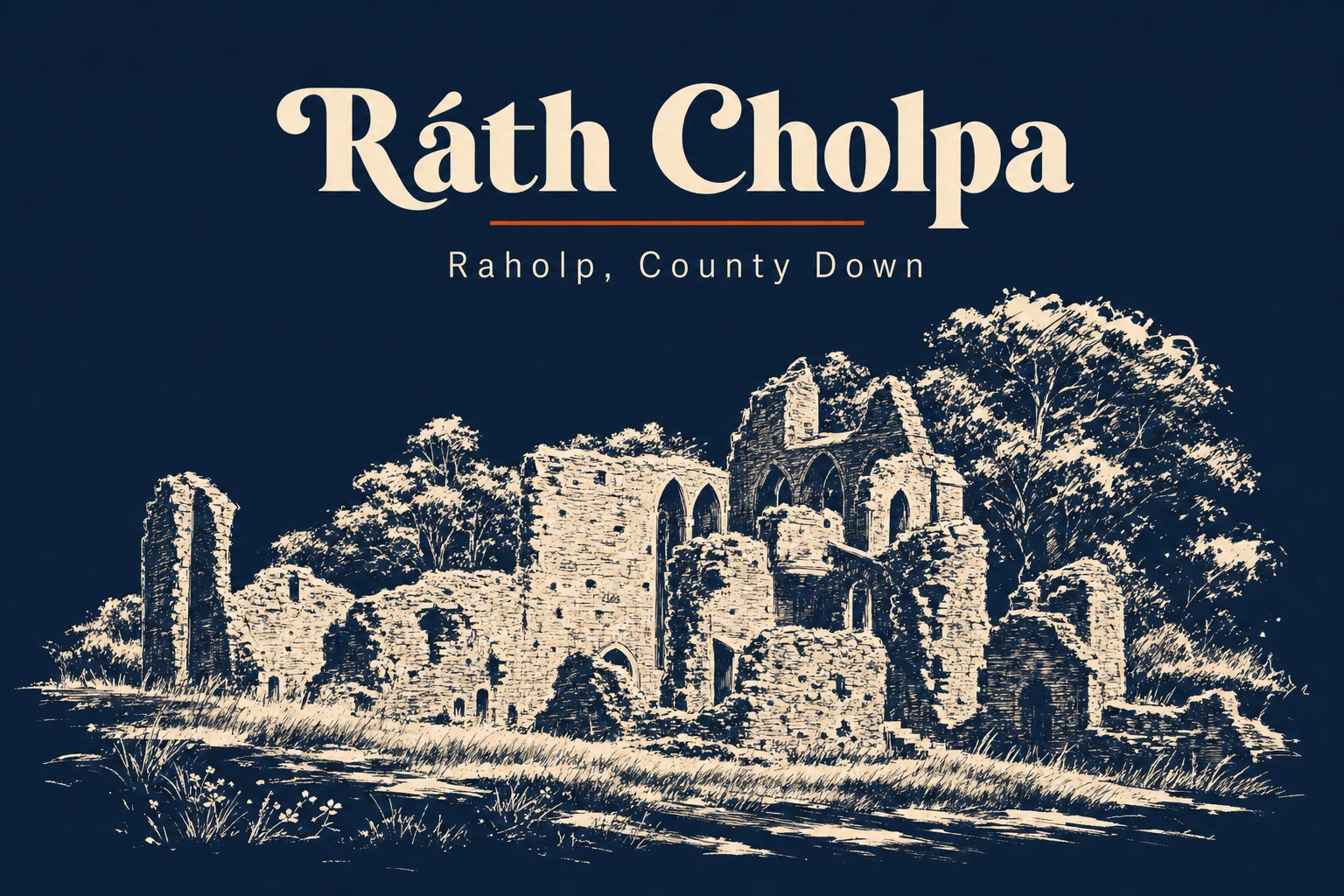
Raholp is a townland and a hamlet a few miles north-east of Downpatrick, in Ballyculter parish, in the old barony of Lecale. The name in Irish is Ráth Cholpa — Cholpa's ring-fort — and the ch- got swallowed somewhere along the way into English. There is no village centre in the usual sense. There is a road, a few houses, a graveyard, and the ruin of a sixth-century church in a field. The point of stopping is the church.

The church is St Tassach's. Tassach was one of Patrick's first disciples and the artisan of the early Irish church — the man who made the crosiers and chalices and shrines for the foundations Patrick scattered across the north. When Patrick founded a church at Raholp he placed Tassach in charge of it. The story everyone knows about Tassach is the one from the Martyrology of Donegal: he was sent for as Patrick lay dying at Saul two miles south, and he gave the apostle the viaticum — the body of Christ before death. Then he came home, ran the church here until around 497, and was buried beside it.

The building you see today is a small rectangular shale structure, originally bound with clay rather than mortar, sitting on a rock platform revetted to the east. It was a ruin by 1622 and stayed that way for three centuries. In 1915 the antiquarian F.J. Bigger paid out of his own pocket for the restoration that gave it the present doorways and the stone altar — a Belfast solicitor's idea of how an early Irish church should look, with enough actual fabric left to keep it honest. The Department for Communities looks after it now. The gate is always open.

Don't make a journey of Raholp on its own. Pair it with Saul two miles south — where Patrick landed and where he died — and Downpatrick four miles west, where he is said to be buried beside Brigid and Columba in the cathedral grounds. The three places together make the whole Lecale chapter of the Patrick story. Raholp is the middle piece, the quiet one. It is also the only one of the three where you stand a real chance of being alone with it.
Population
Hamlet — a few hundred in the townland and surrounds
Walk score
A road, a church ruin, a graveyard — fifteen minutes end to end
Founded
Church of Raholp founded by St Patrick, 5th century
Coords
54.3556° N, 5.6500° W
01 / 06

At a glance.

Three things every local will eventually mention. Read these and you've already understood more than most day-trippers do.

02 / 06

Stories & lore.

The reason to come back. The things every local will eventually tell you about, usually after the second pint.

Tassach at Saul, AD 461

The viaticum

The Martyrology of Donegal carries the line that does the work: "Tassach of Raholp gave the Body of Christ to Saint Patrick before his death in the monastery of Saul." Patrick had spent thirty years moving across the north and had come back to Saul, where he had landed in 432, to die. Tassach was sent for. The viaticum — literally "provision for the journey" — is the last sacrament given to the dying. Tassach gave it. That single act is why a tiny ruined church four miles north-east of Downpatrick is on the Saint Patrick's Way pilgrim path today.

Patrick's craftsman

The artificer

Tassach was not primarily a preacher. He was a craftsman — what the old sources call an artificer. He made crosiers, patens, chalices, credence tables, shrines and crosses for the churches Patrick founded across Ulster. The metalwork that survives from the very earliest Irish church is mostly gone or reduced to fragments, but the names of the workshops survive in the lives of the saints. Raholp was Tassach's workshop. Patrick put him here because he needed the things Tassach made, and because the harbour at the mouth of the Slaney was close enough for the goods to move.

F.J. Bigger, 1915

The ruin and the restorer

The church was reported ruined in 1622 and stayed that way for three hundred years. Francis Joseph Bigger — Belfast solicitor, antiquarian, Gaelic revival enthusiast, restorer of half the early monuments in east Ulster — paid for the present restoration out of his own pocket in or around 1915. The west doorway with the inclining jambs and the stone altar inside are his work, built around what was left of the medieval fabric. Part of the structure is thought to be Anglo-Norman, which puts it in a small group of very early church buildings in County Down. In 1989 Ken Neill of the Historic Monuments and Buildings Branch excavated the site. The Department for Communities took over from there.

Saint Patrick's Way

The pilgrim path

The waymarked Saint Patrick's Way loops the Lecale countryside through the places associated with the saint — Downpatrick, Inch Abbey, Saul, Struell Wells, Slieve Patrick, and Raholp. The Raholp stop is the quietest of the lot. You can walk to it from Saul along the country lanes in about an hour, or drive and park at the gate. There is no visitor centre, no shop, no signage beyond the heritage board. The point of the place is that it has been like this for a very long time.

03 / 06

Things to do outside.

Wear waterproofs. Bring a sandwich. Tell someone where you're going if it's the mountain.

St Tassach's Church grounds Walk in the gate, around the ruin, into the small graveyard that wraps it, and back out. The interpretation panel is brief and honest. Look at the inclining jambs of the west door and the incised crosses on the east lintel — the two pieces of detail that survive in legible form.
~300 mdistance
20 mintime
Saint Patrick's Way — Saul to Raholp The pilgrim path runs the country lanes between Saul and Raholp. Quiet roads, hedge-banks, the southern flank of Slieve Patrick visible behind you for most of it. Do it from Saul Church to St Tassach's and you have the dying-and-anointing chapter of the story in the right order.
~3 km one waydistance
1 hourtime
Down to the Strangford shore From the hamlet, take the lane east toward the lough. The shoreline of Strangford on this side is mudflat and saltmarsh — quiet, birdy, low. Not a beach walk in any tourist sense. A good place to understand why Patrick landed where he did.
~2 km returndistance
40 mintime
04 / 06

When to go.

There is no bad time. There are different times.

Spring
Mar–May

April 14th is St Tassach's feast day — almost no one marks it, which is part of the appeal. St Patrick's Day in March brings traffic to Saul and Downpatrick; Raholp stays quiet even then.

◉ Go
Summer
Jun–Aug

Long evenings make the lane walk from Saul pleasant, and the church grounds are at their best in dry weather. The first Sunday of June is the Slieve Patrick pilgrimage — Raholp itself remains uncrowded.

◉ Go
Autumn
Sep–Oct

Low light through the east window, leaves on the graveyard floor, and the shoreline at its quietest. The best season to have the place to yourself.

◉ Go
Winter
Nov–Feb

The site is exposed and the lanes get the worst of the Strangford weather. There is no shelter at the church. Bring a coat that means it; check the road conditions if there has been frost.

◐ Mind yourself
05 / 06

What to skip.

Honestly? Don't bother.

If a local was sitting beside you, this is the bit where they'd lean in.

×
Treating Raholp as a destination on its own

It is a ruin in a field and a graveyard around it. Twenty minutes of looking. Pair it with Saul, Down Cathedral and Struell Wells and you have a proper Patrick day.

×
Expecting a pub, a shop, or a tearoom

There isn't one in the hamlet. The nearest pint is at Paddy's Barn in Saul, two miles south, or in Strangford or Downpatrick. Bring a flask if you want a hot drink at the church.

×
Looking for the original 6th-century building

What you see is largely F.J. Bigger's 1915 restoration sitting on medieval foundations. The doorways and altar are his. The site and a portion of the wall fabric are old; the legible building is not. Read the heritage panel before you make your mind up about it.

+

Getting there.

By car

Raholp is about 6 km north-east of Downpatrick, signed off the road toward Strangford. Saul is two miles south on the same back-lanes network. Free parking at the church gate; the lane is narrow, so leave room for tractors.

By bus

No direct bus to Raholp. Translink Ulsterbus services run Belfast–Downpatrick (215, 16) and Downpatrick–Strangford (16E); from either drop-off it is a country-road walk or a short taxi.

By train

No train. The nearest line is the Belfast–Bangor service well to the north. Drive or bus from Downpatrick.

By air

George Best Belfast City (BHD) is about 50 minutes by car. Belfast International (BFS) is 70 minutes. Dublin Airport is 1h 40m down the M1.