County Dublin Ireland · Co. Dublin · Balrothery Save · Share
POSTED FROM
BALROTHERY
CO. DUBLIN · IE

Balrothery
Baile an Ridire, Co. Dublin

The Ireland's Ancient East
STOP 07 / 07
Baile an Ridire · Co. Dublin

A 500-year-old church tower in the middle of a small north Fingal village, and a pub licensed since 1656. You could drive past both. You shouldn't.

Balrothery takes its name from the Irish Baile an Ridire - the Town of the Knight - a reference to Robert de Rosel, an ally of Strongbow, who was granted the land around 1171 and, the record says, built the town and castle here. The place gave its name to two of the old baronies of County Dublin, Balrothery East and Balrothery West, administrative units born out of the Norman conquest and now long obsolete. The village sits on the R132, the old N1 Dublin to Belfast road, about two kilometres south of Balbriggan and twenty north of Dublin city.

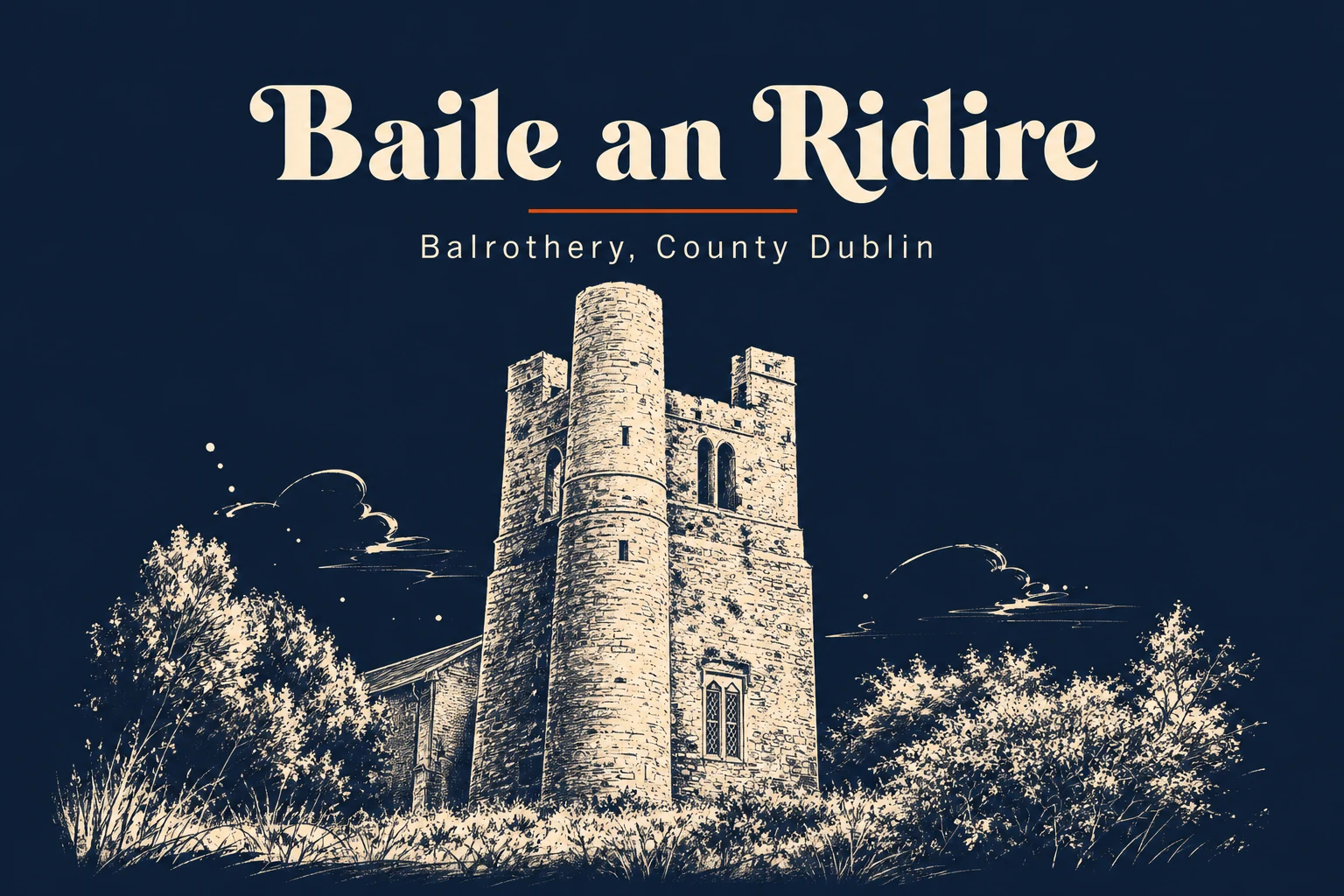
The landmark is the tower. The three-stage western tower of St Peter's church dates to around 1500 and stands at the southern edge of the village, the dominant thing on a flat stretch of north Dublin where dominant things are rare. The church attached to it was rebuilt in 1810, served the Church of Ireland, and has since been deconsecrated and turned over to the Balrothery Heritage Centre. Inside there are displays on the village's Bronze Age, Viking and Norman layers, narrow stone stairs up the tower stages, and a churchyard of cut-stone markers outside. It is free, small, and well done. Half an hour does it.

The village is not trying to be more than it is. There is one pub, the Balrothery Inn, and it earns its keep - licensed since 1656, a former coach house on the old Drogheda road, run now by the McCormick brothers as seventh-generation publicans. Beyond that, Balrothery is a base, not a destination: Balbriggan and the coast ten minutes north, Bremore Castle near the harbour there, Ardgillan Castle and its gardens a short drive toward Skerries, and the Rogerstown Estuary birdwatching south of Donabate. Build it into a north Fingal loop and give it the hour it deserves.
Population
2,282 (2022 census)
Walk score
Round the village on foot in ten minutes
Founded
Anglo-Norman grant to Robert de Rosel, c. 1171
Coords
53.6000° N, 6.1833° W
01 / 07

At a glance.

Three things every local will eventually mention. Read these and you've already understood more than most day-trippers do.

02 / 07

The pubs.

None of these are themed Irish pubs, because they don't need to be. A few that earn the trip:

The Balrothery Inn

Old coach house, family-run
Village pub, on the R132

The one pub in the village, and a good one. Licensed since 1656, when it was a coach house serving travellers on the Dublin to Drogheda road, which makes it one of the oldest licensed houses in Ireland. The McCormick brothers run it as seventh-generation publicans. Recently refitted with custom timber and a hint of gothic, but the bones are genuinely old. Food and a fire. If you stop in Balrothery for one thing besides the tower, it is this.

03 / 07

Stories & lore.

The reason to come back. The things every local will eventually tell you about, usually after the second pint.

c.1500, still standing

St Peter's Tower and the Heritage Centre

There was a church dedicated to St Peter here in the medieval period, described by an 18th-century visitor as a church of extraordinary construction. What survives of the old fabric is the western tower - a single-bay, three-stage structure of coursed rubble limestone with a circular stair turret at its north-west corner, dated to around 1500. The church beside it was rebuilt in 1810 as a Church of Ireland parish church and is now deconsecrated, run as the Balrothery Heritage Centre. The ground floor carries displays on the Bronze Age, Viking and Norman history of the village; narrow stone stairs climb the tower stages. The churchyard outside holds cut-stone grave markers and a small Commonwealth war-graves plot. Admission is free and the whole visit takes about half an hour.

Iron Age and early medieval Fingal underground

Rosepark and the souterrains

Excavations at Rosepark, on the edge of the village, uncovered an Iron Age defended enclosure and seven souterrains - the dry-stone underground passages and chambers that early medieval farmers built for storage and refuge. Before Rosepark was dug, just four souterrains were known in the whole of County Dublin; this one site more than doubled the county's record. The chambers are not open to the public and there is little to see above ground, but it is the reason the Heritage Centre can talk with a straight face about the depth of the village's past. It goes back a long way before the Normans turned up.

Mikey Graham and Anne Cassin

Two from a small village

For a village of a couple of thousand people, Balrothery has put two reasonably familiar faces into Irish public life. Mikey Graham, one fifth of Boyzone, the boy band that sold records by the lorryload across the 1990s, is from here. So is Anne Cassin, the RTE news presenter and broadcaster. Neither fact will change your visit, but it is the sort of thing a local will mention to you in the Inn, and it is true, which is more than can be said for a lot of village folklore.

04 / 07

Things to do outside.

Wear waterproofs. Bring a sandwich. Tell someone where you're going if it's the mountain.

The village and the tower There is not much of a walk inside Balrothery itself - that is the honest size of the place. Start at the church tower and Heritage Centre at the southern edge, walk the few streets, and you have seen the village in half an hour. Pair it with the centre being open and it is a complete morning stop.
1 km loopdistance
30 minutestime
Bremore Castle, Balbriggan Two kilometres north at Balbriggan harbour, a restored 15th-century tower house with its manorial chapel. Community-restored and worth the look. Combine with the harbour and the strand at Balbriggan for a proper north Fingal coastal hour.
Short drive then a strolldistance
1 hourtime
Ardgillan Castle demesne A short drive toward Skerries. A demesne with a walled garden, woodland trails and lawns running down toward the sea, and one of the better coastal views in north Dublin from the high ground. Free to walk the grounds; the house and garden have their own hours.
Several marked trailsdistance
1-2 hourstime
05 / 07

When to go.

There is no bad time. There are different times.

Spring
Mar-May

A good time to walk Balrothery into Balbriggan and the coast. The Heritage Centre is open through most of the year.

◉ Go
Summer
Jun-Aug

Flat farmland, coast and Ardgillan a few minutes away, long evenings. Easy on a good day.

◉ Go
Autumn
Sep-Oct

North Fingal is quietly good in autumn and the tower looks well in low flat light.

◉ Go
Winter
Nov-Feb

The Heritage Centre may run reduced hours. Check before you travel. The Inn keeps going regardless.

◐ Mind yourself
06 / 07

What to skip.

Honestly? Don't bother.

If a local was sitting beside you, this is the bit where they'd lean in.

×
A full day here

Balrothery rewards an hour, not a day. The tower is the thing, the Inn is the other, and Balbriggan, Ardgillan and the coast are minutes away. Build it into a bigger north Fingal loop.

×
Expecting a levelled medieval church

Older accounts say the medieval church was demolished. In fact the c.1500 tower survives and is attached to an 1810 church that still stands and houses the Heritage Centre. The medieval fabric you can actually touch is the tower.

×
A crawl of village pubs

There is one pub in the village now, the Balrothery Inn. Older photos record two others long gone. Do not arrive expecting a session of stops - arrive expecting one very old, very good one.

+

Getting there.

By car

Balrothery is on the R132, about 2 km south of Balbriggan and roughly 20 km north of Dublin city centre. From the M1, exit at Balbriggan and follow the R132 south into the village. Free parking near the Heritage Centre and at Rosepark.

By bus

Dublin Bus routes 33, 33A and 33X (Dublin to Balbriggan) serve the village. Around 70 minutes from the city centre depending on traffic.

By train

Balbriggan station, 2 km north, is on the Northern Commuter line from Dublin Connolly - walk or taxi from there. Donabate DART station is about 6 km south.