County Meath Ireland · Co. Meath · Gormanston Save · Share
POSTED FROM
GORMANSTON
CO. MEATH · IE

Gormanston
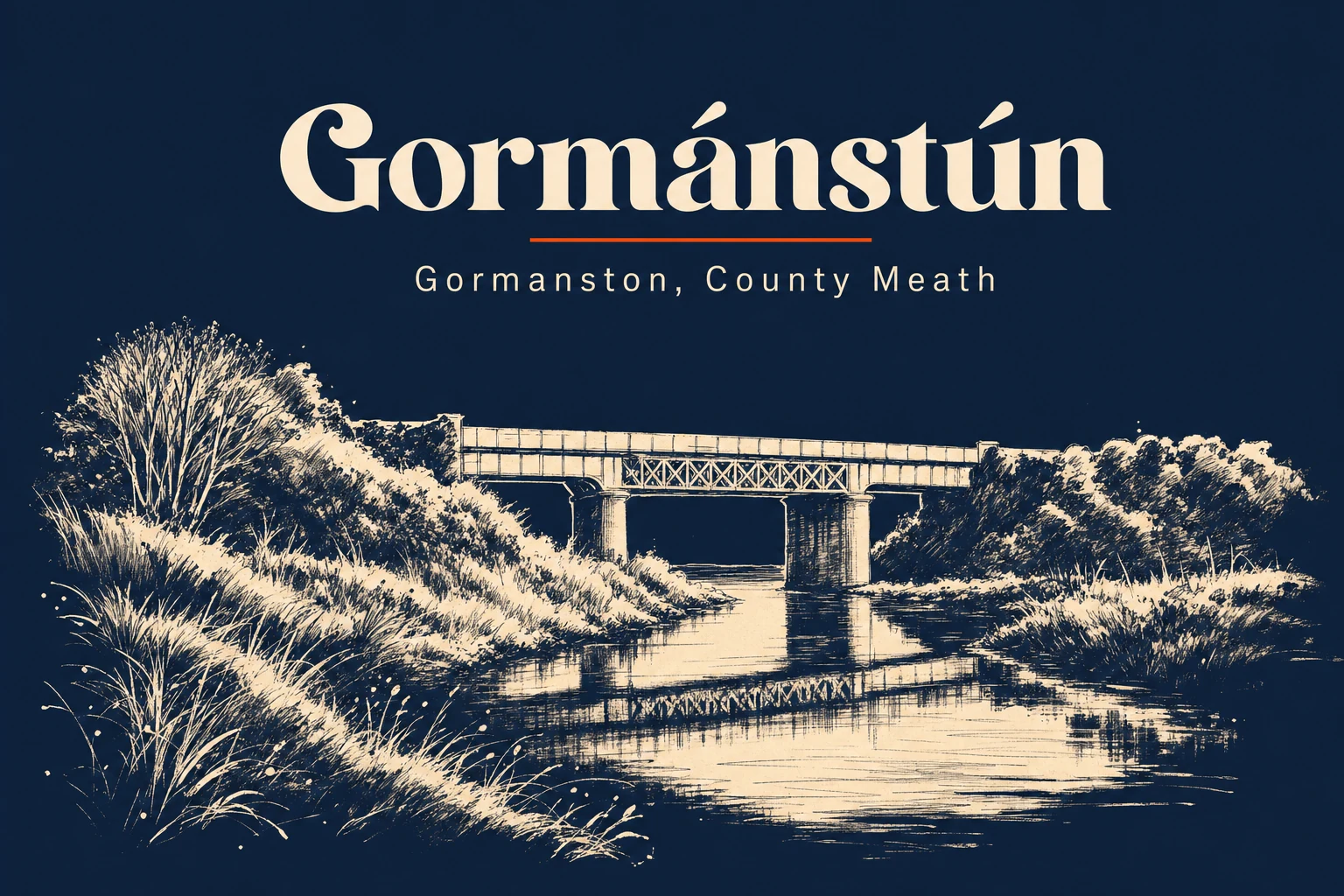
Gormánstún, Co. Meath

The Ireland's Ancient East
STOP 07 / 07
Gormánstún · Co. Meath

A castle the Prestons held for six centuries, an army aerodrome, and a beach where the first polo match in Ireland was played.

Gormanston is a castle, a school, an army camp and a beach, strung along a road near the spot where the River Delvin runs into the Irish Sea. The Delvin is also the county boundary, so the village sits right on the Meath edge of Dublin. Four hundred and thirty-three people at the last count. Most of them you will not see, because the place reads as estate wall, level crossing and shore rather than as a street of houses.

The Prestons made it. They held the land from the 14th century to the 1950s and the head of the family is still styled Viscount Gormanston, the premier Viscount of Ireland - a Catholic title that survived the Reformation, the Cromwellian settlement and the Penal Laws when most did not. The castle on the demesne is a 1786 rebuild on a site fortified in 1372. When the Prestons finally sold up, the Franciscan friars bought the estate and opened a boys' boarding school in the grounds, Gormanston College, which is still there under Franciscan administration.

The other Gormanston is military. The aerodrome on the flat coastal land started as a Royal Flying Corps training depot in 1917, became a permanent Air Corps base in 1945, and is still held by the Defence Forces as a firing range and training ground. So the village has two big walled institutions - the friars on one side, the army on the other - and a small commuter station on the Dublin-Belfast line between them.

Come for the strand and the strangeness rather than for a day out. There is a beach, a level crossing, a pub, and a great deal of history packed into not much ground. The 1870 polo match, the foxes who are said to gather when a Viscount is dying, the refugee families of 1970 - Gormanston has more stories than it has streets.
Population
433 (2022)
Pubs
1and counting
Founded
Castle 1786 on a 1372 site; College from the 1950s
Coords
53.6394° N, 6.2336° W
01 / 07

At a glance.

Three things every local will eventually mention. Read these and you've already understood more than most day-trippers do.

02 / 07

The pubs.

None of these are themed Irish pubs, because they don't need to be. A few that earn the trip:

Gibney's

Country pub, carved interior, sport and live music
Traditional pub & food, on the R132

The Gibney family took over the old Huntsman in 2008 and it is the social centre of a village that does not have many other rooms. Bar food, sport on the screens, live music, a big car park and outdoor seating, and an ornate interior with finely carved woodwork - and, fittingly for Gormanston, a stuffed fox in a glass case. About ten kilometres up the road from Dublin Airport, which makes it a handy first or last pint in Ireland.

03 / 07

Stories & lore.

The reason to come back. The things every local will eventually tell you about, usually after the second pint.

Viscounts Gormanston, premier Viscount of Ireland

The Prestons and the foxes

The Preston family held Gormanston from the 14th century until the 1950s, and the head of the line is still Viscount Gormanston, the premier Viscount of Ireland. They held onto the estate as a Catholic family through the Reformation, the Cromwellian land settlement and the Penal Laws, which almost nobody managed. The estate carries one of the better Irish family legends: that foxes gather and keep vigil at the castle when the head of the family is dying. The New Ireland Review printed the tale in April 1908. Gibney's pub in the village keeps a stuffed fox in a case, which is either coincidence or a long memory.

1786, then the Franciscans

Castle to college

The present Gormanston Castle was built in 1786 on a site that had been castled since 1372. It looks more Gothic and Victorian than its date, because that is the look the long 19th century wanted of a castle. When the Prestons sold the estate in the 1950s, the Franciscan Order of Friars bought it and founded a boys' boarding school in the grounds. Gormanston College opened and has run ever since, latterly under Franciscan administration with Meath education involvement. The castle that housed one Catholic family for six hundred years became a Catholic school for everyone else's sons.

RFC 1917, Air Corps 1945, refugees 1970

The aerodrome

The flat coastal land at Gormanston has carried an airfield since 1917, when the Royal Flying Corps put a training depot here in the First World War. The Irish Air Corps occupied it permanently from 1945; No. 1 Fighter Squadron flew Hawker Hurricanes off it during the Emergency and Supermarine Spitfires after the war, until the fighters moved to Baldonnel in 1956. The airfield was officially closed in 2002 but the Defence Forces still use the ranges for air-to-ground firing and training. In 1969 and 1970, as the Troubles drove families south, the army turned the camp huts into a refugee centre - an RTE Seven Days report in January 1970 counted 81 people from 18 families living there.

The Bremore-Gormanston group

The Delvin passage graves

On either side of the mouth of the River Delvin sits a cluster of passage graves known as the Bremore-Gormanston group. Archaeologists read them as among the earliest of their kind in Ireland - a possible landfall of the passage-grave builders coming up the coast, and a precursor to the great cluster later raised at Newgrange in the Boyne Valley inland. They are low, weathered and almost entirely unvisited, which is its own recommendation. Local legend, never one to undersell a shoreline, also lands both Saint Patrick and Oliver Cromwell on this stretch of coast.

Gormanston Strand, 1870

The first polo in Ireland

In 1870 the 9th Lancers, a cavalry regiment then quartered in Ireland, played what is recorded as the first authenticated game of polo in the country on Gormanston Strand. The beach is wide and flat at low tide, which is exactly what a cavalry regiment wanting to knock a ball about on horseback would look for. It is a small thing, but it is the kind of fact that explains a place: a garrison shore, near a great house, on the edge of the Pale, where the empire came to play.

04 / 07

Things to do outside.

Wear waterproofs. Bring a sandwich. Tell someone where you're going if it's the mountain.

Gormanston Strand The sandy beach runs north from the mouth of the River Delvin. Wide and flat at low tide - the strand the 9th Lancers played polo on in 1870. The Delvin is the Meath-Dublin county line, so a walk south along the sand takes you out of one county and into the next without a sign to tell you. Quiet, exposed, good for a blow of sea air rather than a swim.
2-4 km returndistance
45 min to 1 hourtime
River Delvin and the passage graves The Bremore-Gormanston passage graves sit on either side of the Delvin mouth. They are low and overgrown and there is no visitor centre, no car park and no signage to speak of - this is field archaeology, not a heritage site. Wear boots, mind the railway line and the private land, and treat it as a curiosity rather than a destination.
Short, on foot near the shoredistance
30-45 minutestime
05 / 07

When to go.

There is no bad time. There are different times.

Spring
Mar-May

The strand is at its best in clear spring light, the demesne trees come into leaf, and the coast is quiet before the summer day-trippers.

◉ Go
Summer
Jun-Aug

Longest days and the warmest the sea ever gets. Still never crowded - this is not a resort beach, just a local one.

◉ Go
Autumn
Sep-Oct

Fine on a settled day, but the east coast catches the first of the autumn weather and the strand turns bleak fast when the wind comes in off the Irish Sea.

◐ Mind yourself
Winter
Nov-Feb

Short, raw and exposed. The pub keeps going and the trains keep running, but there is little reason to stand on the beach in January unless you like that sort of thing.

◐ Mind yourself
06 / 07

What to skip.

Honestly? Don't bother.

If a local was sitting beside you, this is the bit where they'd lean in.

×
Expecting to tour the castle or the college

Gormanston College is a working school on private grounds and the castle is part of it. You can read about it and see it from the road, but it is not a visitor attraction. Do not turn up at the gate expecting a guided tour.

×
Looking for a village to wander

There is no real street to stroll. Gormanston is an estate wall, a station, a pub and a shore strung along a road. The interest is in the history and the beach, not in a town centre, because there is not one.

×
The camp

Gormanston Camp is a live Defence Forces firing range and training ground. It is fenced, signed and not open to the public. Admire the history from outside the wire.

+

Getting there.

By car

Off the R132, the old N1, between Balbriggan and Drogheda. From Dublin, about 35-45 minutes north via the M1 (junction 7 for Stamullen, then east) and the R132. Dublin Airport is roughly 10 km south.

By bus

Bus Eireann and local services run the Dublin-Drogheda corridor on the R132 near the village. Check current timetables, as rural stops vary.

By train

Gormanston railway station opened in May 1845 and is on the Dublin-Belfast line. Commuter services run between Dublin and Drogheda, roughly 40-50 minutes into Dublin Connolly.