County Meath Ireland · Co. Meath · Bettystown Save · Share
POSTED FROM
BETTYSTOWN
CO. MEATH · IE

Bettystown
Baile an Bhiataigh, Co. Meath

The Ireland's Ancient East
STOP 09 / 09
Baile an Bhiataigh · Co. Meath

A holiday strand on the east Meath coast where, in 1850, children digging in the sand turned up the finest brooch in early-medieval Ireland.

Bettystown is a seaside village on the east coast of Meath, sitting on a five-kilometre run of sand between the Nanny estuary at Laytown and the mouth of the Boyne at Mornington. It runs straight into Laytown to the south - the two are really one settlement, and the census counts them together with Mornington and Donacarney as a single urban area of 15,642 people. The beach is the whole point. Long, flat, hard sand at low water, the sea a fair walk out, the Cooley hills and the Mournes across the bay on a clear day.

In 1850 children digging on this strand turned up a small brooch: eighth-century gilt silver, set with glass, amber and enamel, the filigree work as fine as anything that survives from early-medieval Ireland. A Dublin jeweller bought it and called it the Tara Brooch to shift replicas during the Celtic Revival, though it has nothing to do with the Hill of Tara. It sits in the National Museum in Dublin now, and the beach that produced it is none the richer for it. Some scholars reckon it was actually found inland and the beach story was invented to dodge a landowner's claim. Either way, Bettystown wears the name.

Beyond the brooch, this is a working holiday village rather than a heritage town. It was a Dublin summer resort for generations - caravan parks, amusements, day-trippers off the train - and the Celtic Tiger turned it into a commuter belt for people driving or training to the city. Reddans of Bettystown, also trading as Neptune Beach, has anchored the Coast Road for well over a century and is the main place to eat, drink and sleep. There is a links golf club, a long beach, and not a great deal else. That is not a complaint. It is what a seaside village is for.
Population
~6,000 (part of the 15,642 Laytown-Bettystown-Mornington-Donacarney urban area, 2022 census)
Walk score
Five kilometres of sand between the Nanny and the Boyne
Founded
Seaside resort village; Tara Brooch found on the strand 1850
Coords
53.7014° N, 6.2461° W
01 / 09

At a glance.

Three things every local will eventually mention. Read these and you've already understood more than most day-trippers do.

02 / 09

The pubs.

None of these are themed Irish pubs, because they don't need to be. A few that earn the trip:

Reddans of Bettystown (Neptune Bar)

Seafront local, the village hub
Bar, Coast Road

On the Coast Road facing the sea, also long known as Neptune Beach. The bar has been on this spot for well over a century. The Neptune Bar runs live music with local players several nights a week and puts the sport on the big screens. It is the social anchor of the village - food, drink and rooms all under the one roof.

03 / 09

Where to eat.

PlaceTypeLocal note
Reddans of Bettystown Bar & restaurant, Coast Road €€ Food served daily from morning to evening - carvery on Sundays and Mondays, weekend specials, the usual bar-and-restaurant range. Sea views from the front. The reliable feed in the village and the one most visitors end up at.
Relish Cafe & restaurant, Coast Road €€ On the Coast Road in the heart of the village, well established and well regarded locally. Irish and European menu, vegetarian options, casual. The alternative to Reddans when you want a coffee or a lighter plate by the strand.
04 / 09

Where to sleep.

PlaceTypeLocal note
Reddans of Bettystown Boutique B&B, Coast Road Luxury bed and breakfast above the bar and restaurant, facing the sea on the Coast Road, with deluxe sea-view suites. The same building has welcomed visitors for over 140 years. Walking distance to the beach because it is on the beach. The obvious bed in the village; book the room with the sea view.
05 / 09

Stories & lore.

The reason to come back. The things every local will eventually tell you about, usually after the second pint.

1850, the strand

The Tara Brooch

In 1850 a brooch was found on the beach at Bettystown - by tradition, by the children of a local woman digging in the sand. It is gilt silver, cast and decorated with panels of gold filigree, amber studs, glass and enamel, and it dates to the late seventh or early eighth century. It is one of the finest pieces of insular metalwork that survives. A Dublin jeweller, George Waterhouse, bought it and named it the "Tara Brooch" to trade on the romance of the ancient royal site and sell replicas through the Celtic Revival - the brooch has no link to Tara at all. Some historians believe it was found further inland and the beach was named instead to stop a landowner claiming it under treasure-trove law. It is now in the National Museum of Ireland in Dublin. There is nothing to see on the beach. The whole value of the place to a visitor is that the thing came out of ordinary sand.

Mornington, the Boyne mouth

The Maiden Tower and the Lady's Finger

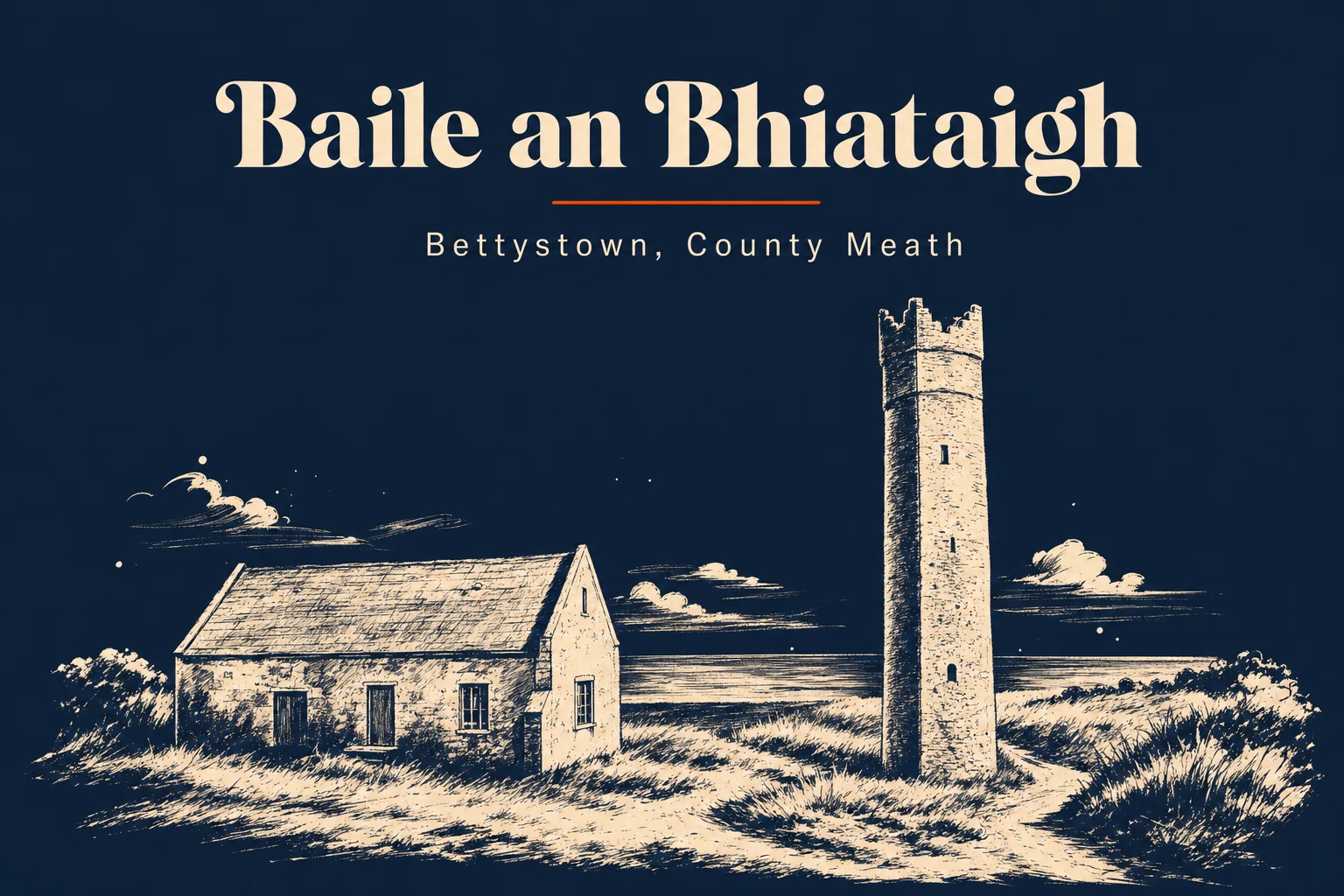
Walk the strand north to where the Boyne meets the sea at Mornington and you reach two strange markers standing in the dunes. The Maiden Tower is a square stone watchtower about eighteen metres tall, built in the late sixteenth century - it is recorded by 1582, in Elizabeth I's reign - as a daymark to guide ships up the river to Drogheda. Beside it is a smaller pillar, perhaps four metres, called the Lady's Finger. Local legend has the tower built by a woman waiting on her lover's ship, with a white flag agreed for safe return and red for disaster; the rest of the story ends the way those stories always do. The pair are the crest of the local golf club and the most photographed thing on this coast.

Holiday Dublin by the sea

A railway resort

The Dublin and Drogheda Railway opened a station at Bettystown itself in May 1844, though it closed within a few years. The line stayed, and the surviving station down the road at Laytown - renamed Laytown and Bettystown in 1913 - put the strand within easy reach of Dublin. For a century this was where the city came for sea air: caravan parks, amusement arcades, day-trippers on the train. The Celtic Tiger then rebuilt it as a commuter suburb, and the holiday village and the dormitory town now sit on top of each other. The National Sandcastle Championship has run on the beach since 2003, a direct descendant of the old resort summers.

06 / 09

Things to do outside.

Wear waterproofs. Bring a sandwich. Tell someone where you're going if it's the mountain.

Bettystown to Mornington and the Maiden Tower Park at Bettystown and walk north along the hard sand toward the Boyne estuary. This is the quieter end of the strand. At Mornington you reach the Maiden Tower and the Lady's Finger standing in the dunes, and the river mouth where the Boyne finally meets the sea. Time it for low water so the sand is firm and wide. The Cooley and Mourne hills sit across the bay.
5 km returndistance
1.5 hourstime
Bettystown to Laytown along the strand South along the beach toward the Nanny estuary and Laytown. Flat, easy, popular with dog walkers and families. This is the stretch the Laytown beach races run on every September. The two villages join at the sand - you will not notice where one ends.
3 km returndistance
1 hourtime
07 / 09

When to go.

There is no bad time. There are different times.

Spring
Mar-May

The strand is clean and quiet, the light is long over the bay, and the golf links is at its best. Waders work the Boyne and Nanny estuaries. Cold water still, but the walking is hard to beat.

◉ Go
Summer
Jun-Aug

The Dublin holiday crowd returns. Warm enough to swim, the beach busy on a fine weekend, the National Sandcastle Championship somewhere in the calendar. Book a table at Reddans ahead on a Saturday evening.

◐ Mind yourself
Autumn
Sep-Oct

Probably the best stretch. Low golden light, emptying beaches, and the Laytown beach races run on the sand next door in early September. Then the quiet comes back.

◉ Go
Winter
Nov-Feb

Grey sea, hard wind off the Irish Sea, storms rolling up the strand. The bar keeps going and the beach walk is bracing if you dress for it. Most of the village is locals only.

◐ Mind yourself
08 / 09

What to skip.

Honestly? Don't bother.

If a local was sitting beside you, this is the bit where they'd lean in.

×
Coming to see the Tara Brooch

It is not here. It has been in the National Museum of Ireland in Dublin since the nineteenth century, and there is nothing on the beach to mark where it was found. Come for the strand and the story, not the object. The object is on Kildare Street.

×
Funtasia

The indoor family entertainment centre that older guides list as the big Bettystown attraction was shut down around 2024. Do not drive the family out expecting bowling and a waterpark. Check before you rely on it.

×
Treating Bettystown as a heritage town

It is a holiday strand and a commuter village, not a medieval town like Trim or Drogheda up the road. The draw is sand, sea and a good walk to a tower. Set your expectations there and it delivers; arrive looking for old streets and you will be disappointed.

+

Getting there.

By car

Dublin to Bettystown is about 45 minutes on the M1, exiting near Julianstown and following the R150 coast road. Drogheda is fifteen minutes north.

By bus

Bus Eireann route D1 links Bettystown with Laytown and Drogheda. Reddans advertises an hourly bus service to Dublin.

By train

No station in Bettystown today - the original 1844 station closed within a few years. The nearest is Laytown (the line was renamed Laytown and Bettystown in 1913), on the Dublin-Drogheda-Belfast commuter line, a few minutes south.