County Fermanagh Ireland · Co. Fermanagh · Florencecourt Save · Share
POSTED FROM
FLORENCECOURT
CO. FERMANAGH · IE

Florencecourt
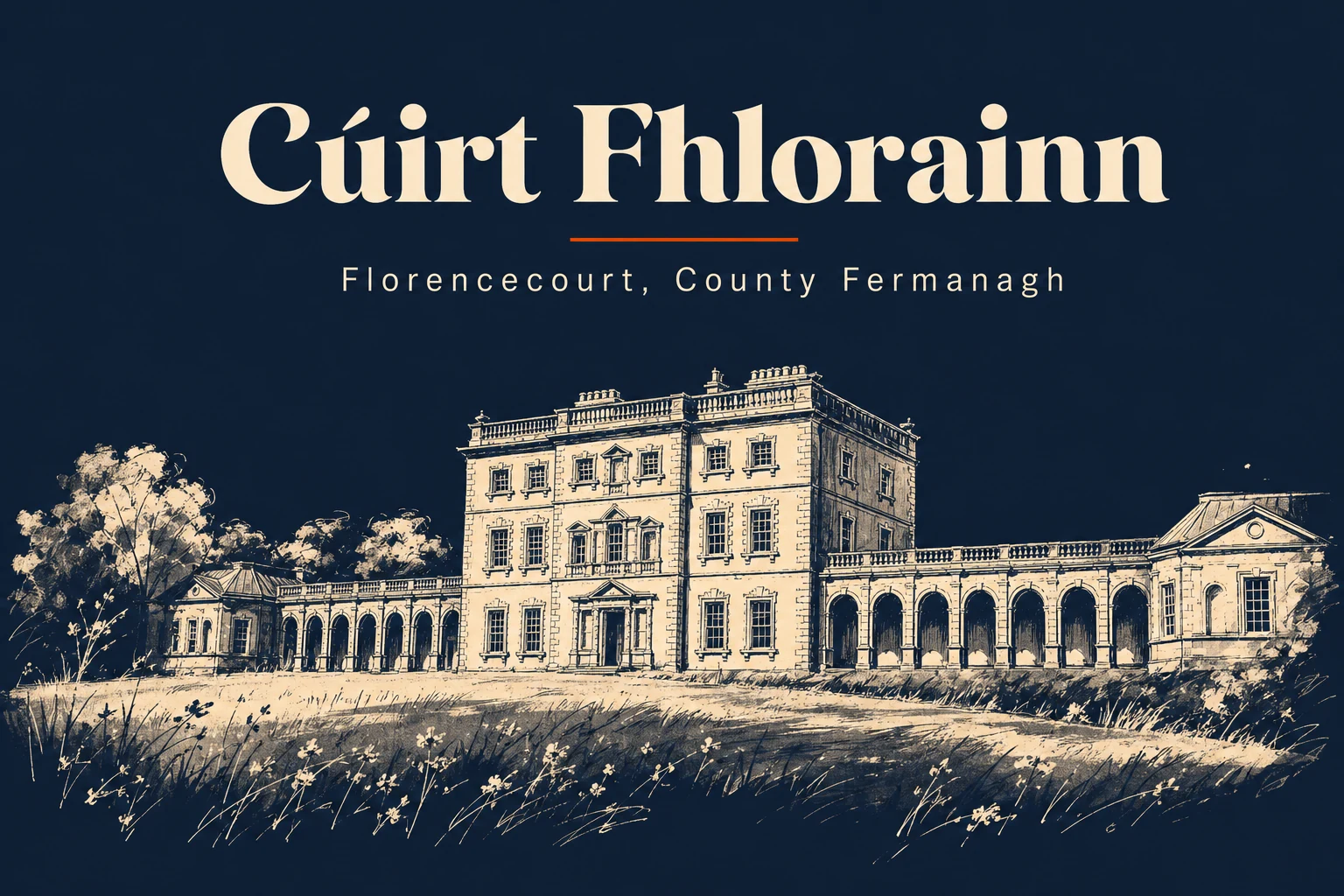
Cúirt Fhlorainn, Co. Fermanagh

The Ireland's Hidden Heartlands
STOP 07 / 07
Cúirt Fhlorainn · Co. Fermanagh

A Palladian mansion, a tree that fathered every Irish yew on earth, and a cave system underneath the mountain behind it.

Florencecourt is not really a village in any conventional sense. It is an estate settlement - a hamlet of perhaps a hundred people that exists because a large house required staff, and staff required houses. The big house is the reason the place has a name at all. The National Trust runs it now, and on the days it is open you can walk through the Rococo plasterwork of the dining room, look at the walled garden, and then walk a mile down a quiet path to see the most botanically significant tree in Ireland.

The house takes its name from Florence Bourchier Wrey, wife of John Cole, who built the first structure on the site around 1710. The current Palladian mansion was completed in phases - the central block finished by 1764, when Cole's son, Lord Mount Florence, held a housewarming that was apparently memorable enough to date the building by. The colonnades and pavilions came later still, around 1771. In 1955 a fire destroyed much of the upper floors. The National Trust restored what it could. Some upper rooms remain closed.

A mile or so southeast of the house, within the site of John Cole's original 18th-century gardens, stands the Florence Court Yew - the original Irish yew from which all others descend. Two saplings were found in 1767 by local farmer George Willis on the slopes of Cuilcagh Mountain. He brought both to Florence Court. One survives. The Irish yew (Taxus baccata 'Fastigiata') can only be reproduced by cuttings, not by seed - which means every fastigiate yew in every churchyard and country house garden across Ireland and Britain and beyond is a genetic copy of this tree. It stands, unremarkably, in an overgrown former rock garden, with no particular fuss made of it.

Five kilometres away, the Marble Arch Caves have been drawing visitors since May 1985. The French speleologist Édouard-Alfred Martel explored the passages first, in 1895, by canvas boat and magnesium flares. The system runs for 11.5 km underground - the longest cave in Northern Ireland - and the rivers that feed it drain off Cuilcagh Mountain, the same mountain where George Willis found the yew. It became part of a UNESCO Global Geopark in 2004. Above it, the Cuilcagh boardwalk trail climbs 666 metres to the summit. The local topography has a way of layering significance without drawing attention to itself.
Population
~102
Founded
Estate house c.1710-1764
Coords
54.2610° N, 7.7273° W
01 / 07

At a glance.

Three things every local will eventually mention. Read these and you've already understood more than most day-trippers do.

02 / 07

Where to sleep.

PlaceTypeLocal note
Rose Cottage, Florence Court Walled Garden Self-catering (National Trust) The 1870s Rose Cottage on the western edge of the walled garden was formerly the head gardener's dwelling. Restored from a derelict condition in the 1990s, it is now let by the National Trust as a holiday cottage. You are inside the demesne. The walled garden is outside your door.
03 / 07

Stories & lore.

The reason to come back. The things every local will eventually tell you about, usually after the second pint.

The tree and its global descendants

The Florence Court Yew

In 1767, local farmer George Willis found two small upright yews growing on Cuilcagh Mountain and brought them back to Florence Court. Both were planted in the gardens. One died. The survivor - Taxus baccata 'Fastigiata', now known as the Irish yew - became the template for one of the most widely planted ornamental trees in the world. Because the fastigiate form of the Irish yew produces viable seed only rarely, and because seedlings do not reliably carry the upright habit, all propagation is done by cuttings. That means every Irish yew planted in every Victorian churchyard, country estate and municipal park from Cork to California is, botanically speaking, the same tree as this one. It stands about a mile southeast of the house, in what remains of the old rock garden, and it looks more or less like any old yew in an overgrown garden.

The woman the house is named after

Florence

John Cole (1680-1726) built the first house on this site and named it for his wife, Florence Bourchier Wrey, daughter of Sir Bourchier Wrey, 4th Baronet of Tawstock in Devon. Florence died in 1718 before any particularly grand structure had been completed - a 1718 account describes the house as 'very costly and sumptuous' while a 1739 visitor called it 'but small'. The central block of the house that stands today was completed, after much conjecture about architects and phases, by 1764 when Cole's son hosted his housewarming. The name Florence Court has remained across three centuries, four earls, a devastating fire, the Troubles, and a transfer to the National Trust. The woman who gave it the name never saw a house worth the naming.

The Cole family and 1955

The Earls and the fire

Florence Court was the seat of the Earls of Enniskillen from the late 18th century until 1973. The 5th Earl transferred the house to the National Trust in 1953 - a decision shaped by death duties, falling agricultural income, and the simple impossibility of maintaining such a house in post-war conditions. Two years later, on 22 March 1955, fire broke out in the early hours and by evening around two-thirds of the Florence Court interior lay in ruins. The dining room was saved by local builders who drilled six holes in the ceiling to drain water that had built up above. Two of those holes are still visible. Sir Albert Richardson led the restoration. The 6th Earl and his wife moved back in 1964 and left for Perthshire in 1973, at the beginning of the Troubles. The 7th Earl lives in Kenya. The house belongs to the Trust.

Canvas boat, magnesium flares

Marble Arch, 1895

The French speleologist Édouard-Alfred Martel and Dublin naturalist Lyster Jameson first explored the Marble Arch cave system in 1895, travelling by canvas boat on the underground Cladagh River with candles and magnesium flares. They mapped the passages and noted the confluence where three rivers meet beneath the mountain. Development into a show cave began in 1982, eighty-seven years after Martel's visit. The cave opened to the public on 29 May 1985. The tour still begins the same way - by boat. In 2001 the site became a European Geopark, and in 2004 it joined the UNESCO Global Network of National Geoparks. In 2008 the boundary was extended across the border into County Cavan, making it the world's first cross-border transnational geopark.

04 / 07

Things to do outside.

Wear waterproofs. Bring a sandwich. Tell someone where you're going if it's the mountain.

Florence Court Estate Walks The estate has a network of waymarked paths through the pleasure garden and demesne. The walk to the Florence Court Yew from the house is about a mile along a quiet path through the old garden. The walled garden and sawmill are accessible on foot from the car park. The Lady Well, a natural spring east of the house, is reachable by a short trail. Ground is generally flat and well-maintained. Check National Trust opening times before visiting.
Various - 1 to 5 kmdistance
30 min to 2 hourstime
Marble Arch Caves Show Cave Tour From Florencecourt, drive approximately 5 km towards the Marble Arch Caves Visitor Centre. Tours are guided and run regularly from March to September. The first section is by boat on the underground Cladagh River. Booking ahead is strongly recommended in summer - tours fill and annual capacity is managed. The visitor centre has a café.
c. 1.5 km undergrounddistance
1.5 hours (guided)time
Cuilcagh Boardwalk Trail The trailhead at Legnabrocky Car Park is adjacent to the Marble Arch Caves Visitor Centre. The route crosses open bog for 5 km, then climbs 450 wooden steps to a viewing gallery near the 666-metre summit - the highest point in both Fermanagh and Cavan. The boardwalk was built to protect the bog from erosion. Use it. The bog does not recover quickly.
12-14 km returndistance
3-4 hourstime
Florence Court Forest Park - Lady's Well Trail A short waymarked trail through the forest park east of the estate, leading to the Lady Well spring. Managed by the Forestry Service. Accessible year-round at no charge. The forest is predominantly larch and the trail is easy underfoot.
c. 2 kmdistance
45 mintime
05 / 07

When to go.

There is no bad time. There are different times.

Spring
Mar-May

Florence Court typically opens in spring. The walled garden rhododendrons are at their best in April and May. The caves re-open in March. Quiet, clear days and few other visitors.

◉ Go
Summer
Jun-Aug

The caves fill up and the Cuilcagh car park is under pressure at weekends. The house and gardens are open and at their best. Book the cave tour in advance and arrive early for the mountain.

◐ Mind yourself
Autumn
Sep-Oct

The caves close late September. The estate is quieter and the forest colour is excellent. The Cuilcagh walk is at its best in October.

◉ Go
Winter
Nov-Feb

The National Trust property operates reduced winter hours or closes entirely - check the NT website before travelling. The caves are closed. The forest trails and the walk to the yew tree are accessible year-round in good weather.

◐ Mind yourself
06 / 07

What to skip.

Honestly? Don't bother.

If a local was sitting beside you, this is the bit where they'd lean in.

×
The house when the National Trust is closed

Florence Court operates seasonal hours. It is not a ruin you can wander around freely - the gardens have access outside house-opening hours, but the interiors and much of the estate experience requires the NT to be open. Check dates on the National Trust website before you drive out.

×
Walking past the yew tree without stopping

It does not look like the most significant yew tree in the world. It looks like an old yew in an untidy garden. The significance is invisible unless you know what you are looking at. Read about it before you go.

×
Treating the caves as a quick detour

The Marble Arch tour is 1.5 hours minimum, guided, non-negotiable in pace. It is not a quick look-around. Allow half a day for the caves, more if you are adding the Cuilcagh walk. Both are worth the time; neither is worth rushing.

+

Getting there.

By car

Enniskillen to Florencecourt is 13 km southwest, around 20 minutes on the A4 and A32 roads. The house entrance is signed from the A32. For Marble Arch Caves, continue past the house a further 5 km towards Legnabrocky.

By bus

Translink Ulsterbus service 95 runs between Enniskillen and Florencecourt on a limited schedule. Check the Translink website for current timetables before relying on it - services to small villages in Fermanagh can be infrequent. A car is by far the most practical option.

By air

Belfast International (BFS) is around 1h 40m by car. Ireland West Airport Knock (NOC) is about 1h 30m. Neither is close.