County Fermanagh Ireland · Co. Fermanagh · Newtownbutler Save · Share
POSTED FROM
NEWTOWNBUTLER
CO. FERMANAGH · IE

Newtownbutler
An Baile Nua, Co. Fermanagh

The Ireland's Hidden Heartlands
STOP 08 / 08
An Baile Nua · Co. Fermanagh

A small border village where a famous battle was fought, a castle burned down by accident, and the oldest yew trees in Ireland are still standing.

Newtownbutler sits in the southeast corner of Fermanagh, close enough to the Cavan border that the county line feels like a suggestion rather than a fact. The village is small - a main street, two pubs, a few hundred people - and it does not make a fuss about itself. It has reason to, if it wanted to. A decisive battle was fought here in 1689. One of the most important conservation estates in Northern Ireland is a few kilometres up the road. The oldest yew trees you are ever likely to stand under grow beside a ruined castle on the lough shore.

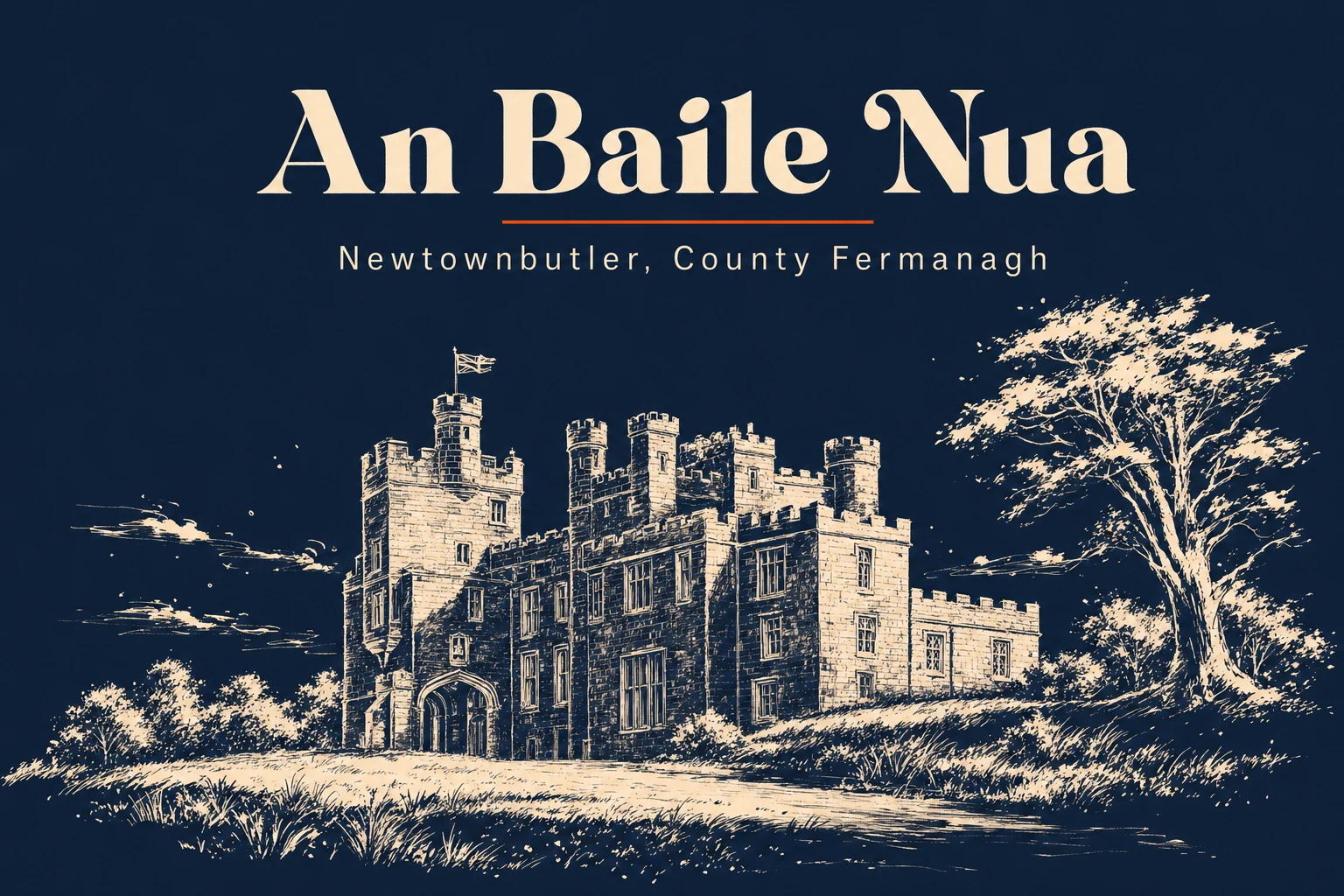
The Crom Estate is the real reason to come. The National Trust manages 2,000 acres of ancient woodland, islands and loughside trails that most of Fermanagh's visitors never reach because they stop at Enniskillen. The ruins of Old Crom Castle - a 1611 Plantation-era tower house that burned down when the owners were out at a party - stand beside those extraordinary yews, their canopy spread wide enough to shelter a dozen people. New Crom Castle, built in the 1830s for the Third Earl of Erne and still in private hands, looks out over the water from among the trees. You can walk past it but not through it.

The village itself rewards a slow hour. Mulligan's Railway Bar has been the social centre of the parish for as long as anyone can reliably say, and the Fermanagh Fleadh chose Newtownbutler as its 2025 host, which is not a coincidence - the traditional music scene here is stronger than the size of the place would suggest. Come for the estate, stay for the session, leave knowing something about a battle most people in Ireland couldn't place on a map.
Population
~972
Coords
54.1717° N, 7.3833° W
01 / 08

At a glance.

Three things every local will eventually mention. Read these and you've already understood more than most day-trippers do.

02 / 08

The pubs.

None of these are themed Irish pubs, because they don't need to be. A few that earn the trip:

Mulligan's Railway Bar

The parish local
Local pub

19-21 Main Street. The social hub of Newtownbutler, named for the old railway that no longer runs. Hosted traditional music sessions as part of the Fermanagh Fleadh 2025. The kind of pub that knows everyone's order before they reach the bar.

An Chead Chumann

GAA crowd, events
Sports bar

8-10 Main Street. The name translates roughly as The First Association - a nod to the GAA connection. Regularly hosts events and draws crowds from across the county. Sessions and live music on occasion.

03 / 08

Where to sleep.

PlaceTypeLocal note
Crom Holiday Cottages Self-catering (National Trust) Traditional stone farm buildings on the Crom Estate, converted into holiday cottages. Book through the National Trust. Waking up inside a 2,000-acre nature reserve on Upper Lough Erne is a different order of experience from a roadside B&B. Book well ahead - there are very few of them.
04 / 08

Stories & lore.

The reason to come back. The things every local will eventually tell you about, usually after the second pint.

31 July 1689

The Battle of Newtownbutler

The Williamite War in Ireland turned on a lot of moments, but this one is undersung. A Jacobite force of around 3,000 men under Viscount Mountcashel advanced on Enniskillen from the south. The Williamite defenders - Enniskilleners, as they were known, fighters loyal to William III drawn from the Protestant settler population of Fermanagh - met them south of the village with fewer troops and worse odds. The Jacobites were routed. Over 1,500 were killed; many drowned trying to cross Lough Erne to escape. Mountcashel himself was wounded and captured. The victory secured Fermanagh for the Williamite cause and ensured that when the Duke of Schomberg landed at Bangor the following month, no Jacobite army was in a position to stop him.

Built 1611, burned 1764

Old Crom Castle

Michael Balfour, a Scottish planter from Fife, built the original Crom Castle in 1611 as part of the Plantation of Ulster - a tower house with a bawn wall and round flankers for artillery, the standard defensive template of the era. It withstood two Jacobite attacks during the 1689 war. It survived a century and a half of Fermanagh weather. It was destroyed in 1764 not by siege or storm but by an accidental fire while the Crichton family, who had inherited the estate, were away at a housewarming party at Florence Court. Two towers, some walls and a ha-ha survive. The National Trust manages the site and you can walk to the ruins.

The 1830s house the Earls built

New Crom Castle

After the old castle burned, the family eventually commissioned a replacement. In the 1830s, John Crichton, 3rd Earl of Erne, hired Edward Blore - the English architect who also worked on Buckingham Palace - to design a castellated Tudor-Baronial mansion on a new site closer to the lough shore. The resulting New Crom Castle is still privately owned by the Erne family, is available for hire, and is not open for public tours. You can see it clearly from the estate walks and from the water. The National Trust was gifted the estate, but not the house, by the 6th Earl in 1987.

Among the oldest trees in Ireland

The Crom Yews

Close to the ruins of Old Crom Castle stand two yew trees - a male and a female - that have grown so close together over the centuries that their canopies have merged into one. Estimates of their age range from 800 to 1,000 years, though the earliest written record of them dates to 1739, when they were already described as venerable. Their combined spread is approximately 23 metres. They have been named among Britain's 50 greatest trees. Stand under them for long enough and the battle, the castle, the plantation, the earls - all of it starts to feel recent.

05 / 08

Things to do outside.

Wear waterproofs. Bring a sandwich. Tell someone where you're going if it's the mountain.

Crom Castle Walk The core walk on the estate, passing Old Crom Castle ruins, the great yew trees, and the loughside woodland. Maps available at the visitor centre. The Cygnet Tearoom near the entrance does tea, scones and light food - cash only.
c. 3 km loopdistance
1-2 hourstime
Crom Wildlife Walk A longer circuit through the ancient riparian woodland along Upper Lough Erne. Red squirrels, otters, pine martens and a good range of waterbirds if you move quietly. The estate has over 12 miles of waymarked trails in total - the National Trust website has full trail descriptions before you go.
c. 5 kmdistance
2 hourstime
Loughside Walk The quietest stretch of Upper Lough Erne you will find outside a boat. Flat, accessible, and good for birdwatching. Do it in the early morning when the light is on the water.
c. 2 kmdistance
45 mintime
06 / 08

When to go.

There is no bad time. There are different times.

Spring
Mar-May

Crom Estate opens from mid-March. Wildflowers in the woodland, waterbirds nesting on the lough islands, almost no one else on the trails. The yew trees look their best in low spring light.

◉ Go
Summer
Jun-Aug

Long evenings on the lough. The estate is at its busiest but still quiet compared with Fermanagh destinations further west. The Fermanagh Fleadh has been held in June - check dates, as the village fills up.

◉ Go
Autumn
Sep-Oct

The woodland turns. Oak and ash along the loughshore go gold and copper. Good fishing on Upper Lough Erne. The estate runs reduced hours from October - check nationaltrust.org.uk before travelling.

◉ Go
Winter
Nov-Feb

The visitor centre and tearoom close from November to mid-March. The grounds remain walkable but facilities are very limited. Worth it if you know what you are coming for - the ruins in frost are something - but plan accordingly.

◐ Mind yourself
07 / 08

What to skip.

Honestly? Don't bother.

If a local was sitting beside you, this is the bit where they'd lean in.

×
Arriving without checking estate opening times

The Crom visitor centre and tearoom close November to mid-March and keep reduced hours in shoulder season. The grounds may be open but the tearoom will not be. Check nationaltrust.org.uk before you drive out.

×
Expecting a food scene

Newtownbutler is a small village. The pubs are real and the welcome is genuine, but there is no restaurant, no café on the main street, and no brunch spot. Eat before you come or plan to use the Cygnet Tearoom at Crom - cash only, closes in winter.

×
Treating the battle site as a marked attraction

There is no monument, no visitor centre, no battlefield trail. The ground where 1,500 men died in an afternoon is ordinary farmland south of the village. It rewards knowing the history before you arrive, not after.

×
Trying to visit New Crom Castle

It is a private residence. You can see it from the estate walks and from the water, and it is worth seeing, but it is not open to the public. Several visitors turn up at the estate expecting a castle tour. The ruins you can walk to are the old one.

+

Getting there.

By car

Enniskillen to Newtownbutler is 18 miles on the A4 and A34 - about 22 minutes. From Clones in Monaghan it is 12 miles south across the border, under 20 minutes. The Crom Estate entrance is a further 3 km east of the village on the Crom road.

By bus

Ulsterbus route 95d runs between Enniskillen Bus Centre and Newtownbutler, five times a day Monday to Saturday, journey time about 33 minutes. No Sunday service. There is no bus to the Crom Estate - you need your own transport once in the village.