County Fermanagh Ireland · Co. Fermanagh · Tempo Save · Share
POSTED FROM
TEMPO
CO. FERMANAGH · IE

Tempo
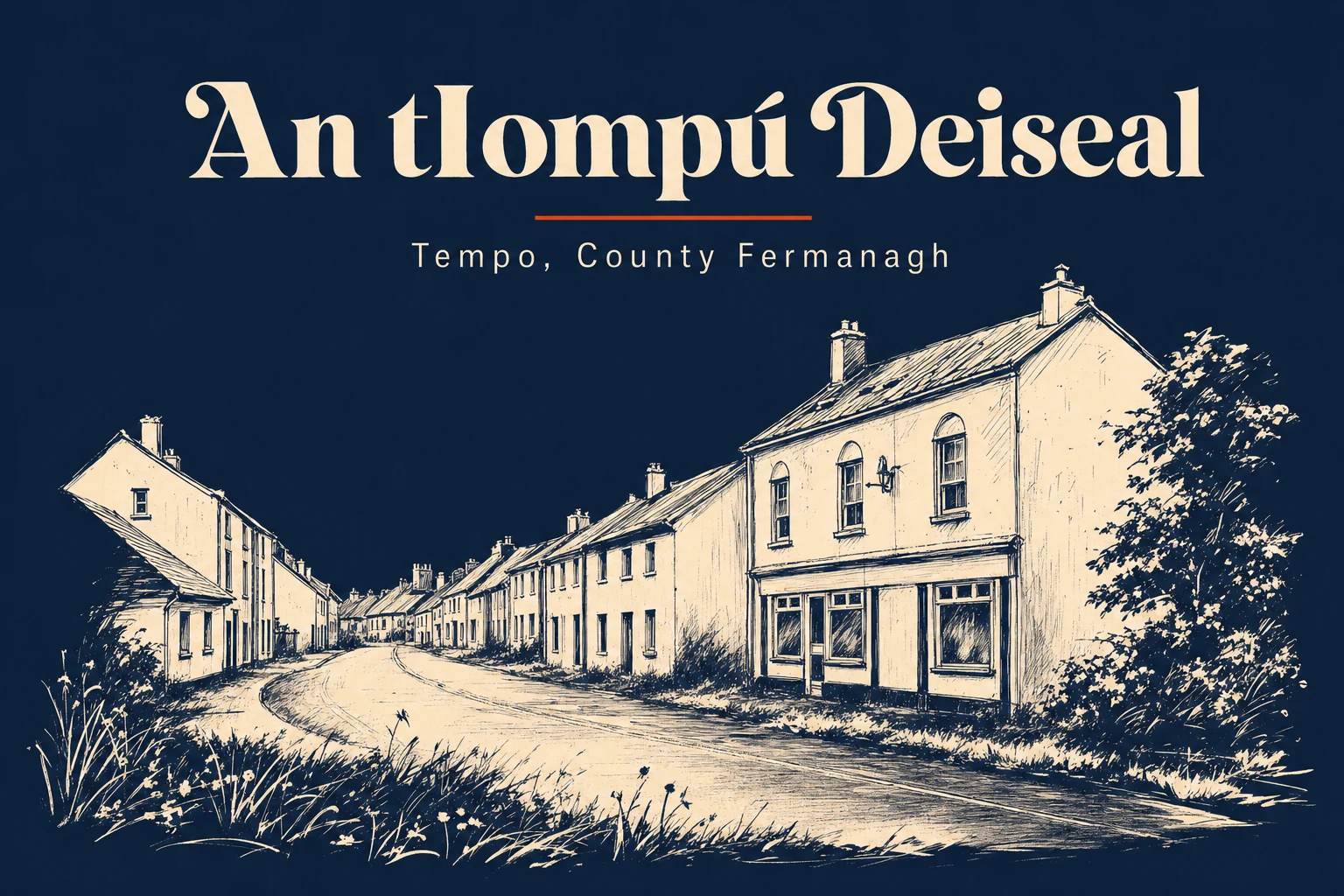
An tIompú Deiseal, Co. Fermanagh

The Ireland's Hidden Heartlands
STOP 06 / 06
An tIompú Deiseal · Co. Fermanagh

A drumlin crossroads east of Enniskillen, with a Victorian manor, a haunted pub, and a rebel birthplace all within walking distance.

Tempo sits in drumlin country about eight miles east of Enniskillen on the B80, at the foot of Brougher Mountain. The drumlins - those long, smoothed hills left by the last ice age - give this part of Fermanagh its particular look: a landscape of small hills and hollows, hedged fields, and roads that curve around things rather than cutting through them. The village is a working place with a Main Street, a handful of pubs, two primary schools, and a GAA ground that would not disgrace a county town.

What gives Tempo its depth is what you don't notice immediately. The manor at the south end of the village, raised to a Gothic design by Charles Lanyon in the early 1860s, was built for a family that had reinvented themselves across two generations - from Belfast bankers to Fermanagh baronets. The Emerson Tennents sold up through marriage, and the Langham baronets held the estate into the 21st century. The house and its 300-acre woods are still there, operating now as a private events venue rather than a seat of landed gentry. Its history is more interesting than its present, which is not unusual for such places.

Tempo also produced Terence Bellew MacManus, a man who left here as a young merchant, joined the 1848 rebellion in a Tipperary cabbage garden, was transported for life to Van Diemen's Land, escaped to California, and died in San Francisco without ever recovering his fortunes. His body was shipped back to Dublin and given one of the largest funeral processions the city had seen, organised by the Fenians as a political statement. Tempo does not make much of this. There is no plaque visible on the main street. The connection is there if you look for it.

Campbell's Bar on Main Street has been described as the most haunted pub in Fermanagh, a claim the Fermanagh News made in 1994 and which has not been seriously contested since. Charlie's Bar is the other Main Street option. Between the two of them and the GAA club up the road, the village has what a village of 458 people needs. No more, and no less.
Population
~458
Coords
54.3750° N, 7.5583° W
01 / 06

At a glance.

Three things every local will eventually mention. Read these and you've already understood more than most day-trippers do.

02 / 06

The pubs.

None of these are themed Irish pubs, because they don't need to be. A few that earn the trip:

Campbell's Bar

Old-school, turf fire, allegedly haunted
Village local

55-56 Main Street. The oldest pub in the village. Open fires in winter, a pint of Guinness that draws consistent praise, and a ghost story that the Fermanagh News ran as front-page material in 1994. The haunting reports are unverified. The Guinness is not.

Charlie's Bar

Cosy, jukebox, occasional live music
Village local

54 Main Street, formerly Kelly's Bar. Open fire, jukebox, and live music at weekends. Friendly and straightforward. The kind of place that does not require a reason to visit.

03 / 06

Stories & lore.

The reason to come back. The things every local will eventually tell you about, usually after the second pint.

The turning place

An tIompú Deiseal

The full Irish name of the village is An tIompú Deiseal - the right-hand turn, or more specifically the rightward (sunwise) turn. The name almost certainly derives from a natural feature: there is a pronounced bend in the Tempo River near the village, and deiseal (rightward, clockwise, sunwise) is a word loaded with old significance in Irish - turning right was the lucky, sacred direction. The more colourful explanation attributes the name to Saint Patrick, who is said to have passed through this part of Fermanagh and told a servant to turn right on the road back to retrieve a manuscript. The servant turned right. The place remembered it. The placenames researchers favour the river-bend reading, but the saint's manuscript makes a better story.

Lanyon, Emerson Tennent, and the Langham baronets

Tempo Manor

The estate at Tempo was acquired around 1815 by William Tennent, a Belfast banker. His son-in-law James - politician, traveller, and writer on Ceylon - had the present house built in 1862 and 1867 to the designs of Charles Lanyon, the architect who also built Queen's University Belfast and the Custom House. The result was a thirty-apartment Gothic manor in hammered sandstone, set in 300 acres of parkland. Sir James was created a baronet in 1867, two years before his death; the baronetcy passed to his son William, who died without a male heir. The estate passed through William's elder daughter, Ethel Sarah, who married Sir Herbert Langham, 13th Baronet, in 1893. The Langham baronets have held the connection since. Sir John Langham, 16th Baronet, is the current holder. The house stands today and operates as a wedding and events venue - the demesne still intact, if in different hands of purpose.

Born here, transported, and buried to a crowd of forty thousand

Terence Bellew MacManus

Terence Bellew MacManus was born in Tempo around 1811. As a young man he moved to Liverpool and became a successful shipping agent; in 1848 he returned to Ireland, joined the Young Irelander movement, and took part in the rebellion at Ballingarry, County Tipperary - a brief and unsuccessful rising that historians sometimes call the Battle of the Widow McCormack's Cabbage Garden. MacManus was convicted of treason, sentenced to death, then reprieved and transported for life to Van Diemen's Land. In 1852 he escaped and made his way to San Francisco, where he spent the remainder of his life unable to re-establish his career. He died in 1861 in poverty. The Fenians organised his repatriation and funeral as a deliberate political demonstration: his coffin was carried through Dublin before a crowd estimated at forty thousand, with forty thousand more watching from Abbey Street. Father Patrick Lavelle gave the oration. The man who left Tempo as an unknown merchant was buried at Glasnevin as a nationalist icon. There is, as far as can be confirmed, no memorial to him in the village of his birth.

The club that took the lords' name

Tempo Maguires

The GAA club was affiliated in 1929, taking the name Maguires to honour the old Gaelic dynasty who ruled Fermanagh from the 13th century until the Ulster Plantation of 1609. St Patrick's Park - the club's ground - was officially opened in 1957, with a crowd reported at four thousand people for a Fermanagh village with fewer than a thousand residents. The club won its first Fermanagh Senior Football Championship in 1970, retained it in 1972 and 1973, and won again in 2012. A 400-seat spectator stand, floodlit training pitches, a gym, and a community walkway followed over subsequent decades. The Irish name on the club's crest is CLG Mhic Uidhir, An tIompú Deiseal - the GAA's MacUidheir and the placename together, which is a tighter compression of the village's history than most tourist boards manage.

04 / 06

When to go.

There is no bad time. There are different times.

Spring
Mar-May

Drumlin country in spring light is at its best - the green is very green, the roads are quiet. A good time to be driving the B80 between Enniskillen and the Monaghan border.

◉ Go
Summer
Jun-Aug

Not a tourist destination, so summer does not overwhelm it. Long evenings and football at St Patrick's Park. Brougher Mountain is walkable if the cloud lifts.

◉ Go
Autumn
Sep-Oct

The woods of Tempo Manor demesne are worth a look from the road in October. The county championship finishes in autumn. The pubs are at their best on a wet evening.

◉ Go
Winter
Nov-Feb

Nothing closes - this is not a seasonal village - but there is little to hold you beyond the pub fires and the quiet. Enniskillen is eight miles away and has more going on.

◐ Mind yourself
05 / 06

What to skip.

Honestly? Don't bother.

If a local was sitting beside you, this is the bit where they'd lean in.

×
Expecting to tour Tempo Manor

The house and demesne are a private events venue, not a heritage attraction. The grounds are not open for casual visits. View from the road and move on.

×
Looking for a food scene

Tempo has two pubs and a SPAR. There is no café, no restaurant, nothing farm-to-table. Enniskillen is eight miles west and has restaurants. This is an honest village and not pretending otherwise.

×
Hunting for a plaque to Terence MacManus

One has not been confirmed on Main Street. The connection is real - he was born here - but Tempo has not made it a visitor attraction. The Glasnevin Trust in Dublin has more on him than the village does.

+

Getting there.

By car

Enniskillen is 8 miles (13 km) west on the B80. Lisnaskea is about 9 miles south. The Monaghan border is roughly 10 miles east. There is no bypass; the B80 is the village street.

By bus

Translink Ulsterbus services link Tempo to Enniskillen. Check the Translink journey planner for current timetables; services are infrequent on this route.

By train

No railway serves Tempo. The nearest operating rail connection is via Enniskillen direction bus to Clones or cross-border services. For practical purposes, a car is required.