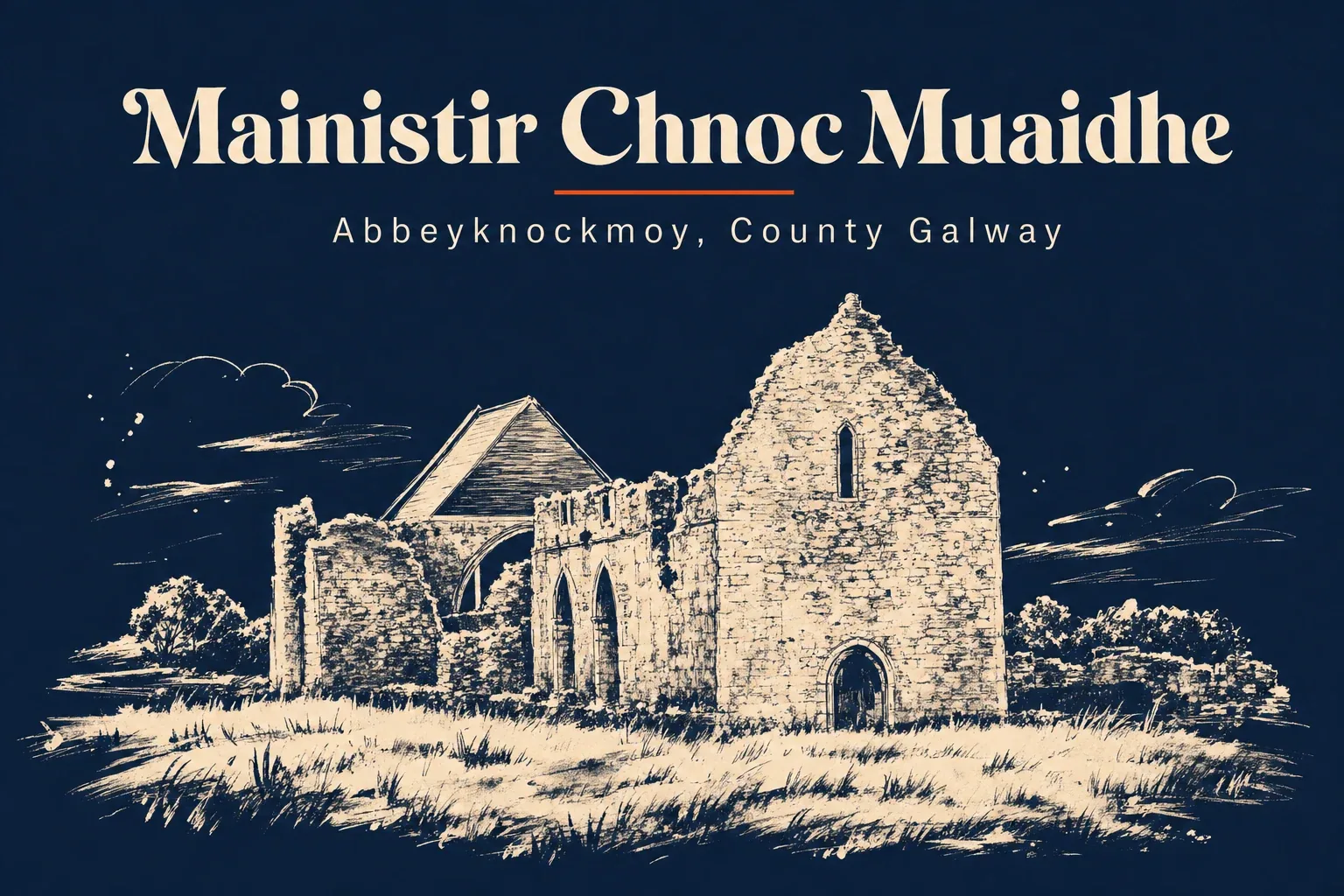
Mainistir Chnoc Muaidhe · Co. Galway
A Cistercian abbey ruin with medieval paintings of Irish kings on the wall.
Abbeyknockmoy is a Cistercian abbey founded in 1189 by Cathal Crobhdearg Ua Conchobair, King of Connacht. It sits on the northern bank of the River Abbert in the east Galway countryside, about a kilometre from the small village of the same name. The abbey is now a ruin. The church still stands. The domestic buildings are mostly rubble. The reason you come here is the medieval wall-paintings inside the chancel.
The paintings are tempera - egg and pigment, mixed and applied to dry plaster - not fresco, which is applied to wet plaster. This is an important distinction because true fresco is extremely rare in medieval Ireland. Knockmoy has one of only four medieval tempera artworks on the island. The paintings depict Irish kings: Roderic O'Conor is recognizable in the centre. There is also a scene of the death of Mac Murrough's son. The work dates to the early medieval period, though the exact century is debated. Long exposed to the elements, the Office of Public Works weatherproofed the segment of the abbey which houses them in the 1980s, and the paintings have survived.
The abbey itself is worth walking through: the chancel with its rib-vaulted ceiling, the nave where the laybrothers worshipped, the narrow transepts to the north and south, each with its own side chapels. The chapter room, the refectory (where the monks ate in silence while someone read aloud), the kitchens. The cloister is now a burial ground. The monastery is claustral in layout - the buildings arranged around a central courtyard - which was standard for Cistercian houses of this period. The buildings you see date mostly from the early thirteenth century, with later repairs and additions in the fifteenth and sixteenth centuries. In 1542, following the dissolution of the monasteries, the abbot surrendered the abbey to Henry VIII. What you see now is what was left after.