Cora Finne · Co. Galway
A small north Galway parish with a ruined de Burgh castle and a Gaelic football club that has won the whole of Ireland five times.
Corofin is a small parish village in north Galway, on the N17 about nine kilometres south of Tuam and roughly twenty north of Galway city. The 2022 census counted 745 people. It sits in old Kilmoylan, in the barony of Clare, at a crossing of the river that gave the place its name - Cora Finne, the weir of the white one. There was a market and a fair here in the medieval period because the crossing mattered. Most of what matters now is the land and the football.
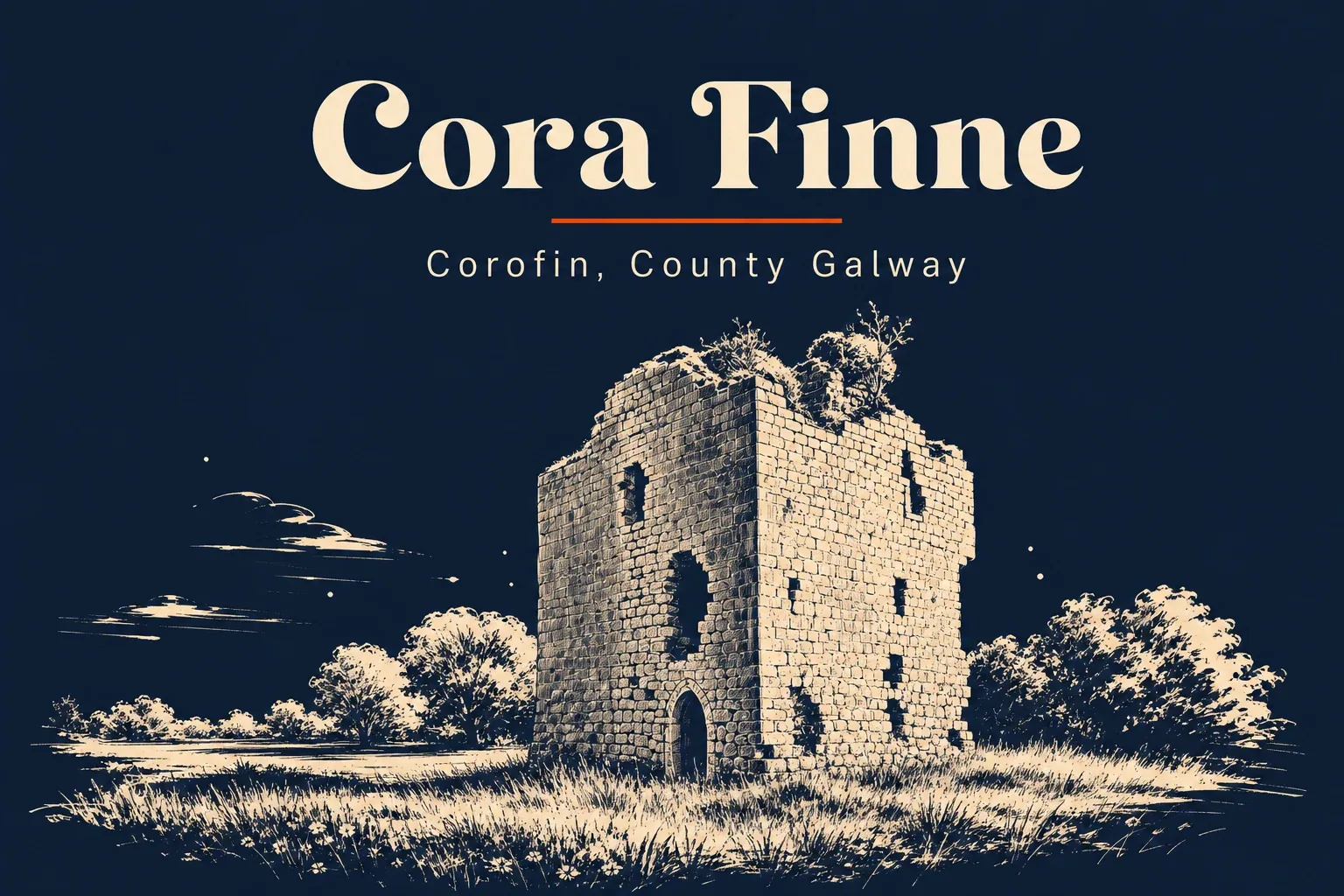
The de Burghs built a castle here. Richard de Burgh, Lord Clanricarde, put up a four-storey tower house in 1451 to hold the country against the native clans. It was damaged by fire in 1599 and captured during the Confederate Wars in 1652, and it has been falling down quietly ever since. It stands just outside the village, on private land, so the honest version is that you look at it from the road and let the landowner keep their privacy unless you have asked. There was an older, deeper layer too - a 2006 excavation turned up fifty-one skeletons inside what looks like an early Christian burial enclosure, the kind of find that tells you people have been living and dying on this ground for a very long time.
But if Corofin is known for one thing beyond the parish boundary, it is football. Corofin GAA, the Gaelic football club, has won the All-Ireland Senior Club Championship five times - 1998, 2015, 2018, 2019 and 2020, with the last three in a row. That is a haul that puts a village of a few hundred households among the greatest clubs in the history of the game. It produced inter-county players like Daithí Burke and Kieran Fitzgerald. On a championship Sunday the whole parish empties toward the pitch. This is not a marketing line. It is simply what the place is for.
Do not come to Corofin for a day out in the usual sense. There is no visitor centre, no heritage trail with brown signs, no row of cafes. There is the ruined castle, the parish church of St Colman built in the 1840s, Raftery's pub, the Centra with the post office, and a great deal of good farming country. If you want to understand the Ireland that does not perform for visitors - the Ireland of the parish, the club and the land - this is an honest place to look at it.