County Galway Ireland · Co. Galway · Kilconly Save · Share
POSTED FROM
KILCONLY
CO. GALWAY · IE

Kilconly
Cill Chonnla, Co. Galway

The North Galway
STOP 07 / 07
Cill Chonnla · Co. Galway

A farming parish on the Mayo border with a tower house two fields east and a prison reformer in its graveyard story.

Kilconly is a farming parish in the north of County Galway, in the old barony of Dunmore, about twelve kilometres north-west of Tuam on the R332 Ballinrobe road. It sits hard against the Mayo border, in good land broken by a long tract of bog, the kind of place the nineteenth-century gazetteers measured in statute acres and reclaimable wet ground rather than in anything you would call a town.

There is a village, just about: a church, a national school, a GAA pitch, a shop and a pub, strung along the road within a short walk of each other. Most people who live here are within five minutes of Tuam and thirty of Galway city, which is how a parish this size keeps its school open and its football team going. It is unspoilt because nothing ever spoiled it - it was never on the way to anywhere.

Do not come to Kilconly for a day out. Come if you are passing between Tuam and Ballinrobe and want to climb to a real tower house with nobody else there, or if you are chasing the thread of a quietly remarkable life. Park at the church. Walk the field road east toward Feartagar. That is the visit, and on the right grey afternoon it is enough.

Population
Small rural parish, a few hundred
Founded
Medieval parish (barony of Dunmore); church rebuilt 1830
Coords
53.5733° N, 8.9728° W
01 / 07

At a glance.

Three things every local will eventually mention. Read these and you've already understood more than most day-trippers do.

02 / 07

The pubs.

None of these are themed Irish pubs, because they don't need to be. A few that earn the trip:

The village pub

A country bar in a small parish
Local pub, Kilconly village

Kilconly has one pub within walking distance of the church and shop. It is a local's local in a parish of a few hundred, not a tourist house, and no source names it reliably here - so ask in the village, take it as you find it, and do not expect it open all hours on a quiet weekday.

03 / 07

Stories & lore.

The reason to come back. The things every local will eventually tell you about, usually after the second pint.

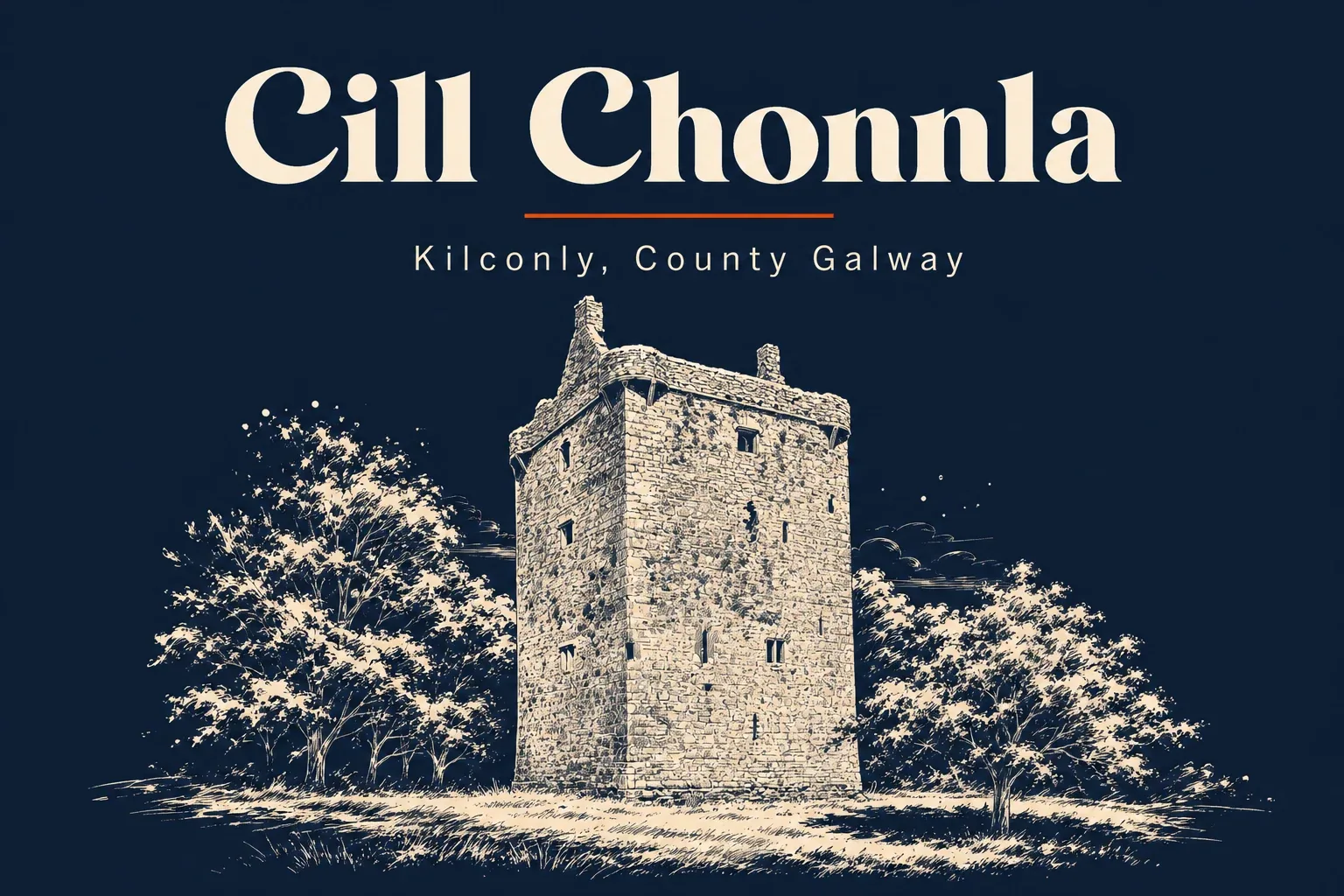
Caisleán Fheartagair - the Burkes' tower house

Feartagar Castle

Two and a bit kilometres east of the village, on a low hill near the River Nanny, stands Feartagar Castle - a five-storey tower house roughly twelve metres by ten at the base, built between the 15th and 17th centuries by the de Burgos. The Burkes, descended from the Anglo-Norman William de Burgh, ruled across Connacht for centuries before being dispossessed in the Cromwellian conquest of 1651; the castle later passed to the Blakes of Tuam, who built a since-vanished house alongside it. Locally it is called Jennings Castle, a name traced from Eoin, anglicised through John to Jennings. It keeps its corner bartizans, a machicolation over the door, a vaulted second floor and two stone stairs. It is a National Monument, reached by a short walk from the road - though it is sometimes locked against vandalism, and you may have to ask at the nearest house.

The Kilconly woman who reformed Holloway

Mary Size of Ratesh

Mary Size was born in 1883 in the townland of Ratesh in Kilconly and went to the local Tubberoe national school, then served as a monitor at Cloghan's Hill, intending to teach. Instead she joined the British prison service, starting her probation at Manchester's Strangeways in 1906. In 1927 she was appointed Deputy Governor of Holloway, the first woman to hold the post and the only woman in an equivalent role in the UK. Over the late 1920s and 1930s she pushed through reforms in England's women's prisons - mirrors and cosmetics allowed in cells, libraries expanded, censorship eased, and the first Catholic chapel at Holloway built in a disused ladder shed. She gifted a large window to the parish church at home in Kilconly. She died in 1959.

Chapel Road, rebuilt 1830

St Conleth's church

The Catholic church on Chapel Road takes its present shape from 1830, when a new building went up at a cost of around fifteen hundred pounds; the parish has long been united with neighbouring Kilbannon. The dedication is to Conleth, and the older form of the placename, Cill Chonnla or Cill Conaola, carries the same sense - a church of a Conla or Conleth. It is a working parish church, plainly built and still in use, with Mary Size's window among its furnishings.

St Benin's monastery, on the road back to Tuam

Kilbannon round tower

About seven kilometres south-east, on the way back toward Tuam at Kilbannon, stand the ruins of an early monastery founded by Benignus - St Benin, a disciple of Patrick said to have died in 467. The badly damaged limestone round tower, dated to the 10th century, still rises some sixteen and a half metres, with a Franciscan church of around 1428 and old crosses and slabs in the graveyard beside it. It is older than the cathedral town of Tuam down the road, and almost nobody stops.

04 / 07

Things to do outside.

Wear waterproofs. Bring a sandwich. Tell someone where you're going if it's the mountain.

The Feartagar field road From the church, east on the country roads toward the tower house on its hill near the River Nanny. The walk is the point - flat farming land, big sky, the castle growing as you come. The site is a short step off the road. Bring boots; the approach can be wet and the door is sometimes locked.
5 km returndistance
1 to 1.5 hourstime
Kilbannon round tower visit Off the Tuam road at Kilbannon, roughly seven kilometres south-east. A 10th-century round tower, a ruined Franciscan church and an old graveyard. Combine it with the run into Tuam rather than treating it as a destination of its own.
Short stop, near Tuamdistance
30 minutestime
05 / 07

When to go.

There is no bad time. There are different times.

Spring
Mar-May

Drier underfoot than winter, the land greening, the long field walk to Feartagar at its best before the grass gets high.

◉ Go
Summer
Jun-Aug

Longest days for the walk east and the easiest driving on the narrow roads. The GAA season is in full swing if you want a glimpse of parish life.

◉ Go
Autumn
Sep-Oct

Good light on the tower house and quiet roads. The wet starts to come back in late October, so go earlier in the window.

◉ Go
Winter
Nov-Feb

Short days, soft ground and bog underfoot. The castle approach can be a mire and there is little shelter. Fine for a quick stop off the Tuam-Ballinrobe road, less so for the walk.

◐ Mind yourself
06 / 07

What to skip.

Honestly? Don't bother.

If a local was sitting beside you, this is the bit where they'd lean in.

×
A day trip to Kilconly itself

This is a working farming parish, not a destination. The honest visit is an hour: the church, the walk east to Feartagar, maybe Kilbannon on the way out. Base yourself in Tuam or Galway and treat Kilconly as a detour, not a stop in its own right.

×
Expecting Feartagar Castle to be open

It is a National Monument reached by a short walk, but it is sometimes locked against vandalism. Do not drive out assuming you will get inside the tower. The setting and the exterior are the reliable reward; interior access may mean asking at the nearest house.

×
Confusing Kilconly with Kilbannon

They are different places. Kilconly is the parish near the Mayo border with the church and the castle; Kilbannon, closer to Tuam, has the round tower and St Benin's monastery. The parishes are linked, the sites are not in the same village.

+

Getting there.

By car

From Tuam, take the R332 Ballinrobe road north-west for about 12 km; Kilconly is roughly a five-minute drive once you turn off. Galway city is about thirty minutes south. The last turns are minor country roads and easy to miss.

By bus

No direct village service. The nearest bus and rail hub is Tuam; Local Link covers parts of rural north Galway. Check current Local Link timetables before relying on it.

By train

Nearest station is Tuam, on the Western Rail Corridor line; from there it is a short drive north-west by car or taxi.

By air

Ireland West Airport Knock is about forty-five minutes north. Shannon and Dublin are the bigger options for international arrivals.