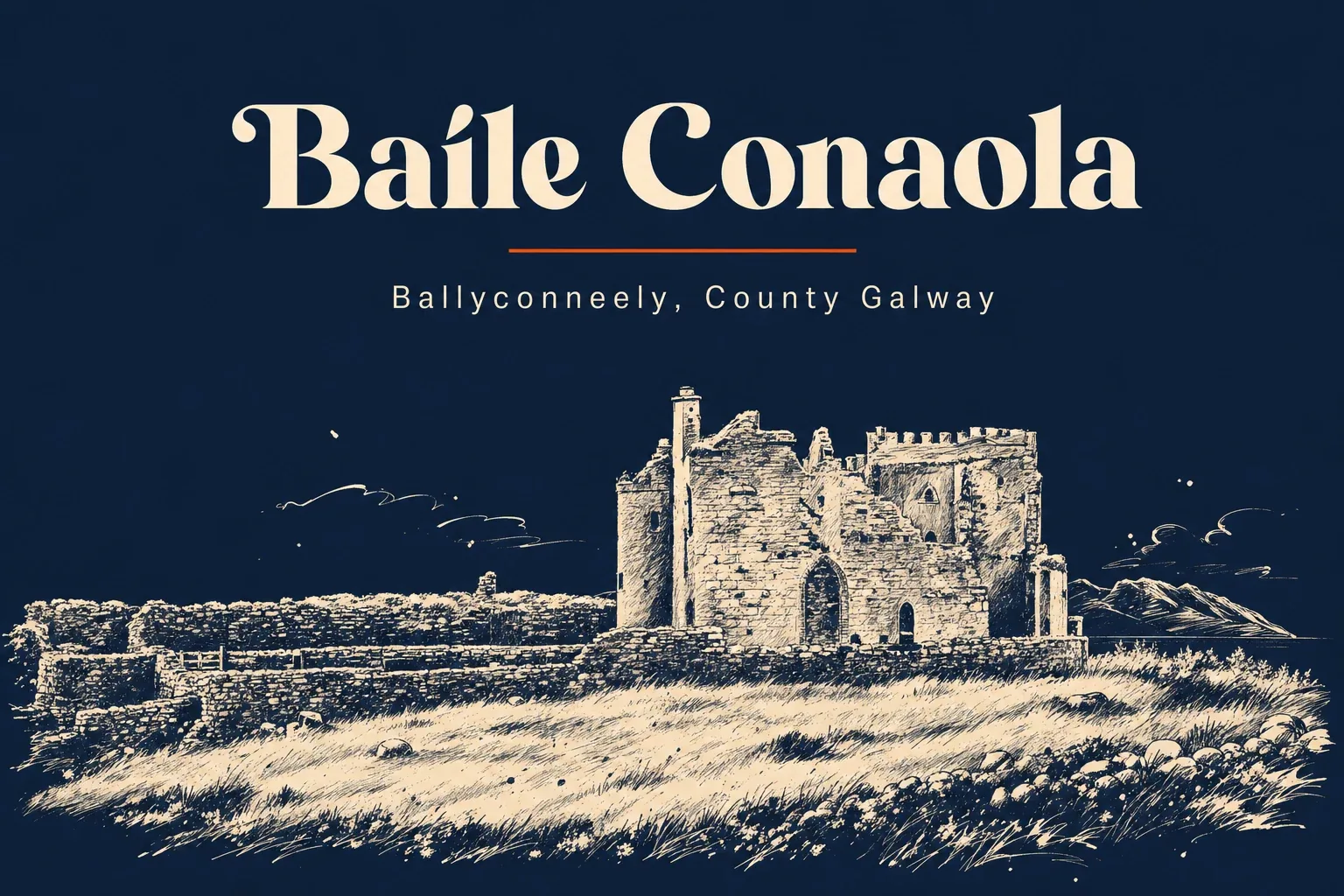
Baile Conaola · Co. Galway
A ribbon village on the most westerly point of Connemara, with a beach made of coral, a bog where the first transatlantic flight crashed, and the home turf of the Connemara pony.
Ballyconneely is a small working village on the south coast of west Connemara, about ten kilometres south of Clifden on the R341 coast road to Roundstone. It sits on a peninsula that pushes out into the Atlantic at the most westerly point of Connemara. This is ribbon development rather than a tight street: a shop, a petrol station, a community hall, St Joseph's Church, a pub, and houses strung along the road and the boreens off it.
The main event is the Coral Strand at Mannin - Trá an Dóilín - a beach made almost entirely of maerl, the bleached skeletons of coralline red algae that grow on the seabed and break loose. It washes ashore in shades of pink and white and gives the strand a softer crunch than sand and a colour that does not look quite Irish. There has been settlement on these shorelines for thousands of years; middens of burnt stone, charcoal and shell turn up along the coast.
Five kilometres east, the Derrygimlagh bog holds a quieter pair of claims. In 1907 the Marconi company sent the first commercial transatlantic wireless message from a station built here on the bog, to Cape Breton in Nova Scotia. Then on 15 June 1919, Alcock and Brown came out of the cloud after sixteen hours from Newfoundland and crash-landed nose-first in the same bog - the first non-stop transatlantic flight. The Derrygimlagh Discovery Loop walks both stories now, past the cairn, the Marconi foundations and a run of interpretive panels.
Beyond that it is pony country and golf country. The Connemara pony is bred all through here, and the Ballyconneely show in July is the village's day in the sun. The Connemara Championship Golf Links runs out along the dunes at Aillebrack, exposed and playing longer than the card says. The village itself is unhurried and small - people come for the strand, the walks, the pony and the location. From here Roundstone is twenty minutes south and Clifden fifteen north.