County Galway Ireland · Co. Galway · Ballymacward Save · Share
POSTED FROM
BALLYMACWARD
CO. GALWAY · IE

Ballymacward
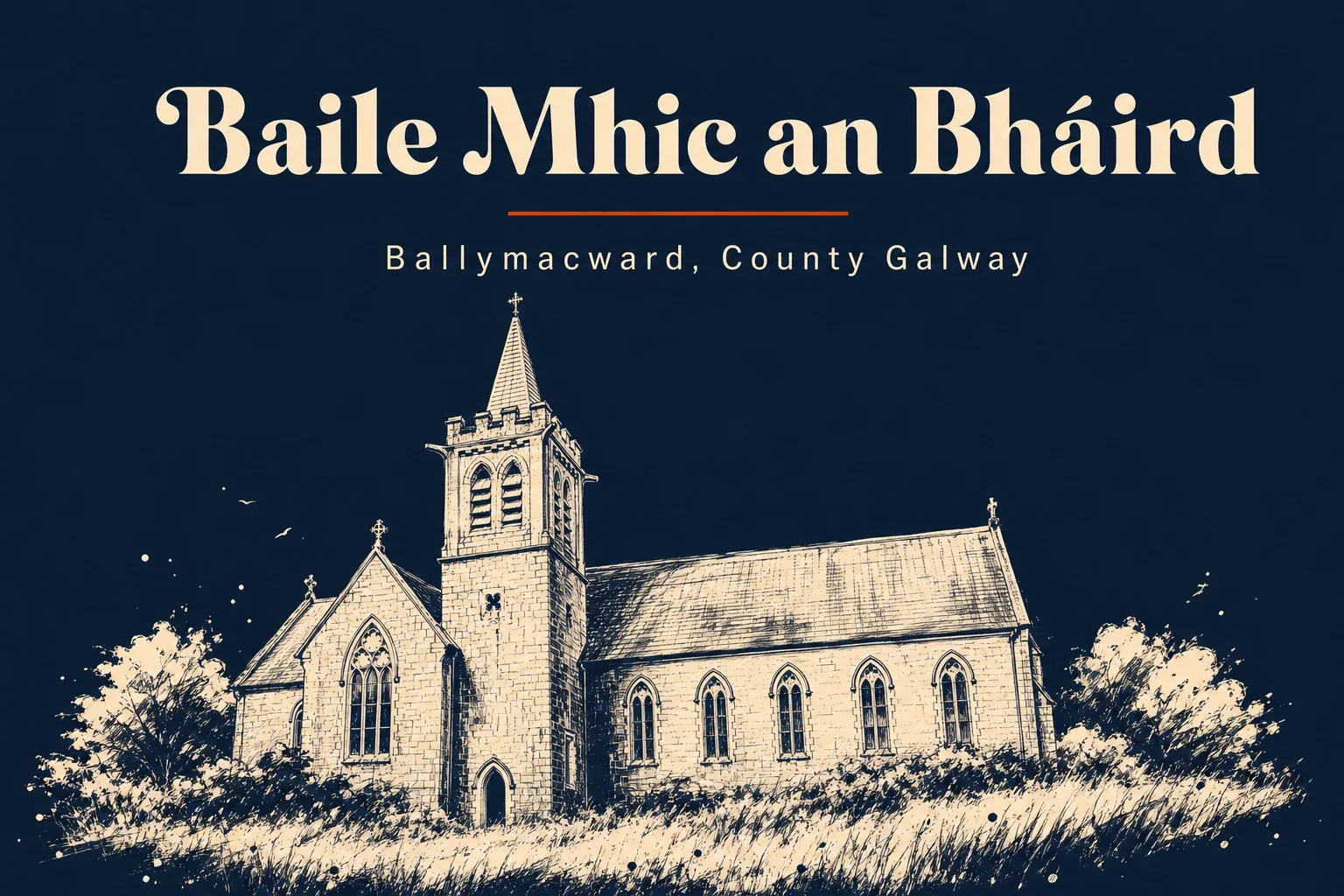
Baile Mhac an Bhaird

STOP 02 / 02
Baile Mhac an Bhaird · Co. Galway

A village with a poet's name in a farmer's landscape.

Ballymacward sits in the rolling countryside of east Galway, about 10 kilometres south-west of Ballinasloe, in deep agricultural territory. The Irish name is Baile Mhac an Bhaird—the townland of the sons of the bard—a reference that reaches back to the Mac an Bhaird family, who were the hereditary poets of Ulster in the medieval period. The connection is old history now, but the name carries it. The village itself is small—maybe 280 people—and shaped entirely by the work of the surrounding farms.

What exists here: a primary school, a couple of pubs, a shop, a church, and the houses scattered along the main road through the village. There is no heritage centre, no museum, no tourist infrastructure announcing the poet connection. The historical identity is in the name alone, passed over daily by people who may or may not think about the meaning. This is how history lives in small villages—embedded in language, unmarked, continuous.

You come to Ballymacward because you are interested in the names things carry and what they mean. Or because you are driving through east Galway and want to see the shape of a real village—not constructed, not curated, just the road, the houses, the work, and the land. The Mac an Bhaird family is a historical hook, but the actual substance is the place itself.

Population
~280
Coords
53.2486° N, 8.1739° W
01 / 02

Stories & lore.

The reason to come back. The things every local will eventually tell you about, usually after the second pint.

Hereditary poets of Ulster

The Mac an Bhaird family

The Mac an Bhaird—or Bárd family—were a learned family of poets in medieval and early modern Ireland, based primarily in Ulster. They served the Gaelic aristocracy as official poets, composers of formal verse praising patrons and recording genealogies. Their training was rigorous and their status was significant. The name Baile Mhac an Bhaird—the townland of the sons of the bard—marks a connection, whether a settlement of the family, a historical association, or simply a naming that honoured them. The actual genealogical link is lost to time, but the name persists.

The actual landscape

East Galway farming

Ballymacward is surrounded by farmland—sheep, cattle, grain. The village exists to serve the immediate hinterland. The road through it is the Ballinasloe–Gort road; traffic passes. The school serves the area. The pubs are local meeting places where the agricultural calendar governs rhythm more than the tourist season. This is not village life constructed for visitors. This is village life constructed for farmers and families who have lived here for generations.

A line running through fields

The Galway–Roscommon border

Ballymacward sits near the border between County Galway and County Roscommon. The administrative boundary runs through the agricultural landscape, separating Galway farming country from Roscommon farming country. For the people who live there, the boundary matters for governance and services, but the landscape, the work, and the seasonal rhythm are identical on both sides. The village is part of the east Galway experience, but it is also part of a border region where the distinction between counties is more administrative than lived.

+

Getting there.

By car

Ballinasloe to Ballymacward is 10 km south-west on local roads. From Galway city, take the M6 to Ballinasloe (1h), then follow signage south toward Gort. Ballymacward is on the road between the two. From Gort, it's about 15 km north.

By bus

Ballymacward is not on a regular bus route. Ballinasloe has Bus Éireann service from Galway (1h). A car is practically essential; a taxi from Ballinasloe is possible.

By train

Nearest station is Athenry (25 km west) on the Dublin–Galway line. Then car or taxi.