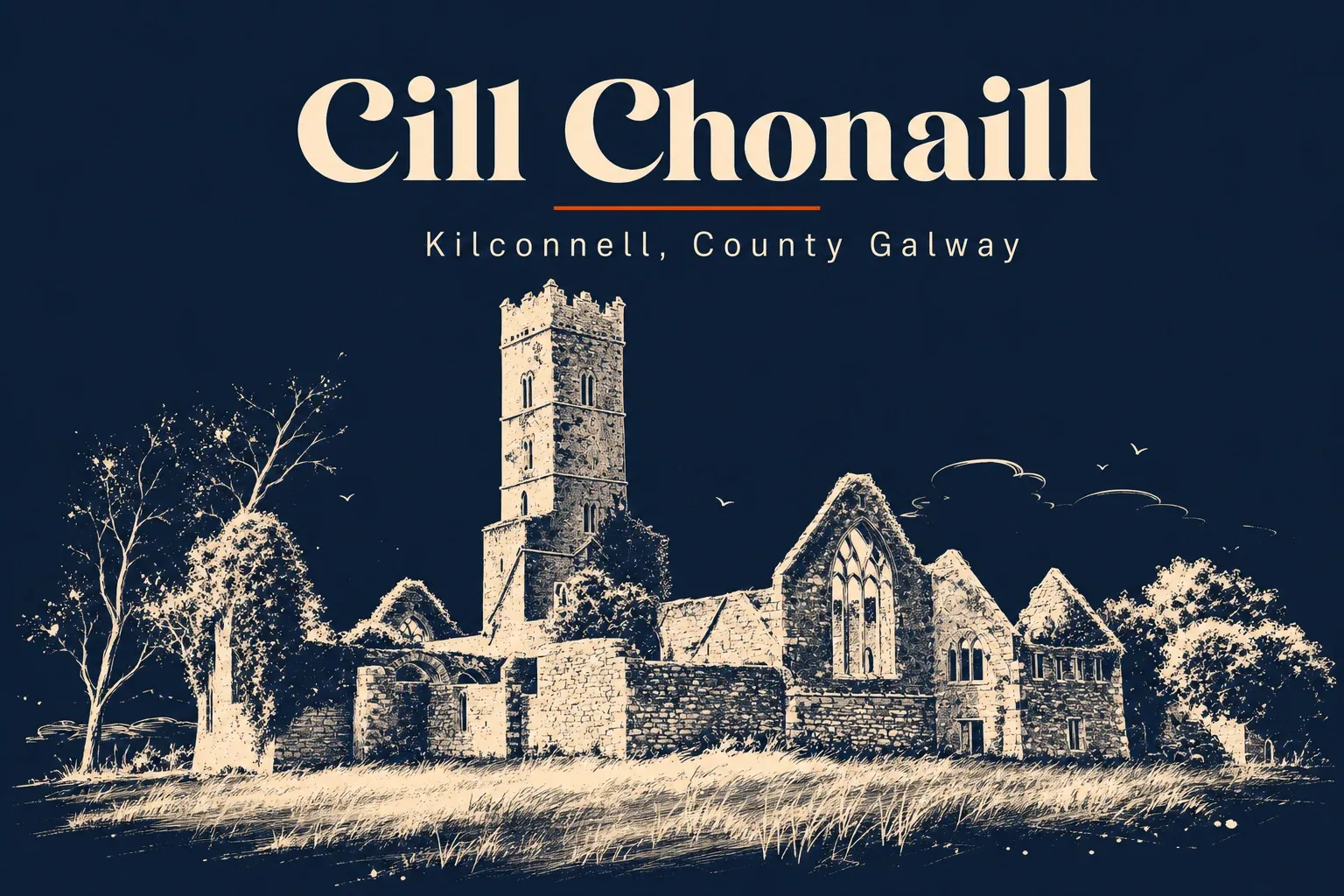
Cill Chonaill · Co. Galway
One pub, one friary, and one of the best-preserved medieval Franciscan houses in Connacht standing free and open at the top of the village.
Kilconnell is a small village 12 km east of Ballinasloe on the R348, and the reason to come is at the top of it: a Franciscan friary that is one of the best-preserved medieval religious houses in Connacht. It is free, it is open, and it is unguided. There is sometimes livestock in the field around it. Mind the gate and mind your feet.
The name is older than the friary. Cill Chonaill means the church of Conall, a 6th-century abbot said to have been here in the time of St Patrick. The Franciscan house came much later. William Buí O'Kelly, Lord of Uí Maine, founded it in 1414, and the friars adapted and extended it through the 15th century, adding the slender central tower you see now. It outlasted the Dissolution of the 1540s by a long way. The Papal Nuncio Rinuccini visited in 1648, an English garrison held it at one point, and there were still friars in the area into the late 1700s. The last of them was gone by around 1785.
What survives is the point. The nave and chancel run about 37 metres, the tower stands, and the east and south sides of the cloister arcade are still in place. The carving is the thing people travel for - a canopied wall tomb near the west end with six saints worked in stone beneath flamboyant tracery, and the Daly family tomb in the chancel. It is the careful, paid-for work of medieval masons, and most of it is still here six centuries on.
The village itself is what it is: a working farming village with one pub, Broderick's, fifth-generation and going since 1875. There are no hotels, no restaurant strip, no crowds. Ballinasloe is fifteen minutes back down the road for everything else. Come for the stone, have a pint, and drive on.