County Galway Ireland · Co. Galway · Kiltartan Save · Share
POSTED FROM
KILTARTAN
CO. GALWAY · IE

Kiltartan
Cill Tartain

STOP 05 / 05
Cill Tartain · Co. Galway

A parish that taught Irish stories to the world. Lady Gregory's literary ground.

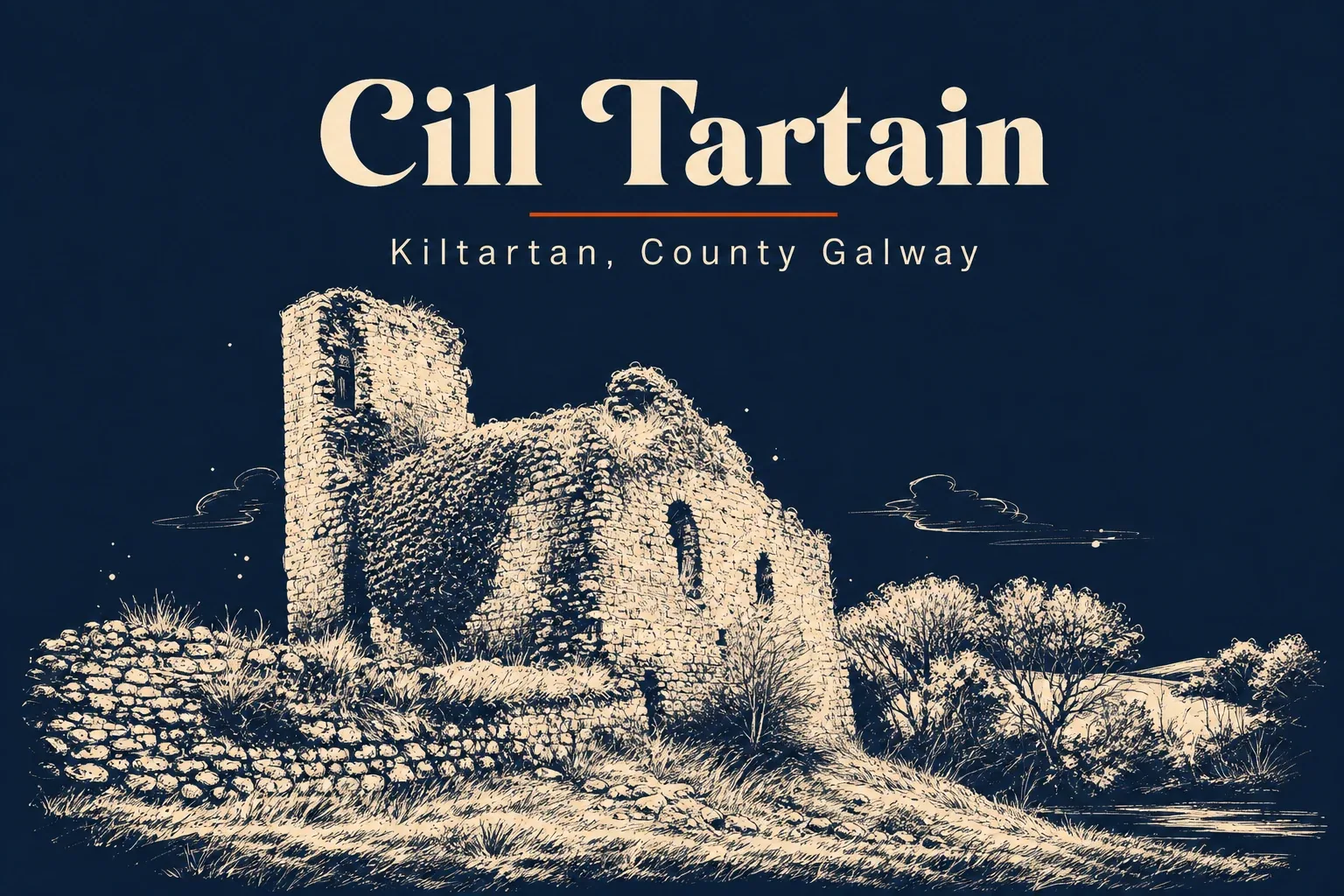
Kiltartan is not a village in the conventional sense. It is a parish in south Galway, near Gort, defined by Lady Gregory and what she did here. Coole Park, her house and demesne, sits within the parish. From 1896 until her death in 1932, Gregory lived here, collected stories, translated folklore, and built the Irish Literary Theatre (which became the Abbey). Yeats visited constantly. Synge came. Shaw carved his name into the copper beech in the walled garden. The place was a salon and a working laboratory for the Irish Literary Revival.

What made Kiltartan unusual was not the house or the aristocracy, but the work done with Irish language and story. Gregory spoke Irish. She learned it from locals, from her tenants, from the speech around her. She collected folklore, peasant stories, oral histories. Then she translated them into English using a style of her own invention — what became known as Kiltartan English or Kiltartanese. It was not dialect, not exactly. It was a deliberate literary gesture: taking Irish narrative rhythms, Irish word order, Irish ways of thinking, and rendering them in English syntax in a way that preserved their flavour. The stories sounded Irish in English. That was the point.

Today, Coole Park is open to visitors. The house itself is a ruin, its rooms exposed to sky, but the demesne survives — the walled garden, the woodland walks, the lake where Yeats wrote about the wild swans. The autograph tree still bears the initials carved by the writers who sat in Gregory's salon. Kiltartan itself remains quiet. It is not a place you pass through. It is a place you come to because you want to understand where the Literary Revival came from.
Population
500
Coords
52.6931° N, 8.8153° W
01 / 05

At a glance.

Three things every local will eventually mention. Read these and you've already understood more than most day-trippers do.

02 / 05

Stories & lore.

The reason to come back. The things every local will eventually tell you about, usually after the second pint.

The founder (1852–1932)

Lady Gregory

Augusta Gregory was born into Protestant gentry. She married into it, then divorced convention. In 1896, at Coole Park, she began collecting Irish folklore with the ethnographer W.B. Yeats. She learned Irish in her fifties. She translated stories—fairy tales, peasant narratives, legends—into English. She co-founded the Irish Literary Theatre in 1899 (which became the Abbey Theatre in 1904). She wrote plays based on Irish stories. She was a producer, a translator, an advocate for Irish language and literature. Yeats called her "a managing woman." That was not a compliment at the time. It was accurate. She died in 1932 and was buried in the local churchyard.

The translation style

Kiltartan English

Kiltartan English (or Kiltartanese) was Gregory's invention. It was a way of translating Irish folklore into English while preserving Irish narrative rhythms and thought patterns. An example: instead of "He gave him the money," a Kiltartan English version might echo Irish syntax: "It is the money he gave him." The style sounds foreign to standard English—archaic, lilting, strange. That strangeness was deliberate. It told the reader: this is an Irish story, told the Irish way, translated but not anglicised. The style fell out of favour by the 1950s, but it was revolutionary. She proved that Irish stories could be made available to English readers without flattening them into standard English prose.

The salon where modern Irish literature was made

Coole Park and the Revival

Coole Park became a gathering place for the writers of the Irish Literary Revival. Yeats came regularly, sometimes for weeks. John Millington Synge visited. George Bernard Shaw visited. Sean O'Casey was here. Guests carved their initials into the copper beech in the walled garden—a living monument to who passed through. Gregory produced Yeats' plays at the Abbey Theatre. She edited his work. She wrote plays herself based on the stories she had collected. The autograph tree became famous; people made pilgrimages to see it. When Yeats wrote 'The Wild Swans at Coole' (1917), he was writing about the lake at Coole Park, where he had walked with Gregory, talking about literature and Ireland. The house is now a ruin, but the demesne remains open, and the tree still bears the names.

03 / 05

When to go.

There is no bad time. There are different times.

Spring
Mar–May

Coole Park is at its best. The walled garden is in bloom. The woods are fresh. Fewer visitors than summer.

◉ Go
Summer
Jun–Aug

Busier. The demesne is green and lush. The visitor centre has extended hours. Coach tours arrive.

◐ Mind yourself
Autumn
Sep–Oct

The light is sharp. The crowds thin. The landscape is quietly dramatic. The best time to walk the woods and understand the place.

◉ Go
Winter
Nov–Feb

Some facilities reduce hours or close. The demesne is austere. Rain and wind are real. But the ruin is more eloquent in winter.

◐ Mind yourself
04 / 05

What to skip.

Honestly? Don't bother.

If a local was sitting beside you, this is the bit where they'd lean in.

×
Visiting Coole Park without knowing who Gregory was

Read a summary of her life and work first. Otherwise you are looking at a pleasant ruin and nothing more.

×
Trying to read Kiltartan English translation without context

The strangeness is intentional and makes more sense when you know why it exists. Start with one short story, not a whole collection.

×
A rushed afternoon covering Gort, Kiltartan, and Thoor Ballylee

Each place deserves its own visit. Pick one. Sit with it.

+

Getting there.

By car

Gort is the nearest town, 5km south. From Galway city, Gort is 40km on the M6/N18 (45 minutes). Coole Park is signposted from Gort. Parking is free.

By bus

Bus Éireann and GoBus serve Gort from Galway. Then taxi or car rental to Coole Park (5km from Gort).

By train

No direct train. Galway or Athenry are nearest. Then bus or taxi.

By air

Shannon Airport is 90km (1.5 hours). Cork is similar.