County Galway Ireland · Co. Galway · Lettermore Save · Share
POSTED FROM
LETTERMORE
CO. GALWAY · IE

Lettermore
Leitir Mor, Co. Galway

The Wild Atlantic Way
STOP 08 / 08
Leitir Mor · Co. Galway

A working Gaeltacht island reached over a chain of low causeways. One pub, the Irish language, and the song Peigin Leitir Moir. It does not cater, and that is the point.

Lettermore is an island in south Connemara, about 40 kilometres west of Galway city. The name is Leitir Mor, the great rough hillside, and the place lives up to it: low rock, bog, small lakes, stone walls running off into nothing, and the sea never more than a field away. The island has two halves - Lettermore in the east, Lettercallow (Leitir Calaidh) in the west - and it is one link in a chain of islands the locals call Ceantar na nOilean, the District of the Islands.

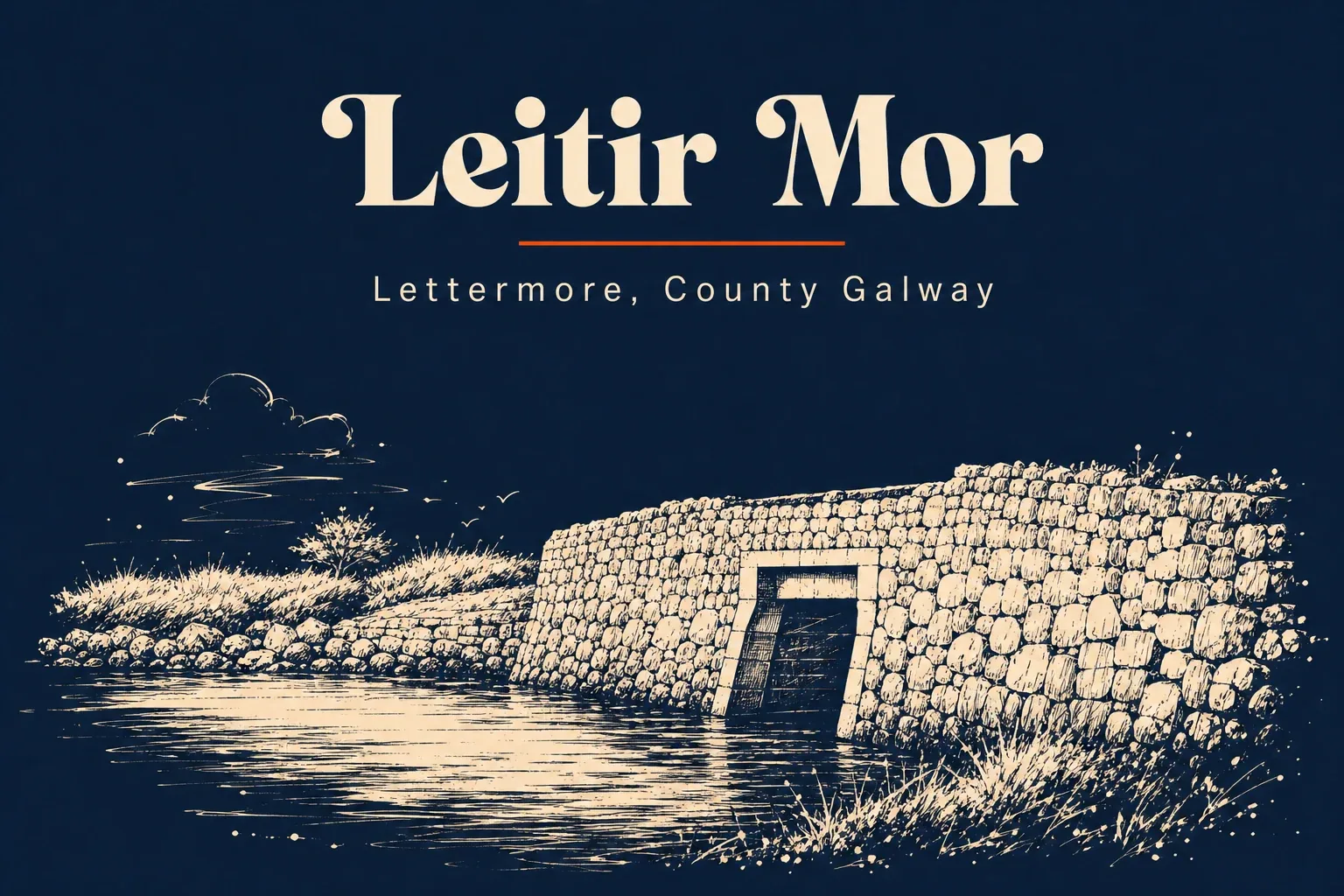
You reach it without a boat. Early in the 20th century the causeways went in, and now the R374 carries you over a sequence of low bridges from the mainland at Bealadangan, across Lettermore, on to Gorumna and out to Lettermullen at the end. These are modest structures, just wide enough for a car and a nod to whoever you meet coming the other way, and they tie a scatter of islands into one working community. The 2022 census counted 542 people. In 1841, before the Famine and the long emigration that followed, there were 844.

This is a Gaeltacht in the true sense - Irish is the first language, the language of the bar and the shop and the school, not a subject anyone studies. The island gave Ireland one of its best-loved songs, Peigin Leitir Moir, written here around the turn of the last century. The boats still go out, the farms are small, and the people who are here live here.

Come if you are driving the back roads of south Connemara and want to cross the causeways to see how a real island community works. Come for the one pub, the water between the islands, and the language. Do not come for restaurants, hotels or attractions, because there are next to none. What Lettermore offers is honest and finite: rock, salt water, the Irish language still doing a day's work, and a song.
Population
542 (2022 census)
Walk score
One pub, one shop, a church and the water - ten minutes
Coords
53.2889° N, 9.6550° W
01 / 08

At a glance.

Three things every local will eventually mention. Read these and you've already understood more than most day-trippers do.

02 / 08

The pubs.

None of these are themed Irish pubs, because they don't need to be. A few that earn the trip:

Tigh Phlunkett

Irish first, trad when it happens
Local pub, in the village

The pub on Lettermore, run alongside the family shop, Siopa Phlunkett. Small, local, Irish by default - English arrives when somebody needs it. There is traditional music here when there is music, not on a printed schedule. This is the island's one hospitality stop and it is the real thing, not a performance laid on for visitors.

03 / 08

Where to eat.

PlaceTypeLocal note
Siopa Phlunkett Village shop The shop in the village, attached to the pub. Supplies, the day's essentials, what you need to keep going. Not a cafe, not a restaurant - a working shop for people who live on the island. For any real choice of food, stock up in An Cheathru Rua (Carraroe) or Casla before you cross.
04 / 08

Stories & lore.

The reason to come back. The things every local will eventually tell you about, usually after the second pint.

The island's song, written around 1900

Peigin Leitir Moir

The best-known song to carry a Connemara place name was made here. The original verses were written in Irish by Mairtin O Clochartaigh and Padraic O Maille of Leitir Calaidh, the western townland of the island, around the turn of the 20th century, and published in the review An Claidheamh Soluis in 1911. It sounds like a love song to a beautiful woman who draws admirers from every district, and there is a quiet joke at its heart: the Peigin of the song was a baby about six months old. New verses were added wherever it travelled, and it is also played as a polka with no words at all. Sung or played, it has carried the name of Lettermore far beyond the islands.

An island chain joined by road

Ceantar na nOilean and the causeways

Lettermore, Gorumna and Lettermullen, with smaller islands between them, are known together as Ceantar na nOilean - the District of the Islands. For most of their history they were reached by boat across the inlets of Kilkieran Bay. In the early 20th century a series of causeways and bridges went in along what is now the R374, joining island to island and the whole chain to the mainland at Bealadangan. They are low and narrow, built for an isolated community rather than for show, and they remain the lifeline of the islands - the thread of dry road across a great deal of salt water.

Irish as a working language

An Ghaeltacht

Lettermore sits in the heart of the Connemara Gaeltacht and has been inside the official Irish-speaking area since the boundaries were first drawn by Coimisiun na Gaeltachta in 1925. Here Irish is not a school subject or a heritage label - it is how people talk to each other in the pub, the shop and the road. The summer colleges still send students out to the islands to live with local families and learn the language where it is spoken. The GAA club, CLG Naomh Anna Leitir Moir, carries the island's name in Irish, as everything here does.

05 / 08

Things to do outside.

Wear waterproofs. Bring a sandwich. Tell someone where you're going if it's the mountain.

The causeway crossings The point of Lettermore is the chain. Walk or drive the low bridges between the islands on a calm day, stopping at the straits where the tide runs between Lettermore, Gorumna and Lettermullen. The landscape is rock, bog and water, not postcard scenery, and it rewards going slowly. Stay off the foreshore in rough weather - the water here is cold and serious.
Drive or walk, several short stretchesdistance
Allow an afternoontime
Island roads on Lettercallow The quiet western end of the island, Leitir Calaidh, is laced with small roads between stone walls, little lakes and the shore. No marked trail and no facilities - just the roads the islanders use. Good for a slow walk in calm weather to see the bare bones of a south Connemara island. Bring everything you need with you.
Variabledistance
1-2 hourstime
06 / 08

When to go.

There is no bad time. There are different times.

Spring
Mar-May

Quiet, the light is true, the island is itself. The water is calmer than winter and the colours come back to the bog.

◉ Go
Summer
Jun-Aug

Calmest water and longest light - the best season for crossing the causeways and walking the island roads. The summer language colleges bring students out to the islands.

◉ Go
Autumn
Sep-Oct

Clear water, gold light, before the worst of the Atlantic weather. Locals favour this season and the island feels most itself.

◉ Go
Winter
Nov-Feb

Atlantic weather is serious out here and the bay shows its teeth. The causeways stay open but the straits between the islands turn angry. Come only if you respect it.

◐ Mind yourself
07 / 08

What to skip.

Honestly? Don't bother.

If a local was sitting beside you, this is the bit where they'd lean in.

×
A visitor industry

There is essentially none. One pub, one shop, a church, a school. No hotel, no restaurant, no visitor centre on Lettermore itself. If you arrive expecting attractions you will be disappointed; if you arrive expecting an island that lives its own life, you will not.

×
Expecting the Aran Islands

Lettermore is not the Arans and is not trying to be. It is joined to the mainland by road, it does not run on tourism, and it has no famous fort or cliff. It is a quieter, more ordinary place - a working Gaeltacht island most visitors drive past on the way somewhere else.

+

Getting there.

By car

From Galway take the R336 west through Casla (about 50 minutes), then turn onto the R374 and cross to Lettermore over the causeway at Bealadangan. The chain continues west over the bridges to Gorumna and Lettermullen.

By bus

Local Link and Connemara Gaeltacht bus services run limited routes along the south Connemara coast roads through Casla and out to the islands. Services are sparse and timed for local life, not for visitors - check the timetable before relying on one.

By train

No train. The nearest station is Galway (Ceannt). From there it is car or local bus west into Connemara.

By air

Ireland West Airport (Knock) is about 2 hours by car. Shannon is about 2 hours 30 minutes. Galway city is roughly 50 minutes to an hour by the coast road.