1702 to 1844, room by room
Inside Derrynane House
The house you walk through is layered. The oldest surviving block is the south wing — the two-storey range with the library, which O'Connell built in 1825 to hold his books and his correspondence. The drawing room, the dining room, the bedrooms above: all his. The original 1702 house sat where the chapel courtyard now is; OPW demolished it in 1967 because it was past saving. The chapel itself was added by O'Connell in 1844, three years before he died, modelled on the ruined abbey on the island across the strand. Inside it: an altar he chose, a marble plaque to his wife, and the same light he prayed under. The library still has his desk, his books, his maps. The duelling pistols he kept after killing John D'Esterre in 1815 are in a case. He never wore black after that day except on the anniversary, and he tied a black ribbon to that hand whenever he received the Eucharist.
A 6th-century monastery and a graveyard the tide owns
Abbey Island
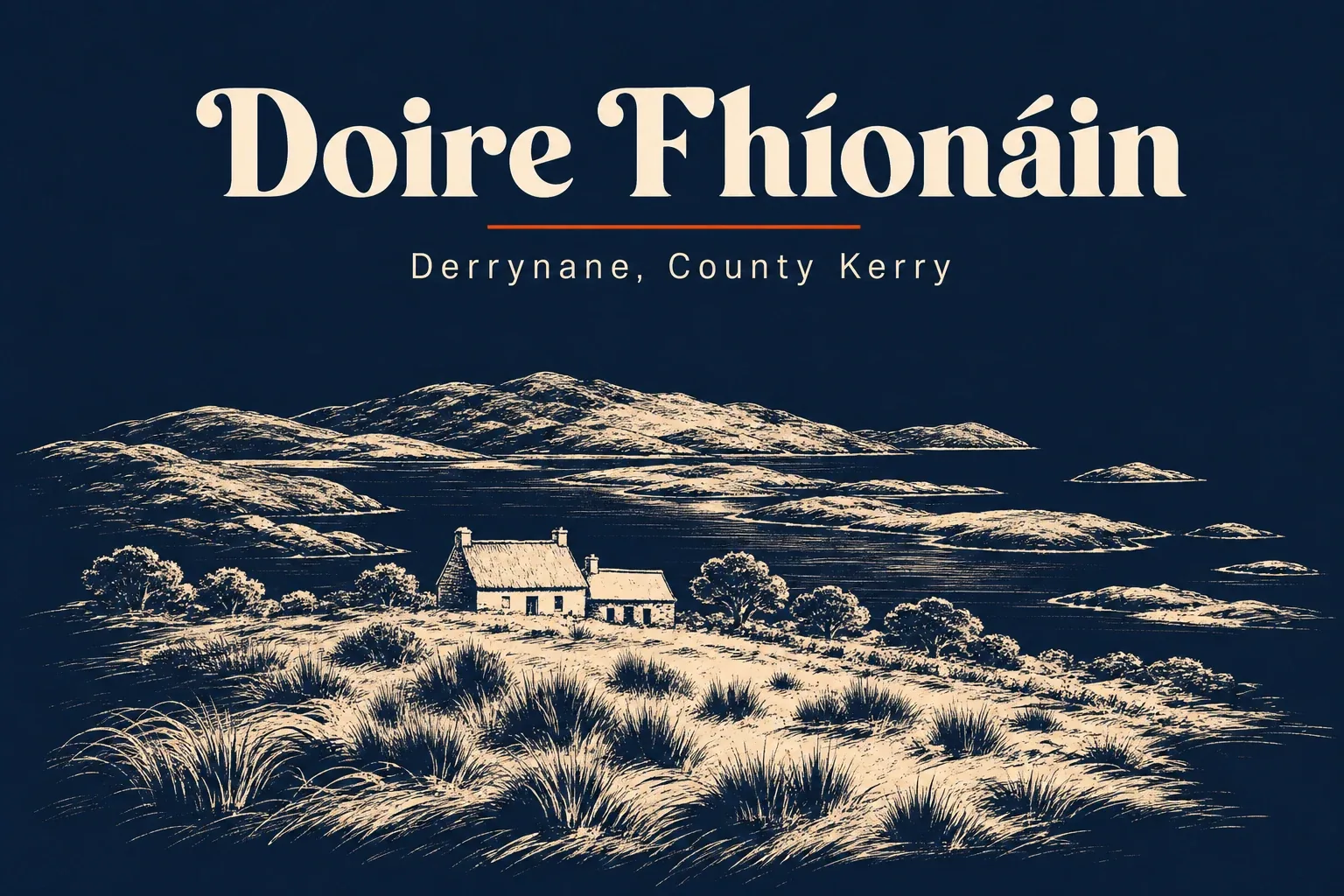
Saint Fíonán — the same Fíonán the townland is named for, Doire Fhíonáin, Fíonán's oak grove — founded a monastery here in the 6th century. What survives on the island is a small ruined church, almost certainly later than that, with the lower courses of older walls around it. The graveyard is what people come for. It is full of O'Connells. Hunting Cap, the uncle who raised the Liberator. The Liberator's own siblings. And, most particularly, his wife Mary, who died in 1836 and whom he buried in the abbey because he wanted her where he could walk to her at low water. He outlived her by eleven years. He is buried in Glasnevin in Dublin — his heart was sent to Rome — but every account of his last years has him here at Mary's grave, watching the tide come and go.
Blue Flag, dune-backed, two miles of white sand
The beach as Atlantic landfall
Derrynane Strand runs a long arc inside the bay, sheltered from the worst of the open Atlantic by Lamb's Head to the south and Abbey Island to the west. The sand is the pale, almost white, shell-ground stuff that gives the south Iveragh beaches their odd Caribbean look on a flat-calm afternoon. Blue Flag every year for as long as anyone tracks it. The dunes behind the strand are the tallest on the peninsula and form a buffer that the rest of the historic park grows in behind. Lifeguarded in summer. In winter the wind comes in across three thousand miles of open water and rearranges the place; the strand can lose two metres of sand in one storm and put it back the next month.
Dunes, oakwood, walled garden, boreens
The 320 acres
Derrynane National Historic Park is one of the larger OPW parks in the country — 320 acres, or 130 hectares, all of it the demesne O'Connell walked. The mix is unusual for the south-west: wind-sculpted oakwood right down to the dunes, a formal walled garden in the lee of the house with cordylines and hydrangeas and tender things that have no business growing this far north, and a network of estate boreens that link the house to the strand to the chapel to the burial ground at Bealtra. The Kerry Way comes down off Eagle's Hill, threads through the park, and leaves over the headland toward Castlecove. You can walk the whole estate in a long afternoon and not see another person off the main path.