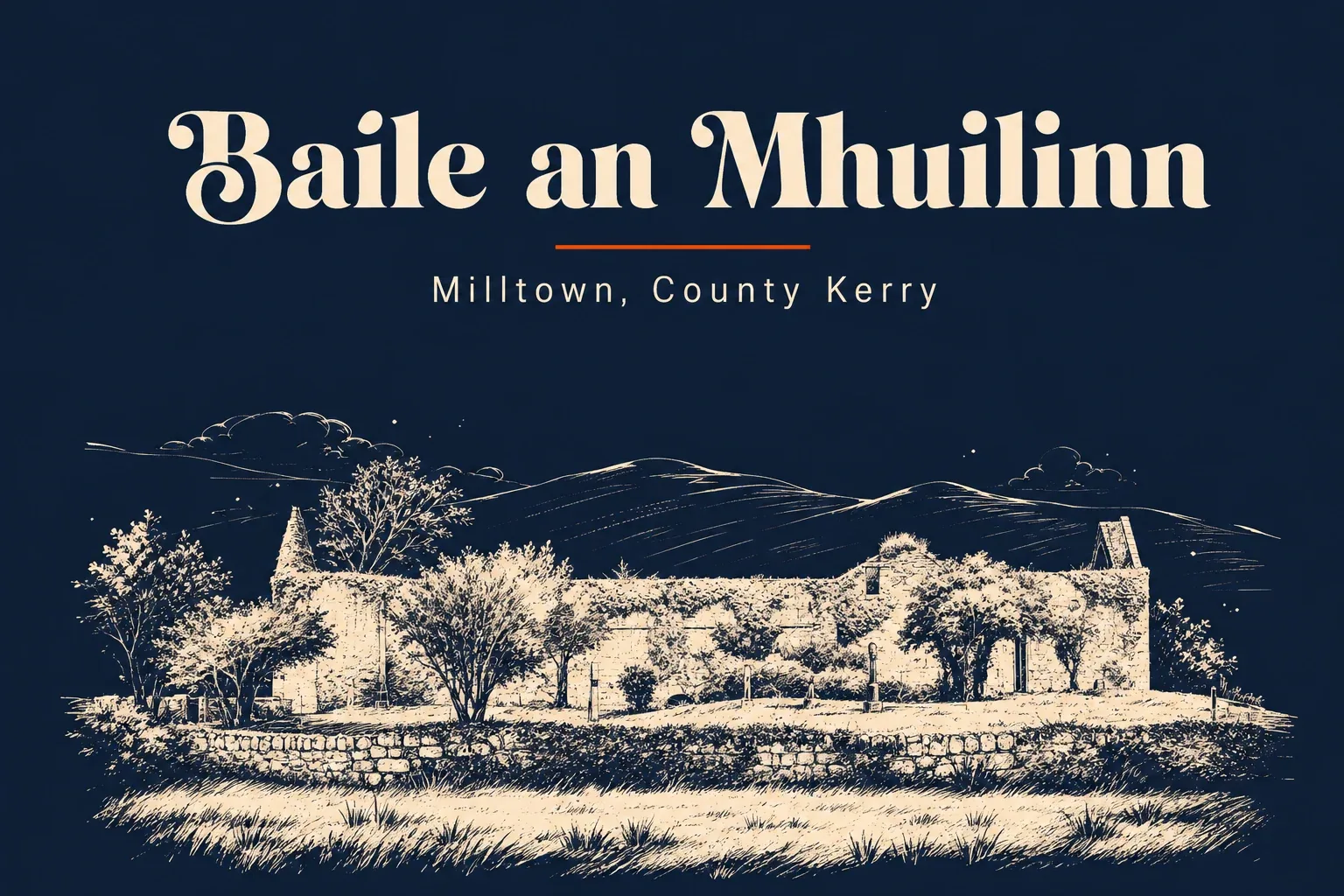
The richest house in Munster, gone
Killagha Abbey
A kilometre north-west of the village, by the river, sit the ruins of Killagha Abbey — also called Kilcolman or Kilcoman, depending on which sign you read. Founded around 1216 by Geoffrey de Marisco, an Anglo-Norman who'd been handed half of Munster by King John. Augustinian canons. For 300 years it was the wealthiest of the 223 Augustinian houses in Ireland and the Prior sat in the Irish House of Lords. Suppressed in 1576, then knocked about by Cromwellian cannon during the Confederate Wars. The fortified buildings came down. The church is still standing, sort of. There's no visitor centre, no ticket booth, no path. Park sensibly and walk in through the field.
A planned town by a planning landlord
The Godfrey mill
Milltown is a Godfrey town. Captain John Godfrey laid it out in the 1750s as the central market town of his estate, and the family put a baronet's house up the road at Bushfield — later renamed Kilcoleman Abbey, and not to be confused with the actual abbey in the field. The Godfreys ran the place until 1958. The house finally came down in 1977, eaten by dry rot. The grid of streets, the bridge, and the name on the postmark are what they left behind. The mill itself, which gave the town its name, is no longer running, but the stonework along the Maine still tells you where it was.
June bank holiday weekend
The World Bodhrán Championships
Every June, Milltown turns into the global capital of the goatskin drum. Heats, semis, finals. Solo, accompanied, junior, senior. Drummers come from America, Australia, Japan. The pubs run sessions back-to-back, Cosgrove's is the official venue, and the village has its one weekend a year of being on the map. It sounds like a niche festival. It is. That's exactly why it's good.
Six thousand years and one cycle
Killaclohane and Curry Foley
Two odd footnotes. In 2015, archaeologists excavating a Neolithic tomb at Killaclohane on the edge of the parish found human remains roughly 6,000 years old — the earliest known settlers in the south-west. And in 1856, Curry Foley was born in Milltown, emigrated to Massachusetts as a child, and became one of the first players in Major League Baseball to hit for the cycle — single, double, triple and home run in a single game, in 1882. Milltown has not produced another major-league baseball player since. The tomb has not produced any more inhabitants either.