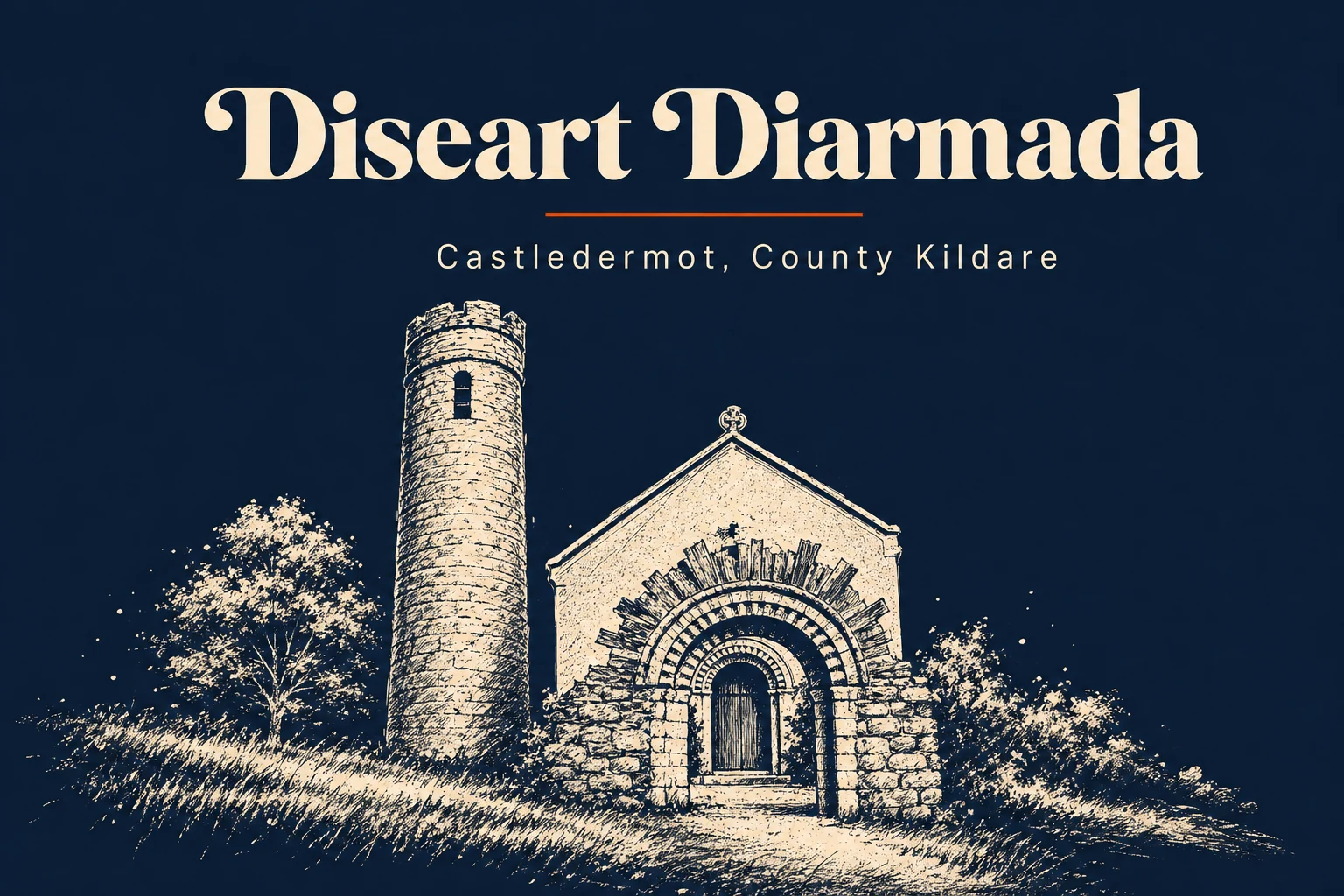
Diseart Diarmada · Co. Kildare
A round tower, two high crosses, and the only Viking grave in Ireland.
Castledermot is a small south-Kildare town built on top of an early-medieval monastery and never quite gotten over it. Saint Diarmuid founded the place around 800 AD as a hermitage - Diseart Diarmada, Diarmuid's desert - and what he started has left more standing stone per acre than anywhere else in Leinster. A 20-metre round tower. Two granite high crosses. A Romanesque doorway. A Franciscan friary up the road. And, sitting in the grass like a piece of misplaced furniture, the only Viking-era hogback grave in Ireland.
The hogback is the secret. It looks like a small carved trough - a stone shaped like the roof of a Norse longhouse, with shingle-pattern carving on the sloping sides. Hogbacks are an Anglo-Scandinavian thing: 10th-century, mostly Yorkshire and Cumbria, scattered through the Viking-controlled north of England. There are around 130 of them. Castledermot has the only one in Ireland. Nobody fully knows how it got here. A Norse trader who converted and was buried by the local monks is the working theory. Most visitors photograph the round tower and miss the stone in the grass.
The other thing to know: in 1264, the earliest Irish parliament on record convened here. Anglo-Norman barons, walled town, lozenge-shaped street plan still visible if you look at a map. The walls were finished by 1302, the same year the Franciscans were re-founded by Thomas, Lord of Ossory. Robert the Bruce's brother Edward burnt the friary on his way through in 1316. Most of what you see today is what was rebuilt afterwards.
Five kilometres west sits Kilkea Castle - built 1180, FitzGerald stronghold for seven hundred years, home of the Wizard Earl. It's a hotel now, the lavish kind. Castledermot itself is a working main-street town with a few pubs, a café, a chipper, and a friary you can walk into for free. Don't expect Kilkea hospitality on the main street. Do expect the actual ruins, with no turnstile and no gift shop.