County Kildare Ireland · Co. Kildare · Moone Save · Share
POSTED FROM
MOONE
CO. KILDARE · IE

Moone
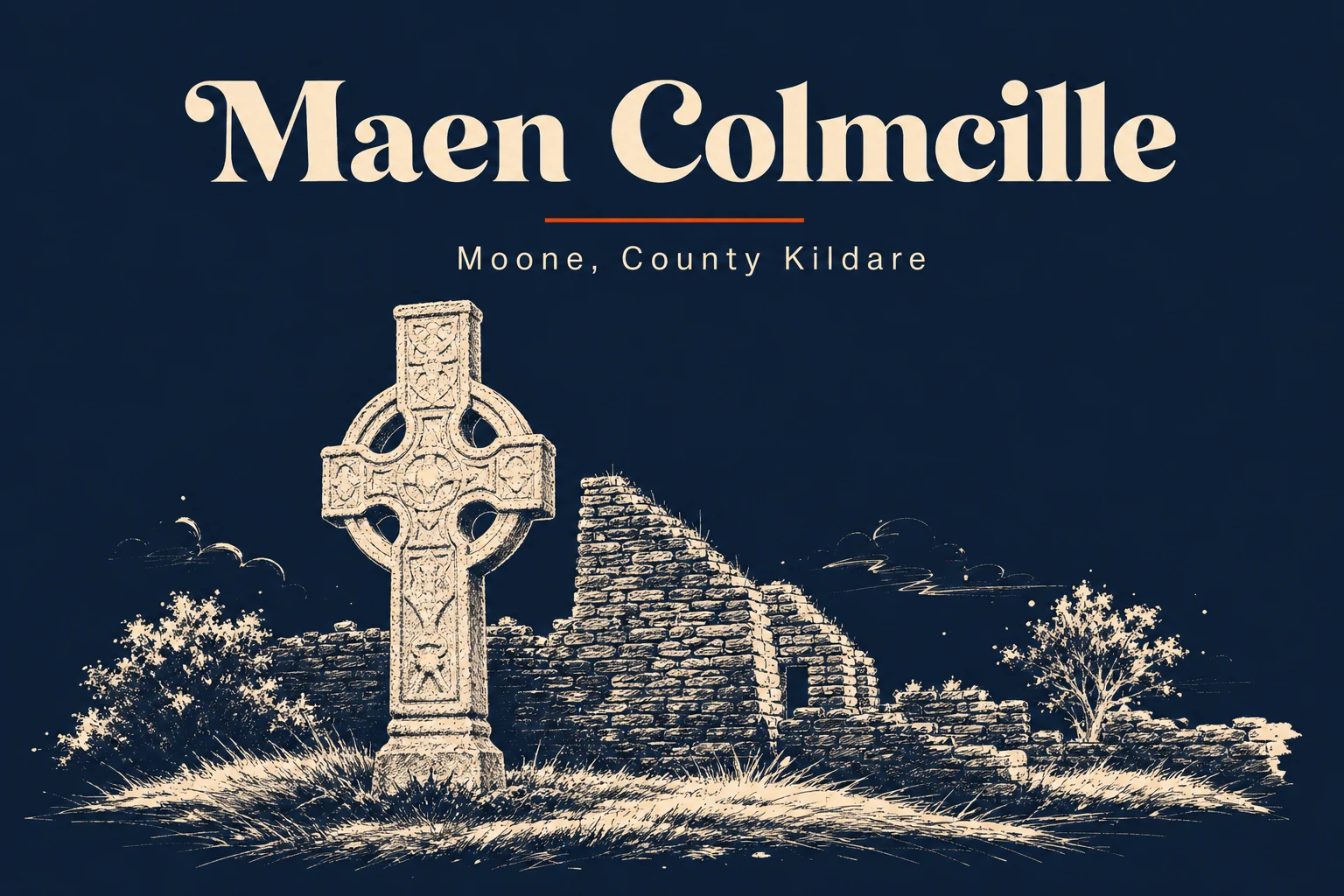
Maen Colmcille

The Ireland's Ancient East
STOP 07 / 07
Maen Colmcille · Co. Kildare

One high cross, twelve apostles in a row, and sixty years to find all the pieces.

Moone is a small village in south Kildare, a few minutes off the M9, and it holds one of the overlooked masterpieces of Irish medieval art. The Moone High Cross stands 5.3 metres tall — over 17 feet — carved in local granite sometime in the 8th or 9th century. You reach it through an inconspicuous wooden door in a stone wall, into the ruins of a Franciscan abbey, and the cross stands under a roof in the shell of the old church. That framing is not incidental. It is the correct amount of drama for a stone that has been standing here for twelve hundred years.

What makes the cross worth studying rather than just photographing is the base. The shaft is decorated with interlace and abstract patterns — the kind of work that would be remarkable in any softer stone, and is extraordinary in granite. But the base panels are the thing. The west face carries the Twelve Apostles, arranged as twelve squat, stylised figures in three rows of four — a design so geometric and so assured that it reads less like stone carving and more like a design from metalwork translated into a harder medium. The east face has the Crucifixion. The other base panels give you Daniel in the lions' den, the Three Children in the Fiery Furnace, Adam and Eve, the Flight into Egypt, and the Multiplication of the Loaves and Fishes. This was a visual Bible for an illiterate population — each panel a complete story compressed into a few square inches of carved granite. Walk around the base slowly. Read the panels in order. It takes twenty minutes and it is twenty minutes well spent.

The cross was not always standing. In the graveyard around the abbey, at some point after the Franciscan friary was dissolved under Henry VIII, the cross fell — or was pulled down — and the pieces were buried. In 1835, labourers working in the graveyard unearthed two sections. Charles FitzGerald, the Duke of Leinster, had them cleaned and re-erected. They assumed that was the cross — two pieces, reasonable height, impressive monument. Then in 1893, sixty years later, workers doing maintenance in the same cemetery turned up the middle section. That third piece is what gives the cross its full height and its extraordinary proportions. The cross you see today is the result of a discovery that took three generations to complete.

There is not a great deal else in the village. The Moone High Cross Inn is a proper country pub with a photo of Clint Eastwood on the wall and reviews describing the welcome as 'like a local.' The M9 is a few minutes away, which means you can pair Moone with Castledermot — whose two high crosses belong to the same Barrow Valley granite group — or Ballitore to the north, or Athy west. But come to Moone for the cross first. It earns the detour on its own.
Population
~487
Walk score
Cross to abbey ruins in two minutes flat
Founded
Monastery c. 6th century AD
Coords
52.9900° N, 6.8167° W
01 / 07

At a glance.

Three things every local will eventually mention. Read these and you've already understood more than most day-trippers do.

02 / 07

The pubs.

None of these are themed Irish pubs, because they don't need to be. A few that earn the trip:

Moone High Cross Inn

Local, unpredictable in the good way
Country pub, village main street

A photo of Clint Eastwood on the wall, old clocks and school desks in the decor, and a welcome that reviewers consistently describe as 'like walking in as a local.' Can be a quiet pint; can be a rock gig; can be a trad session. Food service has varied — check ahead before banking on dinner.

03 / 07

Stories & lore.

The reason to come back. The things every local will eventually tell you about, usually after the second pint.

The most distinctive carved stone in Kildare

The Twelve Apostles panel

The west face of the Moone High Cross base carries the Twelve Apostles as twelve identical squat figures arranged in three rows of four. They are barely individualised — the same round head, the same block body, repeated across the panel. The effect is not crude; it is deliberate. The carver was working in a granite tradition influenced by metalwork design, where repetition and pattern carry theological meaning. Compare them with the apostle figures on the Castledermot crosses, six kilometres south — those are more naturalistic, more Irish Romanesque in feel. The Moone apostles are something older and stranger, closer to abstract icon than to portrait. They are the panel most visitors remember after everything else has faded.

The three-generation reassembly

Found in 1835, finished in 1893

The cross had been buried in the abbey graveyard for centuries — exactly when it fell, or was felled, is not recorded. In 1835, local labourers turned up two sections during graveyard works: a lower section and an upper section. Charles FitzGerald, the 3rd Duke of Leinster, arranged for them to be cleaned and re-erected. This was the standard Victorian response to a good ruin — enthusiastic, well-intentioned, not always accurate. The re-erected cross was impressive. It was also incomplete. In 1893, sixty years later, a third section came out of the same graveyard during routine maintenance. The middle shaft. The piece that accounts for the cross's exceptional height and the full proportions of the design. It was slotted in. The cross has stood as you see it since.

Two saints, one site, twelve centuries apart

Colmcille and Palladius

The monastic site at Moone has a layered founding tradition. Historically, a monastery was established here in the early Christian period — sources connect it with Saint Palladius, sent to Ireland as its first bishop by Pope Celestine in 431, and later with Saint Colmcille (Columba), who founded monasteries at Derry, Durrow, Iona and several other sites in the 6th century. The Irish name — Maen Colmcille, Colmcille's property — records his association with the place. The O'Flanagan clan provided hereditary abbots until the Norman arrival disrupted the old Irish system of clan-based church governance. The Franciscans came around 1300 and built the church whose ruins now shelter the cross. The Henrician dissolution ended that in the 1530s. What remained was the graveyard, the abbey walls, and the cross — buried, waiting.

Moone and Castledermot, reading the same granite

The Barrow Valley group

The Moone High Cross belongs to what scholars call the Barrow Valley group — a cluster of granite high crosses from the south Kildare and Carlow region, all working in the same coarse local stone. Castledermot has two of them, six kilometres south. The granite imposes its own discipline: you cannot cut fine undercutting in granite the way you can in sandstone, so the carvers worked in bolder, flatter relief, and the designs compensate with geometry and pattern rather than naturalistic depth. Moone is the tallest and arguably the most complete of the group. The Twelve Apostles panel at Moone and the knotwork panels at Castledermot are the standard by which all the Barrow Valley crosses are judged. If you do both sites in an afternoon — which is easily done — you see two different solutions to the same problem of how to tell biblical stories in a stone that fights back.

04 / 07

Things to do outside.

Wear waterproofs. Bring a sandwich. Tell someone where you're going if it's the mountain.

Abbey and Cross Loop Through the wooden door in the wall on the Athy road, into the abbey grounds. The cross is under its protective roof in the shell of the old church — take time to read each base panel individually. Walk the graveyard, note the Franciscan church walls, come back out. That is the whole site. Do not rush it.
500 mdistance
30–45 min, depending on how long you spend at the crosstime
Moone to Timolin road walk Timolin is less than a kilometre north. The Irish Pewter Mill operates there — a working craft studio open to visitors. Walk the quiet road between the two villages and you get some idea of the south Kildare plain: flat, hedged, unhurried.
2 km returndistance
30 mintime
Moone to Castledermot (M9 corridor) The logical pairing if you are doing a south Kildare heritage day. Castledermot has its own round tower, two more high crosses from the same Barrow Valley group, and the only Viking hogback grave in Ireland. Drive the R448 south from Moone. The two sites take a comfortable half day together.
6 km by roaddistance
Better driven than walked — 10 min by cartime
05 / 07

When to go.

There is no bad time. There are different times.

Spring
Mar–May

The abbey grounds are quiet and the low spring light reads well on granite. No crowds at the cross. Pack a coat — the Kildare plain is exposed.

◉ Go
Summer
Jun–Aug

Long evenings mean you can linger at the cross after the afternoon tour groups have moved on. The site never gets genuinely busy — this is not Glendalough — but mid-morning weekdays are the quietest.

◉ Go
Autumn
Sep–Oct

The best light for reading carved stone is low-angle side-light, and autumn delivers it. October mornings in the abbey grounds are particularly good — if you visit only once, time it for a clear October morning.

◉ Go
Winter
Nov–Feb

The site is open year-round and free to enter. The Kildare plain in January is cold and flat. Come anyway if you want it entirely to yourself.

◐ Mind yourself
06 / 07

What to skip.

Honestly? Don't bother.

If a local was sitting beside you, this is the bit where they'd lean in.

×
Photographing the cross shaft and moving on

The shaft is the least interesting part. The base panels — the Twelve Apostles, Daniel in the lions' den, the Loaves and Fishes — are why people have been coming here for two centuries. Walk around the base. Read each panel. Budget twenty minutes for it.

×
Driving past on the M9 without stopping

The exit adds eight minutes to your Dublin–Waterford journey. The cross will add forty-five minutes to your afternoon. That is not a bad exchange rate for a 1,200-year-old masterpiece.

×
Coming without enough time to compare it with Castledermot

The two sites are six kilometres apart and they belong together. Moone alone is excellent; Moone and Castledermot in the same afternoon teaches you something about how early medieval stone carvers worked that neither site can demonstrate on its own.

+

Getting there.

By car

Dublin to Moone is just under 1 hour on the M9 — exit at Junction 3 (Moone / Timolin / Castledermot). The cross is on the Athy road at the edge of the village, signposted. Parking on the roadside. Castledermot is 6km south on the R448. Carlow is 20 minutes south.

By bus

Bus Éireann / Kildare Local Link route 880 connects Moone to Castledermot, Carlow, Naas, and surrounding villages daily including Sundays. Check current timetables — services are infrequent.

By train

No station. Athy (15 min by car) and Carlow (20 min) are the nearest stations, both on the Dublin–Waterford line.

By air

Dublin Airport is 1h 15m by car on the M50 and M9.