County Kildare Ireland · Co. Kildare · Ballitore Save · Share
POSTED FROM
BALLITORE
CO. KILDARE · IE

Ballitore
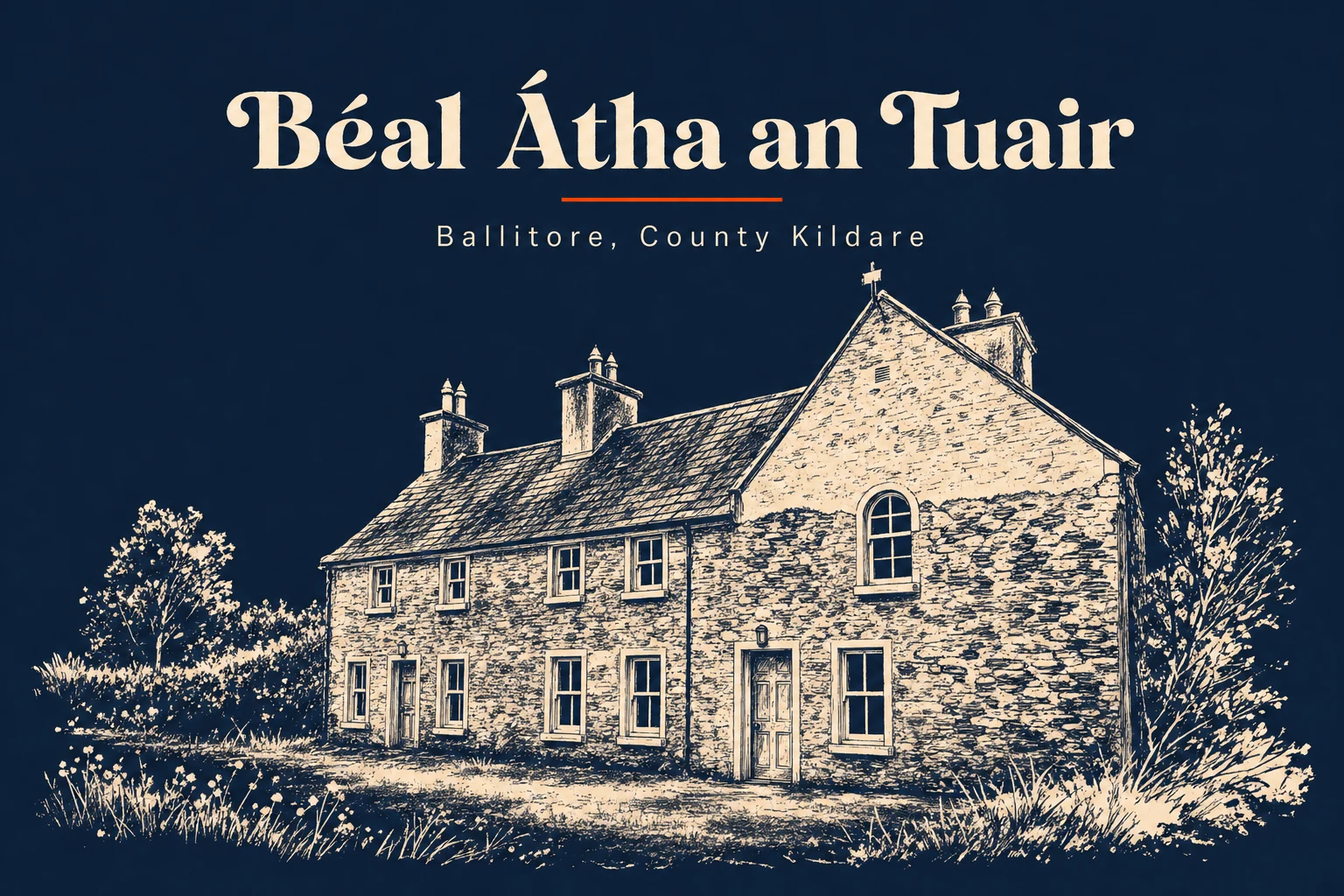
Béal Átha an Tuair

The Ireland's Ancient East
STOP 01 / 03
Béal Átha an Tuair · Co. Kildare

The only Quaker-planned village in Ireland. Edmund Burke went to school here.

Ballitore is a small village an hour south of Dublin, off the old Carlow road, that does one extraordinary thing: it is the only Quaker-planned village in Ireland. Two Yorkshire Friends bought the valley in 1685, drained the bleach-greens by the river Griese, laid out a grid, and built a Meeting House around 1707. The grid is still there. The Meeting House is still there. The whitewashed graveyard, where the flat slabs carry only names because Friends didn't believe in standing out, is still there.

What makes it worth the detour is not the pubs — there are two — and not the food, and not the river, pleasant though the river is. It is that almost nothing in this village is generic. The schoolhouse where Edmund Burke spent three years aged twelve was here. Mary Leadbeater, who wrote the closest thing rural Ireland has to a sixty-year diary, was born here in 1758 and worked the post office until she died. Ernest Shackleton's family came from up the road. James Napper Tandy and Cardinal Cullen sat in the same classroom as Burke. For one square mile of south Kildare, the historical density is absurd.

It paid for the strangeness in 1798. The Rebellion came through Ballitore twice — once with the United Irishmen, once with the yeomanry — and Leadbeater wrote down what she saw, hour by hour, with the cool precision of someone trained from childhood not to embellish. Soldiers tortured villagers in the street. Bodies lay unburied in the fields. The village was burned in places. It came back, more or less, but the population didn't recover for a century and the school never reopened on the same scale.

Come for an afternoon. Park near the square, do the Quaker Museum at Mary Leadbeater House (free, and properly curated), walk to the Meeting House and the graveyard, drive ten minutes to Crookstown Mill and watch the wheel turn, then end up in Butterfield's for a pint. Three women of one family have run the pub for generations. The flagstones are the original flagstones. The First Friday of the month brings a trad and ballad session that nobody invented for tourists. That is the day to come.
Population
~793
Pubs
2and counting
Walk score
Whole village in ten minutes
Founded
1685 (Quaker settlement)
Coords
53.0086° N, 6.8181° W
01 / 08

At a glance.

Three things every local will eventually mention. Read these and you've already understood more than most day-trippers do.

02 / 08

The pubs.

None of these are themed Irish pubs, because they don't need to be. A few that earn the trip:

Butterfield's (The Harp)

Three generations of women, flagstone floors
Country pub, late 1700s building

One room, whitewashed walls, a flagstone floor that pre-dates everything you have walked on this week. Run by three generations of the same family — grandmother, mother, daughter, all behind the same bar. Open Thursday to Sunday. The First Friday of every month is a trad and ballad session and that is the night to plan around.

Case's

Locals, daily
Village pub

The other pub. Smaller crowd, longer hours, the place the village actually drinks in midweek. Don't expect tunes. Do expect to hear a conversation about hurling that started before you arrived and will continue after you leave.

03 / 08

Where to eat.

PlaceTypeLocal note
The Shaker Store Café & shop, c.1770 building An eighteenth-century stone building on the square, restored, now a café and craft store. Soup, sandwiches, scones. The point is the room as much as the lunch — low ceilings, deep windows, the kind of stone walls that mean nothing else.
Crookstown Mill café Mill heritage centre & tearoom Two minutes' drive out of the village. A working 1840 corn mill restored over twenty years by Jim Maher — three sets of millstones, a drying kiln, the wheel still turning. They do tea and a slice and you get the mill thrown in.
The chipper Takeaway There is a chip shop on the village. It is a chip shop. It does what chip shops do. Sit on the wall by the river and eat them.
04 / 08

Stories & lore.

The reason to come back. The things every local will eventually tell you about, usually after the second pint.

1685, and still legible

The Quaker plan

Friends did everything by community decision and built villages the same way. Barcroft and Strettel bought the land, drained the bleach-greens (the tuar in Béal Átha an Tuair — the cloth-bleaching field by the ford), and laid Ballitore out on a grid with a Meeting House at the centre. There are planned Quaker towns in Pennsylvania. There is one in Ireland. This is it.

A philosopher, twelve years old

Edmund Burke at Shackleton's

Abraham Shackleton, born in Yorkshire, opened his boarding school here in 1726 — fifty boys, Quaker discipline, classics and arithmetic. Edmund Burke arrived in 1741 aged twelve and stayed until he was fifteen. He kept up the friendship for life: his last letter, dictated a month before he died in 1797, was to Mary Leadbeater, the headmaster's granddaughter. The school ran in the family for three generations. The building was demolished in 2013 for a Glanbia development. The trees are still there.

Mary Leadbeater, 1766–1823

The Annals

Granddaughter of Abraham Shackleton, postmistress, herbalist, bonnet-maker, mother of six. She kept a diary from the age of eight and wrote the village down for fifty-seven years — births, deaths, weather, who fell out with whom, what the soldiers did in '98. The Annals of Ballitore wasn't published until 1862, thirty-six years after she died. Fifty-five volumes of her private journals sit in the National Library. There is no other rural Irish source like it.

Burned twice in three weeks

1798 in the village

The Rebellion reached Ballitore in May 1798. The United Irishmen came through, then the yeomanry came through harder. Leadbeater wrote it as she saw it: men hung from their own door-frames, the schoolhouse looted, the pikemen drilled in the square. The Quakers, neutral by faith, sheltered both sides and got plundered by both. The village was rebuilt but the school never recovered its numbers. Read the Annals before you walk the square — it changes what you see.

A wheel still turning

Crookstown Mill

Two minutes out of the village, a stone corn mill from 1840 sits on the river Griese. Jim Maher spent twenty years bringing it back — cast-iron wheel, three sets of millstones, drying kiln, the lot working. Industrial archaeology you can have a cup of tea in. Most heritage sites are dead. This one is alive in the technical sense.

05 / 08

Things to do outside.

Wear waterproofs. Bring a sandwich. Tell someone where you're going if it's the mountain.

The Quaker walk Park at the square. Mary Leadbeater House (Quaker Museum and library — free, open Wed/Fri/Sat 10–5, Thu 12.30–8) first. Then the Meeting House and the graveyard with its flat slabs. Then the Shaker Store. You have done the village.
1 kmdistance
30–45 min with the museumtime
River Griese path Out along the river east of the village, past the old bleach-green, mill races still visible in the bank. Boggy in winter. Bring boots. The Quakers chose this valley for the water and you can see why.
3 km returndistance
1 hourtime
Ballitore to Crookstown Mill South-east on minor roads to the restored 1840 mill. Walk it for the approach — the mill sits in trees, you hear the wheel before you see it. Tea inside. Walk back the same way or get a lift if anyone offered.
4 km return on quiet roadsdistance
1 hour 15time
06 / 08

When to go.

There is no bad time. There are different times.

Spring
Mar–May

The river full, the Griese valley green, the museum reopened to longer Sunday hours from June. Pre-summer quiet is the village at its most itself.

◉ Go
Summer
Jun–Aug

Sunday opening 2–6pm at the museum. Heritage Week in late August usually adds a Ballitore walking tour led by a local historian. Worth booking around.

◉ Go
Autumn
Sep–Oct

The Shackleton Autumn School runs in nearby Athy in late October — lectures, field trips, a bus tour through Quaker country. The pub session goes on as ever.

◉ Go
Winter
Nov–Feb

The museum keeps shorter hours. Butterfield's still does Thursday to Sunday. The First Friday session in January is, if anything, the warmest room in the county.

◐ Mind yourself
07 / 08

What to skip.

Honestly? Don't bother.

If a local was sitting beside you, this is the bit where they'd lean in.

×
Looking for Shackleton's schoolhouse

It was demolished in 2013. The Glanbia plant is on the site. The story is real; the building is gone. Don't waste an afternoon on it — go to the Shackleton Museum in Athy, twenty minutes away, instead.

×
A weekend

Ballitore is an afternoon, not a weekend. Combine it with Moone, Castledermot or Athy and you have a full day in south Kildare. Try to stay overnight in Ballitore itself and you will be looking for things to do by 7pm.

×
Treating the Quaker Museum as a side-stop

It is the village. Do it first, properly, with time to read the Annals extracts on the walls. Everything else in Ballitore makes more sense afterwards.

×
Driving past the Meeting House to "see the village"

You have already seen the village. It's a square, two pubs, a museum, a Meeting House and a graveyard. Stop trying to find more. Stop and look at what's there.

+

Getting there.

By car

Dublin to Ballitore is 1 hour on the M9 — exit 3 (Ballitore / Castledermot), then five minutes on the R448. Carlow is twenty minutes south. Naas is twenty-five minutes north.

By bus

Bus Éireann route 880 runs Naas–Castledermot–Carlow via Ballitore, several services daily. Stops on the village square. Slow but it works.

By train

No station. Athy (15 min by car) is the nearest, on the Dublin–Waterford line.

By air

Dublin Airport is 1h 15m by car straight down the M50 and M9.