County Kildare Ireland · Co. Kildare · Athy Save · Share
POSTED FROM
ATHY
CO. KILDARE · IE

Athy
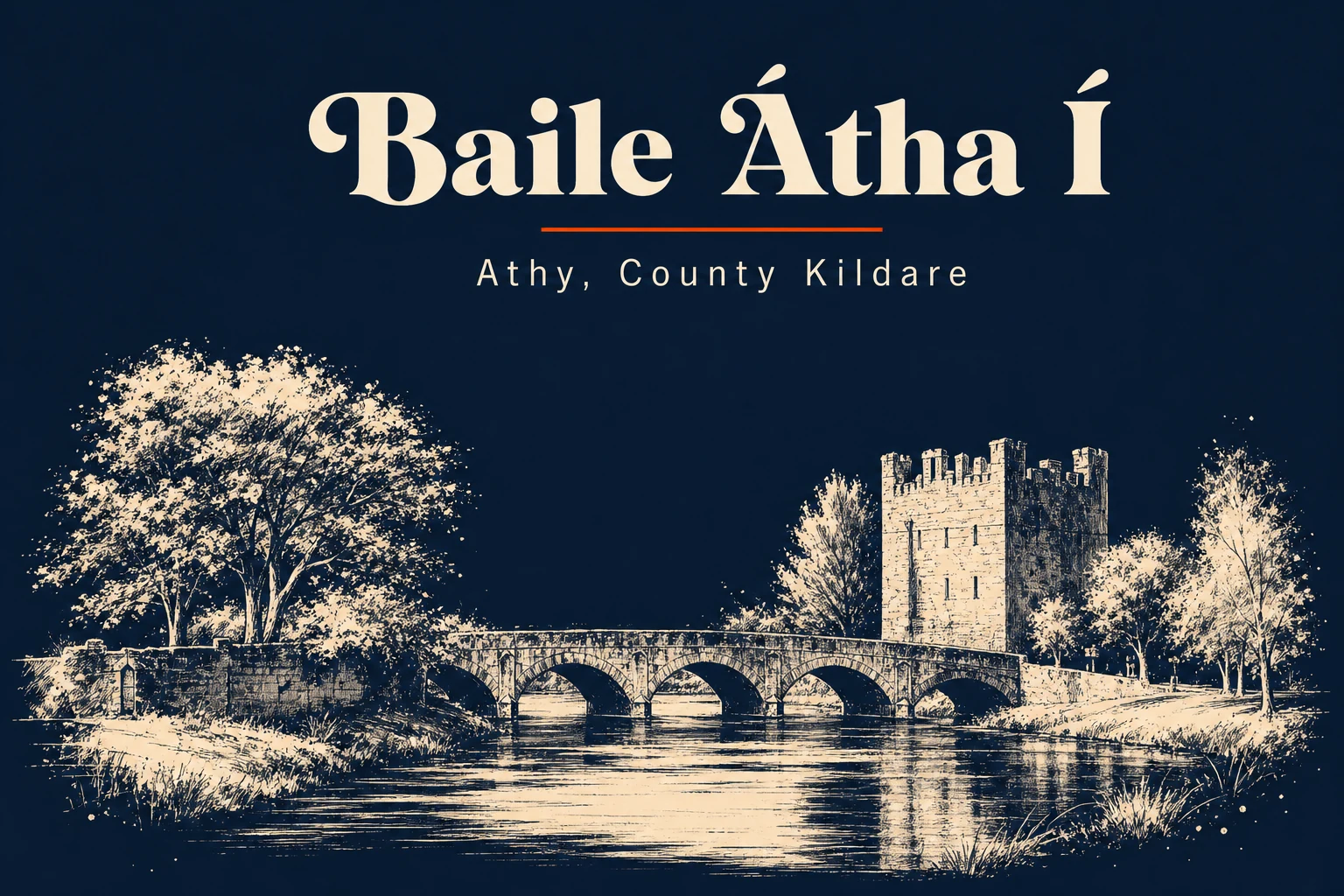
Baile Átha Í

The Ireland's Ancient East
STOP 03 / 06
Baile Átha Í · Co. Kildare

A working market town at the ford, with an explorer in the back room.

Athy is a market town first and a tourist town a distant fifth. The Tuesday market on Emily Square has thinned since the byelaws came in — a handful of stalls along the O'Brien's side now where it used to fill the back square down to the Barrow Quay — but it still happens, and the road still closes for it, and the council and the traders are still arguing about whose fault that is. That argument is the town in miniature: a working place, slowly negotiating with itself about what it wants to be.

The shape of the place is the river. The Barrow runs north–south through the middle of it; the Grand Canal Barrow Line drops in from the east and joins up just below Crom-a-Boo Bridge. White's Castle has been watching that bridge since 1417 — Sir John Talbot built it as the Anglo-Norman strongpoint at the southern end of Kildare, and the FitzGeralds ran the country from it for two hundred years. The town beneath is what that defence allowed to grow. The new church of St. Michael's, all 1960s concrete and glass, sits oddly across the square from the medieval stones. Athy is layered like that.

There were Quakers here from 1671. The Meeting House on Meeting Lane went up in 1780 and the Methodists took it over after 1812 when the Friends had thinned out. The bigger Quaker story is up the road at Ballitore — the only planned Quaker village in Ireland, the school Edmund Burke went to — but Athy's the market town the Friends came in to trade through. That layer is still there if you look for it. Most people don't.

Don't come here for postcards. Come for the autumn school in late October — three days of polar lectures and a town that briefly thinks about ice for a long weekend. Come for a Thursday session in Clancy's. Come for a pint in O'Brien's, which is still half grocer's, still 1875 inside, and which the locals will tell you is the real Athy. Stay one night, walk the Barrow Way at six in the morning when the mist is on the river, and you'll have the whole point.
Population
11,035
Pubs
14and counting
Walk score
Crom-a-Boo Bridge to Emily Square in five minutes
Founded
Anglo-Norman town, 12th century
Coords
52.9908° N, 6.9836° W
01 / 10

At a glance.

Three things every local will eventually mention. Read these and you've already understood more than most day-trippers do.

02 / 10

The pubs.

None of these are themed Irish pubs, because they don't need to be. A few that earn the trip:

Clancy's

Trad seven decades deep
Pub & music venue, since 1879

Jim Clancy started the session in 1966 by clearing the grocery storeroom out the back. It runs every Thursday from 8pm and has done since. Front bar is a proper traditional pub. Through the back is a cocktail bar and an outdoor terrace, which sounds like a clash and somehow isn't.

Frank O'Brien's

Time capsule, no apology
Pub & grocery, since 1875

Old-style shop in the front — sweets, fruit, sliced pan — pub through the swing doors at the back. They have been running it like that for 150 years and have no plans to change. Order a pint, look at the shelves, listen to whoever is talking. That's the whole experience.

The Auld Shebeen

Food-led, modern
Gastro bar

The pivot Athy has been quietly making — a proper kitchen, a wine list, a Sunday roast that books out. If you want a sit-down meal in a pub rather than a session in one, this is where to go.

Paddy Dunne's

Quiet, no music
Town local

The kind of small bar where the same six people have been drinking in the same six seats for thirty years. No menu, no telly worth watching, no reason to go in unless you want a slow pint and a chat. Which is sometimes exactly what you want.

The Castle Inn

Locals-leaning
Pub by the bridge

Sits a stone's throw from White's Castle, hence the name. Sport on the screens at weekends. A reliable mid-evening stop on the Leinster Street walk between the river and Emily Square.

03 / 10

Where to eat.

PlaceTypeLocal note
The Bay Tree Restaurant & guesthouse €€ On Stanhope Street. The most consistent kitchen in town for years now. Sunday lunch is the institution — book it. Coeliac-friendly the whole way through, properly so, not as a tick-box.
Bradbury's Bakery, café & deli Leinster Street. Family-run, everything baked on site. Soup-and-sourdough lunches, scones that ruin the chain-bakery scones forever, strong coffee. Day-only — closes when the bread is gone.
The Auld Shebeen kitchen Gastro bar food €€ Yes, the pub. The food is the reason most people walk in now. Steaks, fish, a Sunday carvery that draws from forty miles around. Book at the weekend.
New World Oriental Chinese €€ Athy's go-to for a sit-down Chinese — the kind of long-running town restaurant that has fed three generations of debs nights and post-match gatherings. Not aspirational. Reliable.
Mama Mia Pizza & pasta Italian-leaning, kid-friendly, busy on a Friday. The town's default pizza answer. Eat in or take away across the bridge.
04 / 10

Where to sleep.

PlaceTypeLocal note
Tonlegee House Country house & restaurant Two miles outside town on the Carlow road. Georgian house, antique furnishings, open fires, a restaurant that draws diners up from the M9. Status worth confirming before you book — it has changed hands more than once. When it is on, it is the best stay around Athy by a distance.
The Bay Tree Guesthouse & restaurant Six rooms above the restaurant on Stanhope Street. Walking distance to everything. The breakfast is the breakfast you came for.
Coursetown Country House B&B Out the Stradbally road, three miles from town. Working farm, four rooms, gardens, the kind of breakfast that means you skip lunch. The local fallback when town accommodation is tight.
A house on the Barrow Self-catering Drive ten minutes north towards Levitstown or south towards Maganey and the river-side cottages start. Quieter than town and closer to the Barrow Way. Worth the swap if you have a car.
05 / 10

Stories & lore.

The reason to come back. The things every local will eventually tell you about, usually after the second pint.

Born at Kilkea, 1874

Shackleton

Sir Ernest Shackleton was born on 15 February 1874 at Kilkea House, four miles south-east of Athy. He left Ireland at ten and spent the rest of his life trying to get further from it than anyone ever had — to the South Pole on Discovery, to Elephant Island on Endurance, to South Georgia in an open boat. The town has claimed him properly. The Shackleton Museum at the old Town Hall holds the Endurance scale model and the autumn school the last weekend of October pulls in polar people from everywhere. It is the cultural event of the Athy calendar, full stop.

The Anglo-Norman strongpoint

White's Castle

Sir John Talbot — later the English commander at the Battle of Castillon, where the Hundred Years' War effectively ended — built White's Castle in 1417 to defend the bridge over the Barrow. The FitzGerald earls of Kildare took it over and ran the south of the county from it for two centuries. Their war cry was 'Crom abú' — Crom forever, Crom being the FitzGerald rallying place — and that is where the bridge gets its name. The castle is still there. The cry is still on the bridge. The earls are gone.

Two waters, one town

The river and the canal

Athy sits at the only place in Ireland where the Grand Canal meets a major river — the Barrow Line drops in from Robertstown and joins the Barrow just below Crom-a-Boo Bridge. From the 1790s until the railway took over in the 1840s, that junction made Athy the inland port of south Leinster. Coal up from the Castlecomer mines, malt and grain down to Dublin, beet to the sugar factory at Carlow. The barges are gone but the lock gates still work, and the Barrow Way towpath runs the whole way south to St Mullins in Carlow. The river is doing the work the railway used to.

Friends in Meeting Lane

The Quakers

The first Quaker meeting in Athy was held in 1671. Thomas Weston and his wife had been converted in 1657 by the English preacher Thomas Loe, brought the message to Athy, and the Friends ran a small community here for 150 years — never as big as the planned Quaker village up at Ballitore, where Abraham Shackleton's school taught Edmund Burke and Cardinal Cullen, but a working trading community in a market town. The Meeting House went up on Meeting Lane in 1780. The Methodists took it over after 1812. Meeting Lane is still called Meeting Lane and most people in Athy do not know why.

06 / 10

Music, by day of the week.

Schedules drift. This is roughly right. The real answer is "ask in the first pub you find."

Mon
Quiet across the town
Tue
Market day — the music is the stalls
Wed
Occasional acoustic at The Auld Shebeen
Thu
Clancy's — trad session from 8pm, every Thursday since 1966
Fri
Clancy's — bands or DJs out the back
The Auld Shebeen — live music most weeks
Sat
Clancy's — late, busy
Pub-by-pub on Leinster Street
Sun
Sunday-afternoon trad pops up around the autumn school weekend; otherwise quiet
07 / 10

Things to do outside.

Wear waterproofs. Bring a sandwich. Tell someone where you're going if it's the mountain.

Barrow Way — Athy to Maganey South along the river towpath, past Ardreigh Lock, on to Maganey. Flat, traffic-free, mostly empty. The water is doing the work. Pub at Maganey if you time it right; otherwise turn around at the lock.
11 km returndistance
3 hourstime
The Heritage Trail A self-guided walk around the medieval core — White's Castle, Crom-a-Boo Bridge, the Dominican Abbey site, Emily Square, the new St. Michael's, Meeting Lane. The leaflet from the Shackleton Museum is the one to follow. A wet hour well spent.
2 km loop, towndistance
1 hourtime
Grand Canal Barrow Line — Athy to Vicarstown East along the canal towpath into Laois. Locks, lift bridges, herons, almost no one. Get a lift back or commit to a 28 km return day.
14 km one-waydistance
Half daytime
Bray Hill The local high point south of the town — modest by mountain standards, but a clear view over the Barrow valley and across to the Wicklow hills on a good day. Bring boots; the field-edge path is honest about Irish weather.
4 km returndistance
1 hour 15time
08 / 10

When to go.

There is no bad time. There are different times.

Spring
Mar–May

River paths drying out, lambs in the fields towards Kilkea, the canal lock-keepers back at work. Quiet weekends.

◉ Go
Summer
Jun–Aug

Long evenings on the Barrow Quay, the Athy Bluegrass Festival in mid-July at the GAA grounds, boats actually moving on the canal. Athy is never crowded — there's plenty of room for you.

◉ Go
Autumn
Sep–Oct

The autumn school weekend (last weekend in October) is the busiest the town gets all year. Book accommodation a month out. Worth it whether or not you go to a single lecture.

◉ Go
Winter
Nov–Feb

Cold, dark, the canal sometimes freezes at the lock. The Thursday session in Clancy's carries through regardless. Half the town is closed by 9pm.

◐ Mind yourself
09 / 10

What to skip.

Honestly? Don't bother.

If a local was sitting beside you, this is the bit where they'd lean in.

×
The Carlton Abbey Hotel

It has been closed for years. Planning permissions and rumoured re-openings have come and gone. Until you can ring it and book a room, treat it as shut.

×
The new shopping centre dining

The Bay Tree, Bradbury's, O'Brien's and The Auld Shebeen are all five minutes' walk from each other and all better. There is no reason to eat in a chain unit.

×
Treating the town as a Shackleton theme park

The museum is good. The autumn school is excellent. But Shackleton was born at Kilkea and left Ireland at ten — Athy is not his town in the way Dingle is Fungie's. Visit the museum, then go drink in O'Brien's like an adult.

×
Driving to the Cliffs of Moher from here

Athy is on the Dublin–Waterford line and the M9. It is a south-Leinster base, not a west-of-Ireland one. Carlow, Kilkenny, the Wicklow hills and the Curragh are the day trips. The Atlantic is six hours away.

+

Getting there.

By car

Dublin to Athy is 1h on the M9 — exit 3, then ten minutes on the R417. Carlow is 30 minutes south on the same road. Kilkenny is 50 minutes via the M9.

By bus

Bus Éireann route 132 runs Dublin–Carlow–Waterford via Athy several times daily. JJ Kavanagh's Dublin–Athy commuter service also runs. Drops on Leinster Street, two minutes from the bridge.

By train

Iarnród Éireann Dublin Heuston–Waterford line stops at Athy. About 1h from Heuston, several services daily. Station is a five-minute walk from Emily Square.

By air

Dublin Airport (DUB) is 1h 15m by car. Cork is 2h 15m. There is no closer airport.