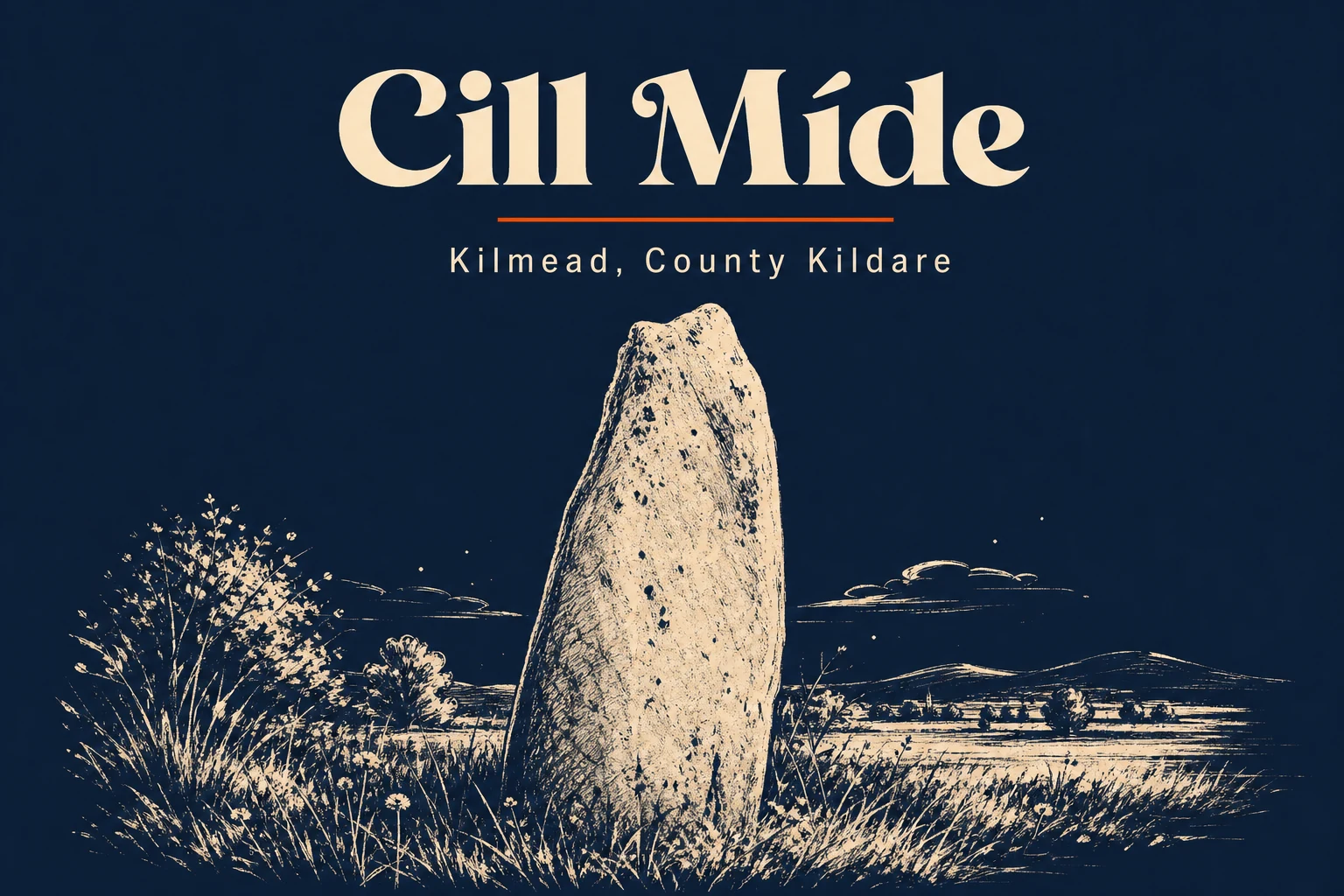
Cill Míde · Co. Kildare
A south Kildare crossroads with a pre-Emancipation church and one of the darkest hills in Irish memory a few fields north.
Kilmead sits on the R418, seven kilometres northeast of Athy, at a crossroads where a church, a graveyard and a scatter of farms gather around the road south to Castledermot. The surrounding country is flat, quiet south Kildare - wide fields, hedgerows, the Greese River threading through the townlands nearby. This was Fitzgerald country for centuries. Kilkea Castle, the family's old seat, is a few kilometres down the same road.
The Irish name, Cill Míde, is usually read as middle church - not, as the similar-sounding Kilmeedy in Limerick, the church of Saint Ita. The dedication of the church here to Saint Ita is the later layer. The building itself, Saint Ita's, was raised around 1798, before Catholic Emancipation, which makes it an unusual survival: a substantial Catholic church put up in the open three decades before the law fully allowed it. T-shaped plan, lancet windows, stained glass, a cut-stone bellcote, a freestanding belfry added around 1870.
The bigger history is a few fields away. Mullaghmast, to the north near Ballitore, is where in the winter of 1577 to 1578 Crown forces under Sir Francis Cosby summoned the Gaelic gentry of Laois - the O'Moores, O'Lalors and the rest - to a meeting under safe conduct, and killed most of them. The hill has been a watchword in Irish memory ever since. Daniel O'Connell held one of his great Repeal meetings there in 1843, the last but one before he called off Clontarf. Kilmead wears none of this on its sleeve. It is a working crossroads. The weight is underfoot.