County Kildare Ireland · Co. Kildare · Kilmeage Save · Share
POSTED FROM
KILMEAGE
CO. KILDARE · IE

Kilmeage
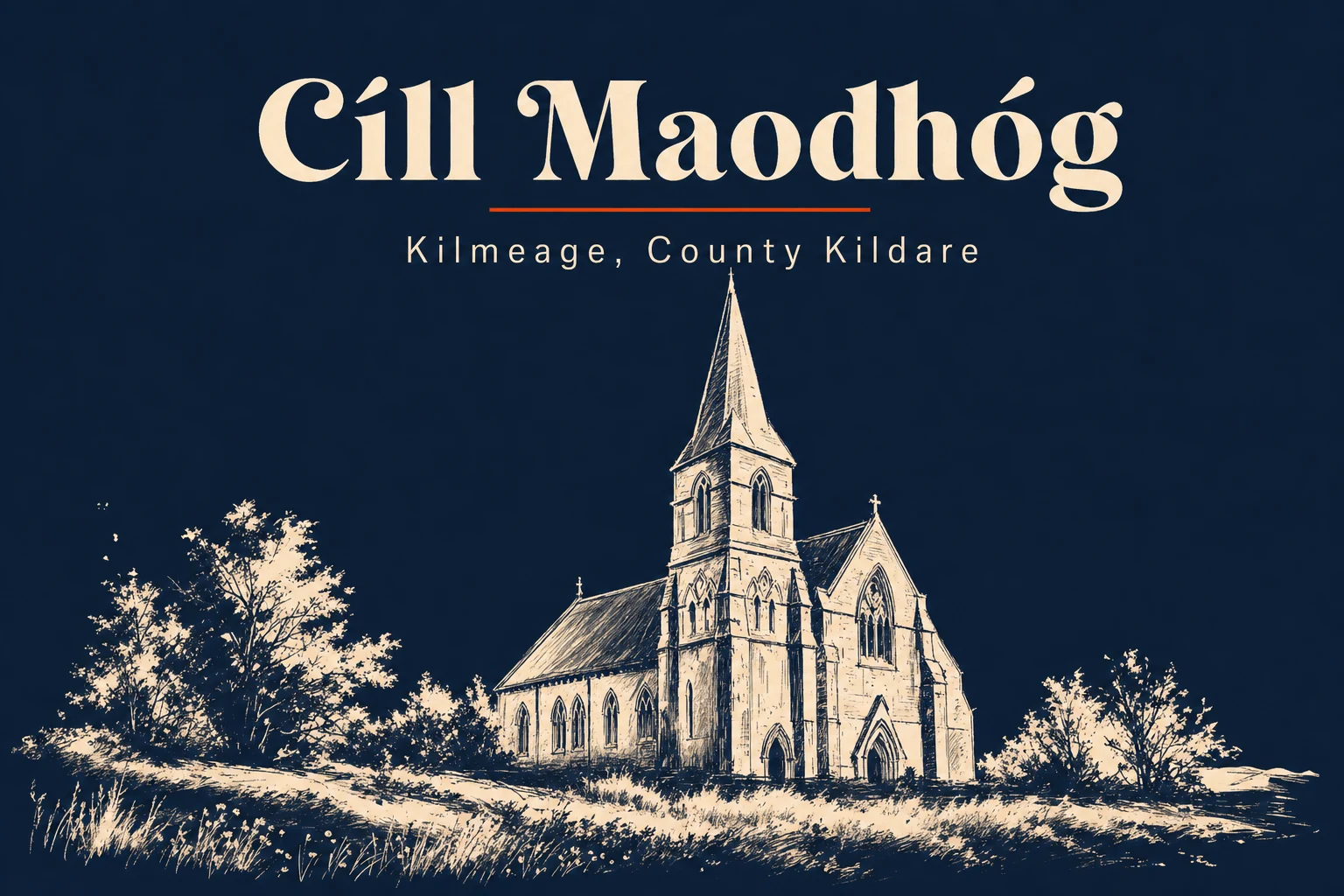
Cill Maodhóg

The Ireland's Ancient East
STOP 07 / 07
Cill Maodhóg · Co. Kildare

A saint's name, a ruined castle, and the bog at the edge.

Kilmeage is a small parish village on the R415 in west Kildare, between the Hill of Allen and the Grand Canal at Robertstown. The name is the village's best fact — Cill Maodhóg, the church of Saint Maodhóg, a 6th-century monk who trained under Saint David in Wales, returned to Ireland, and founded thirty churches across Leinster before dying in 632. He is the first Bishop of Ferns. Kilmeage is one of the foundations he left behind, and the Irish name has carried that fact intact across fourteen centuries.

The other layer is the Fitzgeralds. The family that gave Kildare its dukedom built a castle here — the Fitzgeralds of Allen, a branch of the Geraldines. In the autumn of 1649, as Cromwellian forces moved through County Kildare, General Hewson's dispatches recorded that the garrison at Kilmeague fired their own castle rather than surrender it. What remained became what remains: a low scatter of stone beside the old church site, on a lane at the edge of the village.

The population was 997 at the last count. The R415 passes through. There is a pub. The bog is visible from the road. Robertstown, with its intact Georgian canal hotel and harbour, is a short drive northeast. The Hill of Allen, with its Victorian folly tower and the long view across the midlands, is southwest. Kilmeage itself is the crossroads between them — useful, quiet, and honest about its own scale.
Population
997 (2011)
Walk score
Small crossroads — five minutes end to end
Founded
6th-century church foundation
Coords
53.2506° N, 6.8394° W
01 / 07

At a glance.

Three things every local will eventually mention. Read these and you've already understood more than most day-trippers do.

02 / 07

The pubs.

None of these are themed Irish pubs, because they don't need to be. A few that earn the trip:

Travellers Rest

Proper local — pool, darts, good Guinness
Local pub, R415

On the R415 at Littletown, the edge of Kilmeage. No food served, but the bar is consistently praised for a clean pint and a decent atmosphere. The staff are happy for you to order in from a nearby takeaway if you need feeding. Weekends get the locals in.

03 / 07

Stories & lore.

The reason to come back. The things every local will eventually tell you about, usually after the second pint.

Thirty churches and a name that stuck

Saint Maodhóg

Áed — later Maodhóg, an affectionate diminutive meaning 'my dear little fire' — was born around 558 in what is now County Cavan. He studied under Saint Finnian of Clonard, then crossed to Wales to learn under Saint David. When he came back he began founding churches across Leinster. Tradition counts thirty of them. King Brandubh of Leinster elevated Ferns to a diocese and made Maodhóg its first bishop. He died on 31 January 632 on the shore of Lough Melvin in County Leitrim. Kilmeage is one of the foundations he left — a field, a name, a church site still in use.

The Fitzgeralds burn their own house

Kilmeague Castle, 1649

The Fitzgerald family — a branch of the Geraldines, the great Norman dynasty that controlled much of Kildare — held land at Allen and built their castle a few perches from the village. In late 1649 General Hewson, one of Cromwell's commanders in Ireland, reported that the garrison of Kilmeague torched the castle as his forces approached. It was a common tactic: deny the enemy a stronghold. Today extraordinarily little of the structure remains. The low ruins stand near the old church site, in a field that most people drive past without stopping.

A burial ground used by both, until recently

The Protestant church on the Catholic site

The present Church of Ireland building in Kilmeage was erected on the site of the earlier Catholic church. The adjoining burial ground continued to be used by Catholics until comparatively recently. The Anú Heritage organisation has documented this layering of faiths on a single site as part of a recorded historic footpath through the village. It is the kind of thing that is very Irish and rarely remarked upon.

04 / 07

Things to do outside.

Wear waterproofs. Bring a sandwich. Tell someone where you're going if it's the mountain.

Kilmeague Historic Footpath Documented by Anú Heritage. Takes in the castle ruins, old church site, and the layered Protestant/Catholic burial ground. Short and specific — the kind of walk that gives you the whole village history in under an hour.
Village-scale loopdistance
30–45 mintime
Grand Canal Towpath — Robertstown Drive or walk northeast to Robertstown harbour and pick up the Grand Canal towpath. Flat, open, big bog sky. The Georgian canal hotel still stands at the quay. Walk in either direction and the midlands does the rest.
2.5 km one waydistance
35 mintime
Hill of Allen Three kilometres southwest. Park near the old graveyard in Allen village and take the eastern approach to the folly tower on the summit. The view across the Bog of Allen explains why Fionn mac Cumhaill supposedly made this his headquarters. The western face is an active Roadstone quarry — stay on the eastern path.
Short steep climb from Allen villagedistance
40 min up and downtime
05 / 07

When to go.

There is no bad time. There are different times.

Spring
Mar–May

Bog cotton comes out, the canal path is walkable again, the Hill of Allen is clear on a good day.

◉ Go
Summer
Jun–Aug

Long midlands evenings. Everything is accessible. Robertstown gets some canal boat traffic, which is pleasant.

◉ Go
Autumn
Sep–Oct

The bog turns colour. The Hill of Allen is at its emptiest. Low light, large sky.

◉ Go
Winter
Nov–Feb

The towpath turns to mud and the Hill is often in cloud. The pub at the crossroads is the reasonable option.

◐ Mind yourself
06 / 07

What to skip.

Honestly? Don't bother.

If a local was sitting beside you, this is the bit where they'd lean in.

×
Looking for a castle to walk around

Kilmeague Castle is a low scatter of stone in a field. It rewards knowing the story — which is real — but not the hope of standing walls or a photogenic ruin.

×
Expecting food at the Travellers Rest

It is a genuine local bar. No kitchen. Worth the pint; not the dinner. Robertstown or Allenwood has options.

×
Treating the Hill of Allen as part of Kilmeage

The Hill is in Allen, three kilometres southwest. Worth the detour — but it is a separate stop. Don't drive to Kilmeage expecting to park and climb.

+

Getting there.

By car

Dublin to Kilmeage is about 50 minutes via the M7 to Naas, then north on the R445 to Newbridge and west on the R415. The R415 runs through the village between Allen and Robertstown. Naas is 12 km southeast.

By bus

No direct bus service to the village. The nearest useful stop is on the Bus Éireann Naas–Edenderry corridor. A car is the practical option for visiting.

By train

No station. Sallins/Naas (approximately 15 minutes south by car) is the nearest commuter rail on the Dublin–Kildare line.

By air

Dublin Airport is about 70 km, roughly an hour by car via the M7.