Baile na Coille · Co. Laois
A small planned estate town in south Laois that was once a parliamentary borough. The Square, a Market House, a 1798 monument, and Lutyens gardens a mile down the road.
Ballinakill - Baile na Coille, the town of the wood - is a small estate town in the south of Laois, between Abbeyleix and the Kilkenny border. The name suggests woodland, and the country around it is still soft and wooded. But the village itself is the thing to read: a planned town built on ambition that history quietly walked away from.
It was chartered by James I in 1612, after Sir Thomas Ridgeway took the lands the year before, built a castle and set about making a colony of it. From 1613 to 1800 Ballinakill was a parliamentary borough, returning two members to the Irish House of Commons - a rotten borough in the end, but a borough. The castle was besieged and plundered in the 1641 rebellion and later cannonaded by Cromwell's gunners from the high ground above the town. The 18th century was the good century, when the Trench family laid out the present plan: The Square, Church Street, Bride Street, a Market House, and one of the busiest cattle fairs in the county, which ran on until 1963.
Most of that is still legible if you walk it. The Square holds the Market House and a monument raised in 1898 to the men of 1798. Church Street has the unusual sight of two churches standing all but shoulder to shoulder. The town that once had 4,000 people in its parish now has around 450, and the through-traffic that would have made it a stop is mostly gone. That is the trade. It is quiet, and the quiet is the point.
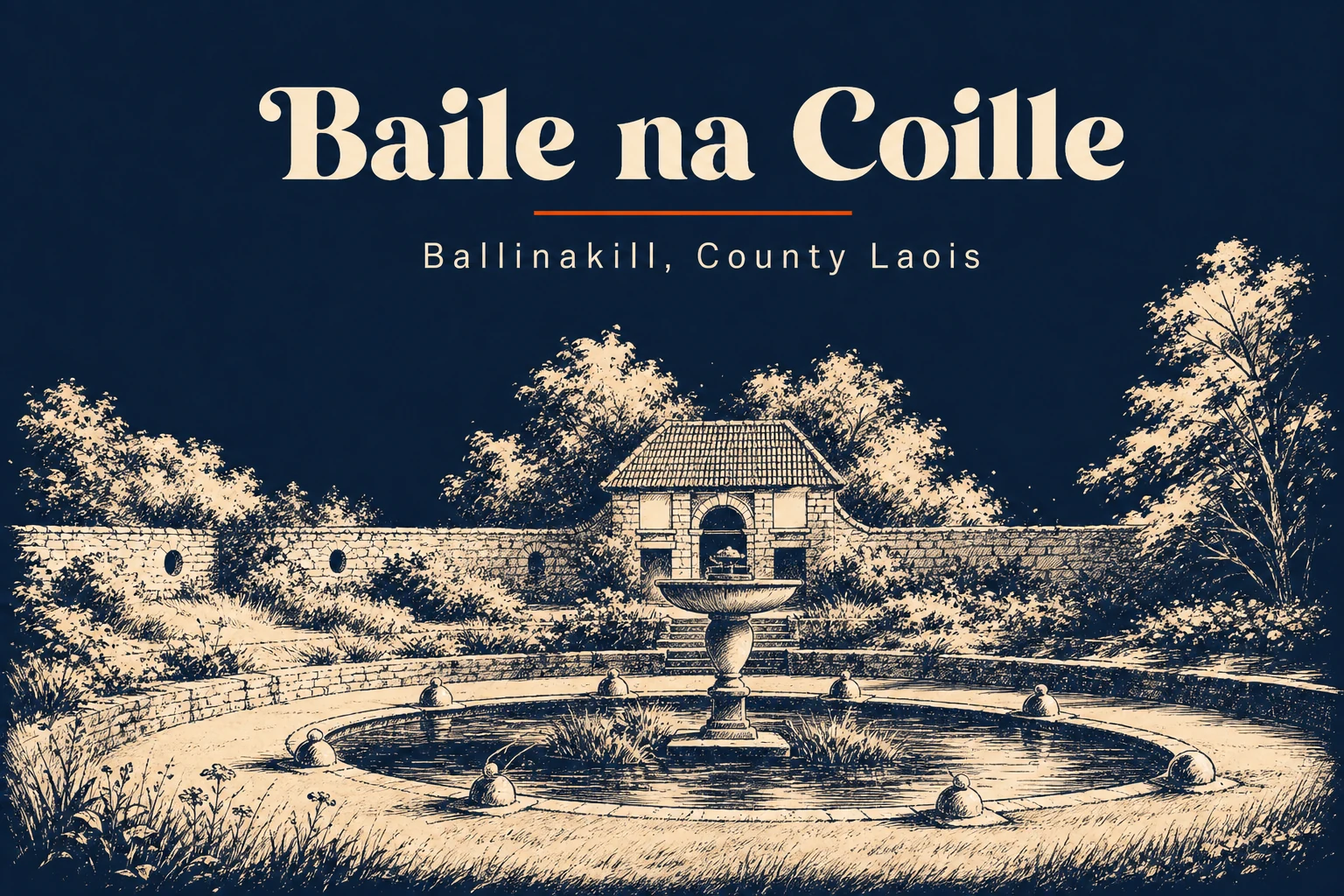
The reason to make the detour is Heywood. A mile out the R432, on the demesne now shared with Heywood Community School, the Office of Public Works keeps the formal gardens Sir Edwin Lutyens designed around 1906 - a sunken garden with a long elliptical pool, a fountain, a red-tiled loggia, all dropped into an older romantic parkland of lakes and woodland that Frederick Trench began in the 1700s. The big house is long gone. The gardens are not, and they are free to walk.