County Laois Ireland · Co. Laois · Ballyroan Save · Share
POSTED FROM
BALLYROAN
CO. LAOIS · IE

Ballyroan
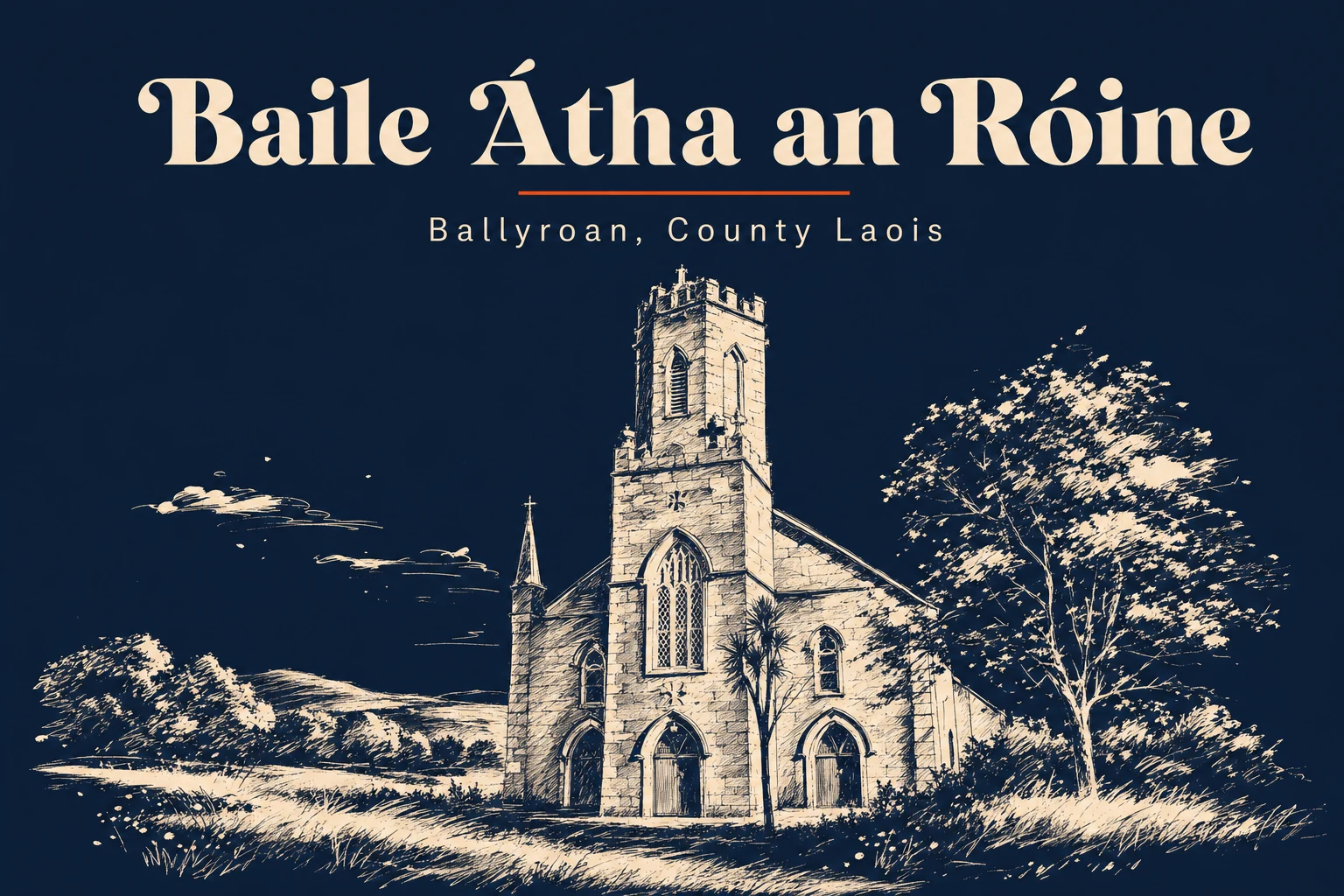
Baile Átha an Róine, Co. Laois

The Ireland's Ancient East
STOP 07 / 07
Baile Átha an Róine · Co. Laois

A small village in central Laois that the O'Mores held for two centuries, with three pubs, a GAA club, and a song of its own.

Ballyroan sits in central Laois, five kilometres north-east of Abbeyleix on the R425, in the old barony of Cullenagh. It is a Main Street village - a row of houses, three pubs, a church, a GAA pitch - the kind of place that connects Abbeyleix to Portlaoise without setting out to be a destination. Neither dramatic nor dull. Just real.

It is older than it looks. Conall Ó Mórdha built a castle here in the fourteenth century, and the O'Mores - the family that gave Laois its Gaelic lords - held the ground until the Tudor plantations broke them. The castle is gone now, but the name remembers it: Baile Átha an Róine, the town of the ford. Later the place picked up other layers. Alderman John Preston endowed a school here in 1686, the Brigidine Sisters opened a convent and school in 1877 that ran until 1974, and the RIC barracks was burned in 1920 like so many across the country.

What you find today is a working village rather than a heritage stop. The pull is the GAA club, Ballyroan Abbey, and the rhythm it gives the place: quiet on a Tuesday, the centre of everything on a match Sunday. The village even has its own song, "The Skies O'er Ballyroan", which is more than most places this size can claim. Come for a pint and the talk in Whelan's or Doogue's, not for monuments.

If you are passing through Laois off the M7, Ballyroan is a five-minute detour from Abbeyleix and worth it for the unhurried version of the county. Most of inland Laois looks like this once you leave the Heritage Towns behind, and Ballyroan is an honest sample of it.
Population
~563 (2016)
Pubs
3and counting
Founded
Medieval O'More castle, 14th century
Coords
52.9478° N, 7.3053° W
01 / 07

At a glance.

Three things every local will eventually mention. Read these and you've already understood more than most day-trippers do.

02 / 07

The pubs.

None of these are themed Irish pubs, because they don't need to be. A few that earn the trip:

Whelan's Bar

The Main Street local
Village pub, Main Street

On Main Street, the village's anchor pub. The morning Local Link to Portlaoise and Tullamore stops outside it. A proper rural local - pint, talk, the GAA on the television - and the first place to head for the feel of the village.

Doogue's Bar

Old-school local
Village pub

One of the three pubs that keep a village of this size in conversation. Traditional, unfussy, locals first. The kind of bar where the match is the only thing on and that is exactly the point.

Scully's

The song pub
Village pub

Long associated with "The Skies O'er Ballyroan". For a village of a few hundred people to hold on to three pubs says something about the place. This is the third, and on a county-final weekend it earns its keep.

03 / 07

Stories & lore.

The reason to come back. The things every local will eventually tell you about, usually after the second pint.

Conall Ó Mórdha, 14th century

The O'More castle

The annals record that Conall Ó Mórdha, son of Daibhí Ó Mórdha and a lord of Laois, built the castle of Baile Átha an Róine in the fourteenth century. The O'Mores were the dominant Gaelic family of this county, and they held Ballyroan and the surrounding country until the Tudor plantations of the sixteenth century dispossessed them. Nothing of the castle stands today, and the precise site is uncertain - this is a place where the history is in the name and the records rather than the stones. But the village exists because a Gaelic lord chose to fortify a ford here, and the Irish name still says so.

1686 to 1974

Preston, the Brigidines and the schools

Ballyroan has a long schooling history for so small a place. In 1686 Alderman John Preston founded a school in the village, endowed with lands, in a large slated building put up at a cost of five hundred pounds - Protestant boys taught free, Catholic boys paying a pound a quarter. Nearly two centuries later, in 1877, the Brigidine Sisters arrived: three nuns took up residence in a newly built convent on the 25th of September that year and opened a school that ran until 1974. In 2017 the village's boys' and girls' primary schools merged into Pope John Paul II National School. Education has been part of Ballyroan's story for over three hundred years.

1914 to 1920

The barracks and the Volunteers

Ballyroan had a sharper political edge than its size suggests. When the Irish Volunteers split in 1914 over John Redmond's call to support the British war effort, Ballyroan's corps was the only one in Laois to side with Eoin MacNeill against him. Six years later, on the 3rd of April 1920, the abandoned RIC police barracks in the village was attacked and burned - one of hundreds of such raids across the country during the War of Independence, intended to deny the Crown forces a foothold in rural districts.

04 / 07

Things to do outside.

Wear waterproofs. Bring a sandwich. Tell someone where you're going if it's the mountain.

Main Street and the village Ballyroan is a walk-it-in-one-go village. The Church of Ireland church from around 1800, renovated about 1860 and possibly on the site of a seventeenth-century church, sits among the houses. There is no signposted heritage trail - this is a place you read by walking it slowly and reading the name into the ground.
1 kmdistance
20 minutestime
Abbeyleix and Heywood The serious walking is five kilometres south-west. Abbeyleix has its town park and the Sensory Gardens, and Heywood Gardens at Ballinakill - Lutyens-designed, with a Gertrude Jekyll planting scheme - is one of the finest formal gardens in the midlands, free to enter and signposted off the R432.
Short drivedistance
Half a daytime
05 / 07

When to go.

There is no bad time. There are different times.

Spring
Mar-May

Green fields, long light, the GAA season cranking up. The quiet, comfortable face of inland Laois.

◉ Go
Summer
Jun-Aug

Long evenings and championship football. A match weekend is when the village is most itself.

◉ Go
Autumn
Sep-Oct

County-final season. If Ballyroan Abbey are in it, this is the time to hear "The Skies O'er Ballyroan" sung in earnest.

◉ Go
Winter
Nov-Feb

Short days and very quiet. The pubs keep going; little else does. Pair it with Abbeyleix for a fuller day.

◐ Mind yourself
06 / 07

What to skip.

Honestly? Don't bother.

If a local was sitting beside you, this is the bit where they'd lean in.

×
Looking for the castle

The O'More castle is gone and its exact site is not certain. Come for the story and the name, not for a ruin to photograph. The history here is in the records, not the stones.

×
Treating it as a heritage town

Abbeyleix and Durrow are the Heritage Towns of south Laois. Ballyroan is a working village - three pubs, a church, a football club. Set your expectations to a quiet local stop and it delivers; set them to a tourist destination and it will not.

×
A weekday in winter

Come through on a wet Tuesday in January and you will wonder why you bothered. The village runs on the GAA calendar and the weekend. Time it for a match if you can.

+

Getting there.

By car

Five kilometres north-east of Abbeyleix on the R425, about 12 km south of Portlaoise. From the M7/M8 motorway, exit for Abbeyleix and follow the R425.

By bus

TFI Local Link Laois Offaly route 4994 (Durrow - Abbeyleix - Ballyroan - Portlaoise - Mountmellick - Tullamore - Athlone) stops at Whelan's Bar on Main Street, weekdays. The nearest frequent services and the train are at Portlaoise.

By train

Nearest station is Portlaoise (about 12 km north), on the Dublin Heuston to Cork/Limerick main line.