County Leitrim Ireland · Co. Leitrim · Dowra Save · Share
POSTED FROM
DOWRA
CO. LEITRIM · IE

Dowra
An Damhshraith, Co. Leitrim

The Ireland's Hidden Heartlands
STOP 07 / 07
An Damhshraith · Co. Leitrim

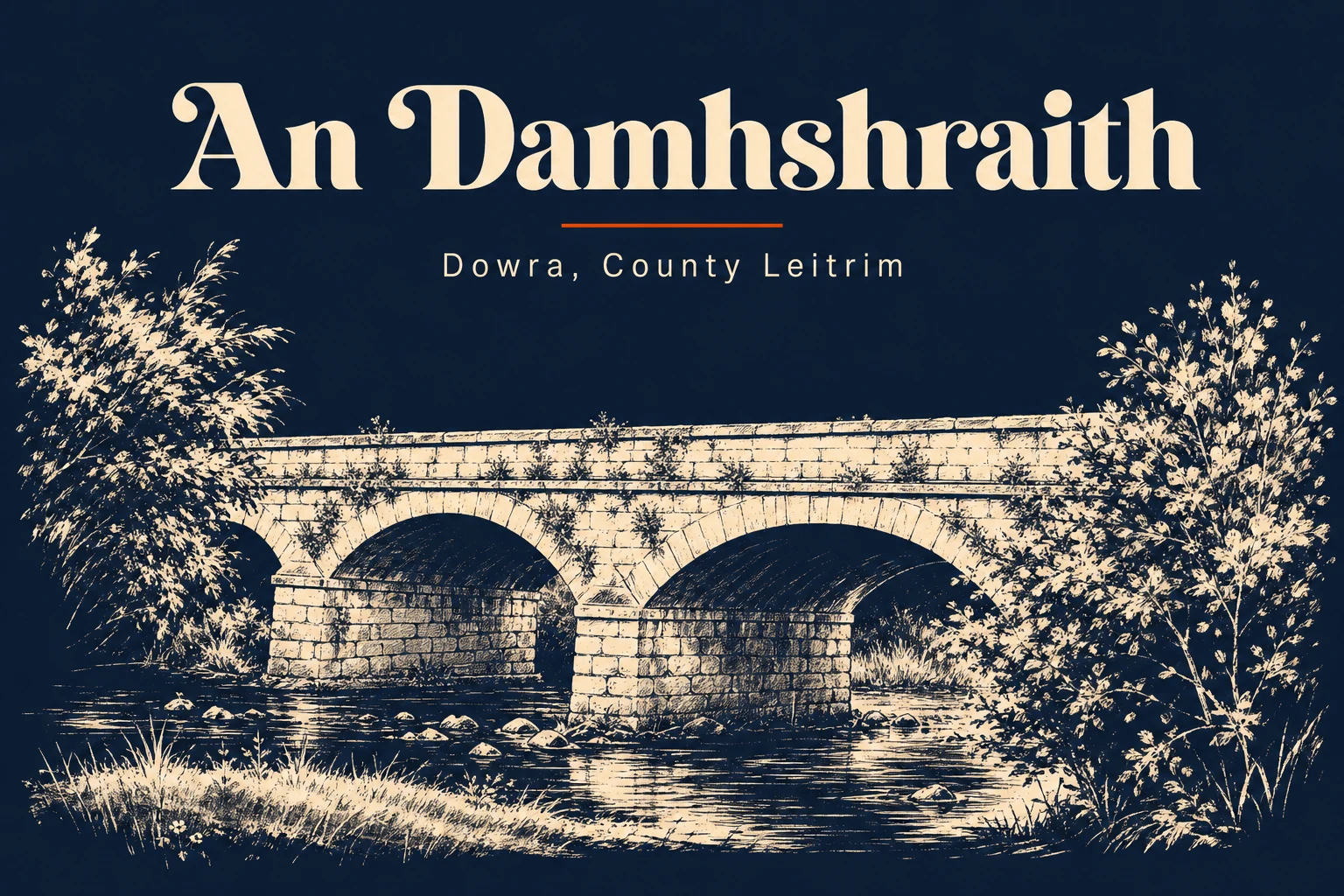
A border bridge over the young Shannon where the Cavan Way ends and the Leitrim Way begins, with the Black Pig's Dyke running off into the bog beside it.

Dowra is a tiny village on the Cavan/Leitrim border, in a valley at the head of Lough Allen, and it is built around a bridge. On one side of the bridge is Cavan, on the other is Leitrim, and the village has spent its existence being claimed by both and administered between them. The river under the bridge is the young Shannon - Ireland's longest river, rising a few miles north on the Cuilcagh plateau - and Dowra marks its uppermost navigable point. This is the very top of the Shannon system, the source end, remote and high and quiet.

The village is young by Irish standards. The settlement that came before it, Tober, was washed away by landslides in the summer of 1863, and Dowra grew up afterwards near the bridge. By 1925 it was eighteen houses, ten of them licensed to sell drink - a ratio that tells you what a market and droving village did with itself in the long evenings. A livestock mart still runs on a Saturday. The country around is McGovern (Magauran) clan land, the old chiefly family of this corner of Breifne.

Do not come expecting much in the way of services. This is a place of perhaps a hundred and fifty people, a handful of buildings, a pub or two, a shop, the restored courthouse, and a great deal of bog, hill and water in every direction. The reason to stop is the walking and the strangeness of the geography: the top of the Shannon, two long-distance trails crossing at the bridge, and an Iron Age rampart running off into the fields. It is honest emptiness, and it knows it.

If you are basing yourself for the upper Shannon and the Cuilcagh country, Dowra is a reasonable jumping-off point, but plan to find food and a bed in the bigger places. Drumkeeran and Drumshanbo are south along Lough Allen, Blacklion and Glangevlin are over the Cavan side toward the mountain, and the Shannon Pot - the traditional source of the river - is a short drive north at the top of the Cavan Way.
Population
~147 (2002 census)
Walk score
Two waymarked long-distance trails meet at the bridge
Founded
Late 19th century, after the village of Tober was lost to landslides in 1863
Coords
54.1896° N, 8.0150° W
01 / 07

At a glance.

Three things every local will eventually mention. Read these and you've already understood more than most day-trippers do.

02 / 07

The pubs.

None of these are themed Irish pubs, because they don't need to be. A few that earn the trip:

Creightons Bar

Family-run local with live music
Village bar, on the Cavan side

A family-run bar in the village, well regarded locally for friendly staff and for live music. In a place where 1925 counted ten licensed houses among eighteen, the pub is still the social centre of gravity. Expect a small, genuine local rather than a gastro operation - a pint, a chat, and a tune when there is one on.

03 / 07

Stories & lore.

The reason to come back. The things every local will eventually tell you about, usually after the second pint.

Cavan at one parapet, Leitrim at the other

The bridge between two counties

Dowra is one of those Irish places that exists across a line. The bridge over the Shannon carries the county boundary: the main cluster of the village, with its pubs and shop, sits on the Cavan side, while the national school and a good part of the parish are in Leitrim. Locally this is simply a fact of life rather than a curiosity - people are from Dowra, and which county the post comes from is a secondary matter. The village formed in its present spot after a neighbouring settlement, Tober, was destroyed by landslides in the summer of 1863. By 1925 Dowra had grown to eighteen houses, of which ten held licences to sell alcohol, which is the kind of statistic that explains a droving village at the head of a lake better than any guidebook sentence.

An Iron Age frontier in the bog

The Black Pig's Dyke

Outside Dowra, running south-west alongside the River Shannon, is a surviving stretch of the Black Pig's Dyke - an Iron Age linear earthwork of bank and ditch that once marked and controlled a frontier across the old province of Ulster and the kingdom of Breifne. The Dowra section, around 4.4 kilometres long, is one of the better-preserved lengths of a monument that appears in fragments across several counties. Folklore attached the name to a great black pig that rooted up the ground in a single night, which is the sort of story people told when the real builders had been forgotten for over a thousand years. Archaeologists date the construction to roughly the first centuries BC. It is not a tidied, signposted heritage site - it is a feature in the landscape, and you need a bit of guidance and a willingness to read the ground to make sense of it.

Uppermost navigable point of the longest river in Ireland

The top of the Shannon

The Shannon rises at the Shannon Pot on the Cuilcagh slopes a few miles north, and by the time it reaches Dowra it is still a young upland river running toward the head of Lough Allen. Dowra marks the uppermost navigable point of the whole Shannon system - the furthest up that a boat can go on a river that runs 360 kilometres south to the Atlantic below Limerick. There is something worth pausing over in standing at the very top of a waterway that defines the middle of the country. The Cavan Way, which begins in the village, runs north up to the Shannon Pot itself, letting you walk from the navigable head of the river to its traditional source in a morning.

Restored 2014, a creative hub on the border

The courthouse that became an arts space

Dowra's former courthouse, a modest stone building from the era when petty sessions sat in every market village, was restored and reopened in 2014 as the Dowra Courthouse Community Creative Arts Space. The work conserved the roof, windows and doors, added disabled access and a lift, and turned the old sessions house into a venue for exhibitions, workshops and gatherings under the stewardship of Cavan County Council, with a stated emphasis on supporting small and emerging artists. For a village this size to keep its courthouse standing and put it to use, rather than let it fall in, is the kind of small civic stubbornness that keeps places like Dowra on the map. Opening hours follow events, so check locally before relying on it being open.

04 / 07

Things to do outside.

Wear waterproofs. Bring a sandwich. Tell someone where you're going if it's the mountain.

Cavan Way (Dowra to Shannon Pot and Blacklion) The Cavan Way begins in Dowra and runs north to the Shannon Pot - the traditional source of the River Shannon - and on through upland and karst country toward Blacklion. Walking the southern section from Dowra to the Pot takes you from the navigable head of the Shannon to its source. Waymarked; boots and waterproofs for the boggy upland stretches.
26 km full routedistance
Full day, or section walkstime
Leitrim Way (Dowra section) The Leitrim Way passes through Dowra, where it meets the Cavan Way. The Dowra section is rated moderate and runs roughly 15 kilometres through the hill country above Lough Allen. Part of a 56-kilometre waymarked long-distance route down the county; section-walk it from the village.
~15 km sectiondistance
~3 hr 45 mintime
Black Pig's Dyke The surviving 4.4-kilometre stretch of the Iron Age earthwork runs south-west of the village beside the Shannon. There is no formal trail and the monument sits in farmland, so go with local guidance and respect for the ground. More of an archaeological curiosity to seek out than a developed walk.
Short, alongside the riverdistance
~45 minutestime
05 / 07

When to go.

There is no bad time. There are different times.

Spring
Mar-May

The upland trails dry out from April and the bog colours are fresh. Long evenings coming in and almost no one about. A good time for the Cavan Way south of the Pot.

◉ Go
Summer
Jun-Aug

The best window for the long-distance walking and for the Shannon Pot. Even in summer this is a quiet corner - the crowds are over on the Fermanagh boardwalk, not here. Long daylight for full-route days.

◉ Go
Autumn
Sep-Oct

October colour on the bog and hills above Lough Allen is the reason to come. Trails still walkable, days shortening but workable. The quietest and arguably the most atmospheric season.

◉ Go
Winter
Nov-Feb

Short days, exposed upland, and weather that comes hard off the Cuilcagh plateau. The trails are wet and the navigation demanding in cloud. The pub keeps going; the hill walking does not always reward you. Check conditions.

◐ Mind yourself
06 / 07

What to skip.

Honestly? Don't bother.

If a local was sitting beside you, this is the bit where they'd lean in.

×
Dining and accommodation in Dowra itself

This is a village of roughly a hundred and fifty people. There is no hotel and very little in the way of restaurants or beds. Base in a bigger place - Drumshanbo, Drumkeeran or over toward Blacklion - and use Dowra as a trailhead and a pub stop.

×
Expecting the Black Pig's Dyke to be a visitor attraction

It is an Iron Age earthwork in farmland, not a heritage centre. There is no car park, cafe or interpretation on the ground at the Dowra stretch. Read up first, or you will drive past a bank in a field and wonder what you were meant to see.

×
Arguing about which county Dowra is in

It is in both, and that is the point. The bridge is the boundary. Locals settled the question long ago by not minding. You should do the same.

+

Getting there.

By car

Dowra sits at the junction of the R200 and R207 regional roads, in the remote north-west between Lough Allen and the Cuilcagh mountains. A car is essential. Drumshanbo is about 25 minutes south down the western shore of Lough Allen; Blacklion and the Cavan border country are 20 to 30 minutes east toward the mountain.

By bus

There is no useful scheduled bus service to Dowra. Local Link operates limited rural routes in this part of Leitrim and Cavan, but frequency is low - check current timetables before relying on public transport. In practice you will need a car.

By train

No railway. The nearest mainline stations are Carrick-on-Shannon (about 45 minutes south) on the Dublin-Sligo line, and Sligo itself, both requiring onward driving.