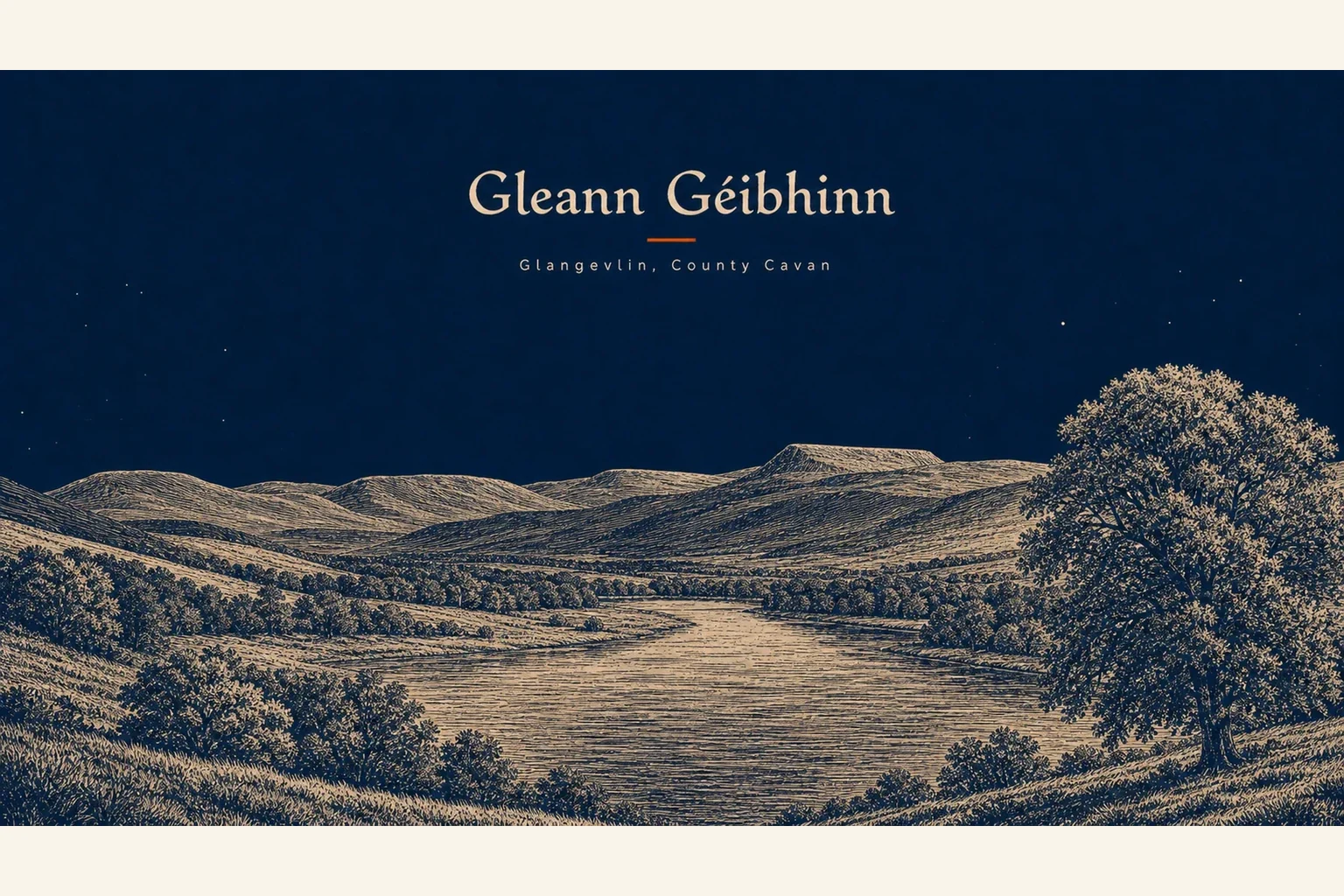
Gleann Géibhinn · Co. Cavan
The road ends here. The mountain and the Stone Age do not.
Glangevlin is in the extreme north-west of Cavan, up a valley under the Cuilcagh mountains, at the end of a road that does not continue. The Irish name, Gleann Géibhinn, translates as the narrow glen, and the landscape enforces it - the valley walls rise steeply on both sides, Cuilcagh closes off the north, and the only practical way in or out is the single road south. About two hundred people live here. The area is strongly Gaelic in character: Irish language, traditional music, the deep rural quiet that comes from a place that has always been at the edge of what maps consider worth annotating.
Cuilcagh Mountain is the dominant fact. At 665 metres it is the highest peak in both Cavan and Fermanagh, and Glangevlin offers the southern approach - longer, steeper, and far less used than the celebrated boardwalk route from the Fermanagh side. The Shannon Pot, a spring on the western slopes of the mountain, is the traditional source of the River Shannon, which runs 360 kilometres south to the Atlantic. That a river as large as the Shannon originates in a quiet pool on a mountain above a valley this small is the kind of geographical fact that takes a moment to sit with.
A few kilometres from the village, the Cavan Burren Park covers a plateau of exposed limestone pavement: grykes, clints, and the remnants of a megalithic landscape put in place by people farming here five thousand years ago. The court tombs and portal dolmens are not the tidied-up, sign-posted monuments of more visited places. They stand in fields and on hillsides more or less as they were left. The geology is the same formation as the Burren in County Clare - the same carboniferous limestone, the same karst drainage, the same sense of looking through the ground at a vastly older world.
You come to Glangevlin for the mountain or the megaliths, ideally both, and you stay longer than you planned. There is no through-traffic, no tourist office, and no confusion about why you are here. The valley knows what it is.