County Cavan Ireland · Co. Cavan · Swanlinbar Save · Share
POSTED FROM
SWANLINBAR
CO. CAVAN · IE

Swanlinbar
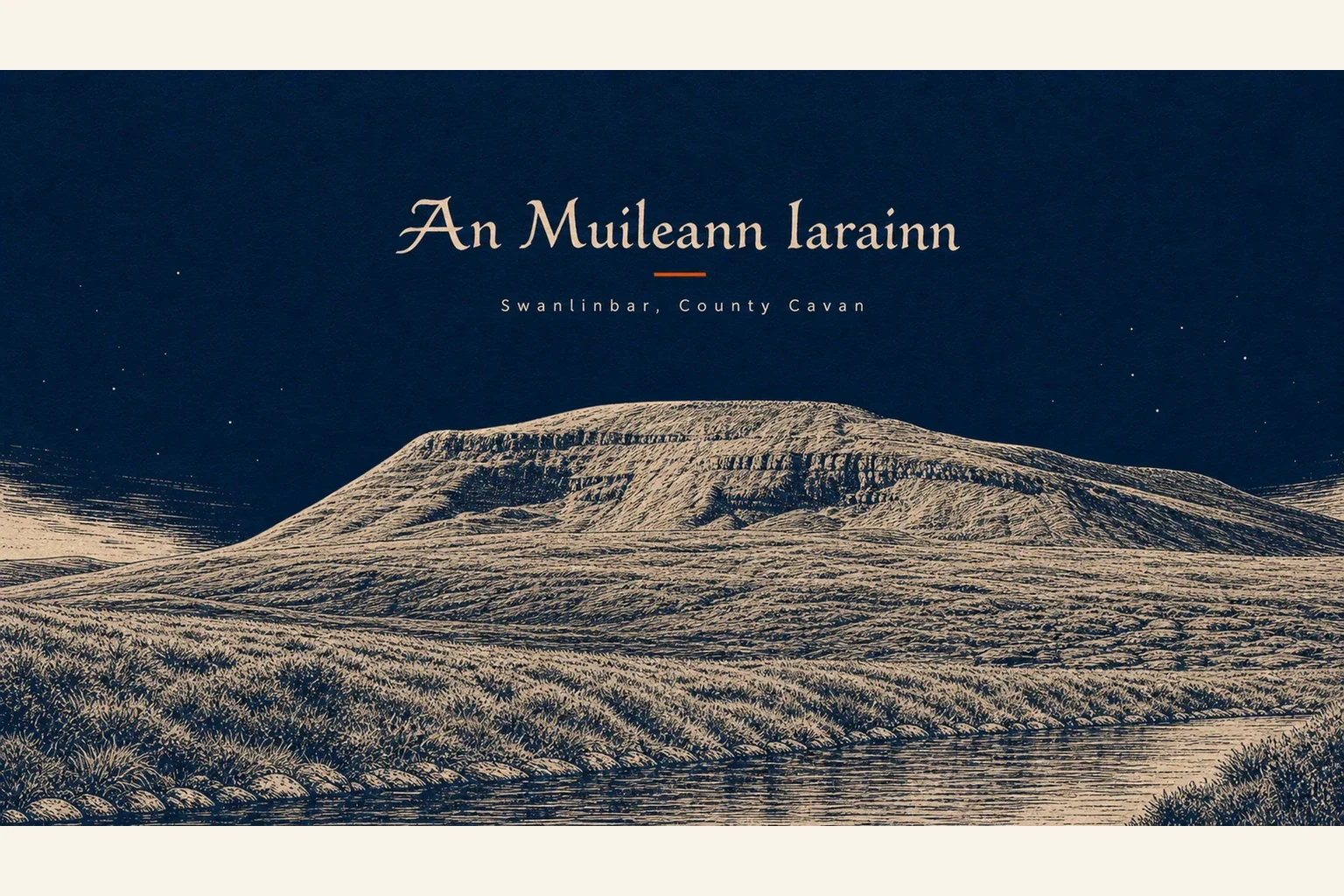
An Muileann Iarainn

The Ireland's Hidden Heartlands
STOP 06 / 06
An Muileann Iarainn · Co. Cavan

Named for four men who dug iron out of the hills and left before the timber ran out.

Swanlinbar sits in the north-west corner of Cavan, a few kilometres from the Fermanagh border, on the N87 between Blacklion and Ballyconnell. The population is around two hundred. The village is small enough that the main road through it is also the high street, the main square, and the edge of town all at once. This is not unusual for Cavan. What is unusual is how much history ended up concentrated in a place this size.

The ironworks came first. In 1682 a group of four entrepreneurs — Swift, Saunders, Darling, and Barry — took a lease on the land and began smelting. The village name is their initials joined together: Sw-and-Ling-Bar. Jonathan Swift, who may or may not have been related to one of them, wrote about the etymology in 1728 as if it were already an established curiosity. The smelting used charcoal from the surrounding oak forests. By the early 1800s the forests were gone and the ironworks closed. The townland of Furnaceland remembers where the furnaces stood.

The spa era followed the ironworks and lasted about fifty years. Sulphur springs were found nearby — mineral-rich, smelling of bad eggs, exactly what Georgian medicine prescribed for half a dozen ailments. The gentry of Ulster arrived each summer, took lodgings, and drank the waters. At its peak the springs were described as the strongest in County Cavan. By 1824 the fashion was fading and by 1836 the resort trade had largely gone. The village stayed. It has been quietly agricultural ever since.

Locally it is called Swad. The GAA club is Swanlinbar St Mary's. The Cladagh River runs nearby. If you are coming to walk Cuilcagh, this is the nearest settlement in the Republic. That is enough of a reason.
Population
~220
Founded
c. 1682
Coords
54.1927° N, 7.7062° W
01 / 06

At a glance.

Three things every local will eventually mention. Read these and you've already understood more than most day-trippers do.

02 / 06

Stories & lore.

The reason to come back. The things every local will eventually tell you about, usually after the second pint.

A name built from initials

The four ironmasters

In 1682 four men — Goodwin Swift, Robert Saunders, Richard Darling, and Richard Barry — took a lease on land in this corner of north-west Cavan and established an ironworks. The village that grew around the works took its name from their surnames: Sw (Swift), and (Saunders), Ling (Darling), Bar (Barry). Jonathan Swift — whether a relative of Goodwin Swift or simply a well-travelled observer — recorded this etymology in a 1728 essay. The ironworks ran on charcoal smelting, which consumed the surrounding oak forest at a rate the landscape could not sustain. When the timber ran out in the early 1800s, the works closed. The townland where the furnaces once stood is still called Furnaceland. The four men who named the place are otherwise forgotten.

Taking the waters in Cavan

The sulphur springs

Swanlinbar had mineral springs strong enough to attract a seasonal resort trade in the late 18th and early 19th centuries. The waters were described as containing sulphur, sea salt, earth, and fossil alkali — a combination that Georgian medicine considered powerfully restorative. Visitors arrived from April to September, took lodgings in the village, and followed the regimen of drinking and bathing that was standard practice at spa resorts across Britain and Ireland. At the time, Swanlinbar's springs were considered the most potent in County Cavan. The resort was never on the scale of Lisdoonvarna or the English spa towns, but it had a real season and a real clientele. By 1824 the fashion was declining. By 1836 the trade had mostly stopped. Nothing marks the spring sites now.

Twenty-two houses gone in one night

The fire of 1786

In 1786 a fire destroyed twenty-two houses in Swanlinbar. In a small settlement in that period, twenty-two houses was most of the village. The cause is not recorded with any certainty that survived into the present. The village was rebuilt. Given that the ironworks were still operating and the spa trade was building, there was economic reason to rebuild quickly. The event left no monument and is not marked locally. It is one of those facts that surfaces in historical accounts and then submerges again, leaving no trace in the landscape.

03 / 06

Things to do outside.

Wear waterproofs. Bring a sandwich. Tell someone where you're going if it's the mountain.

Cuilcagh Boardwalk Trail (Legnabrocky Trail) The main trailhead is at Corry, County Fermanagh — accessible from Swanlinbar via the border road. The trail runs across open bogland on a raised boardwalk before climbing 450 wooden steps to the summit at 666 metres. Known locally as the Stairway to Heaven. The summit sits on the Cavan-Fermanagh border. Water off the south slope feeds the Shannon Pot underground. Busy at weekends from spring through autumn — arrive early. The last section is exposed; weather changes fast.
12–14 km returndistance
2.5–3.5 hourstime
Local roads and the Cladagh River The minor roads around Swanlinbar run through drumlin farmland with good views toward Cuilcagh. The Cladagh River passes nearby. There is no formal trail network in the village itself, but the roads are quiet enough to walk without incident. Follow the river road south of the village for the flattest ground.
2–5 kmdistance
45 min–1.5 hourstime
04 / 06

When to go.

There is no bad time. There are different times.

Spring
Mar–May

The boardwalk trail opens up properly from April. Bogland is wet underfoot earlier in the season. Good light and few crowds.

◉ Go
Summer
Jun–Aug

Cuilcagh gets busy at weekends. The Stairway to Heaven can have queues on bank holidays. Midweek mornings are a different experience entirely.

◐ Mind yourself
Autumn
Sep–Oct

The bogland colours are at their best. Visitor numbers drop after school returns. The mountain is quiet and the weather is still often manageable.

◉ Go
Winter
Nov–Feb

The summit trail is exposed and the wooden steps ice up. The village closes in. Not a season for the mountain unless you know what you are doing.

◐ Mind yourself
05 / 06

What to skip.

Honestly? Don't bother.

If a local was sitting beside you, this is the bit where they'd lean in.

×
Driving through expecting a spa village

The waters are gone. The resort is gone. What remains is a small agricultural settlement on the border road. Come for the mountain, not for the history of a cure that no longer exists.

×
Parking at Corry trailhead on a summer Saturday afternoon

Cuilcagh now draws 60,000 walkers a year. The carpark fills early. If you arrive at noon in July you will park on the verge and walk an extra kilometre before you start. Go at nine or go in September.

×
Expecting facilities in the village

Swanlinbar is a small settlement. Do not arrive expecting a cafe, a gear shop, or a tourist office. Blacklion, fifteen minutes north-west, has Neven Maguire's restaurant if you need a landmark meal. Ballyconnell, twenty minutes south-east, has more day-to-day services.

+

Getting there.

By car

Dublin to Swanlinbar is about 2 hours via the M3, N3 through Cavan town, then west on the R200 to Ballyconnell and north on the N87. Enniskillen is 35 minutes north across the border. Blacklion is 15 minutes north-west on the N87.

By bus

Bus Éireann services run on the Cavan–Blacklion corridor passing through Swanlinbar. Infrequent — check timetables before travelling. A car is the practical way in for the Cuilcagh trailhead.

By train

No railway. Nearest mainline station is Drogheda (2h by road) or Sligo (1h 30m). Both require connecting transport.

By air

Dublin Airport is around 2 hours. Belfast International is 1h 15m. Ireland West (Knock) is 1h 45m.