County Cavan Ireland · Co. Cavan · Corlough Save · Share
POSTED FROM
CORLOUGH
CO. CAVAN · IE

Corlough
Cor Locha

The Ireland's Hidden Heartlands
STOP 06 / 06
Cor Locha · Co. Cavan

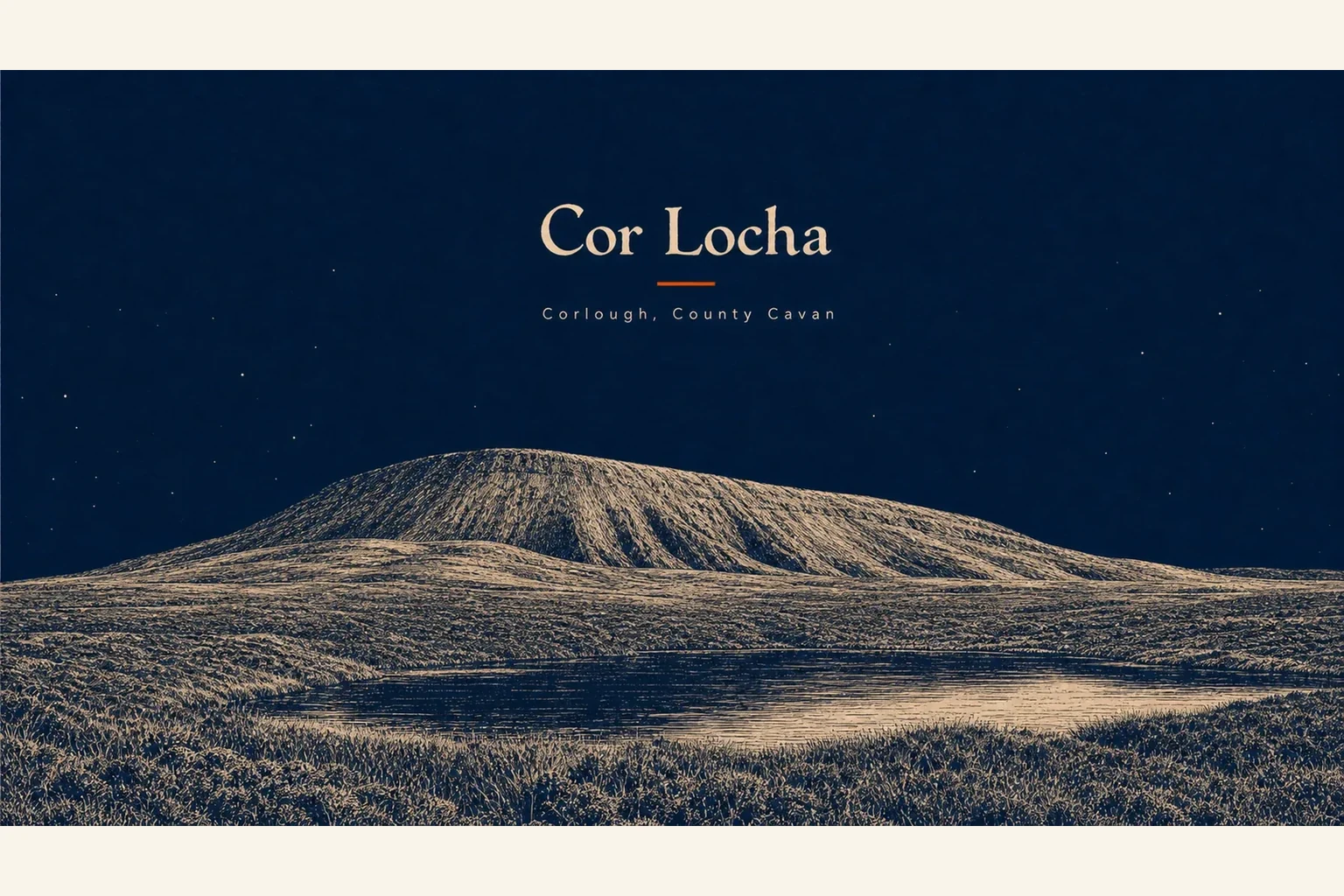
The round hill of the lake. Bog, border, and not much else — in the best sense.

Corlough is a small townland settlement in the north-west corner of Cavan, a few kilometres from both the Leitrim border to the west and the Fermanagh border to the north. The population has been under three hundred for as long as reliable records have existed, and considerably lower than that for most of the last century and a half. It is not a place that grew; it is a place that contracted and then stabilised at a level the land could actually support.

The Irish name, Cor Locha — the round hill of the lake — is accurate. The landscape is a mix of raised bog, poorly-drained farmland, and the small dark lakes that sit in the depressions between drumlin ridges. The Cuilcagh mountain region rises to the north, marking the Fermanagh border. On a clear day the plateau is visible from the high ground around the village. It is not close, but it is present.

This was always poor-land country. The soils in the west Cavan corridor are thin above the rock, wet for most of the year, and never easily tilled. The Famine years of the 1840s cleared the already sparse population further, and emigration continued through the following century in a way that was less dramatic than a disaster and more like a slow bleed. The people who left went to England, to New York, to Boston. The lanes that lead out of Corlough in several directions were the first step of many long journeys that most people never reversed.
Population
<300
Coords
54.1667° N, 7.9000° W
01 / 06

At a glance.

Three things every local will eventually mention. Read these and you've already understood more than most day-trippers do.

02 / 06

Stories & lore.

The reason to come back. The things every local will eventually tell you about, usually after the second pint.

Cor Locha — landscape as language

The name and the hill

Irish place names in this part of Cavan tend toward simple description: a hill, a lake, a colour of soil, the species of tree that grew on a riverbank. Cor Locha fits exactly in this tradition. Cor means a rounded hill or a circular prominence; locha is the genitive of loch, a lake. The name identifies the place by what the eye lands on first — the drumlin above the water. This is naming as map-making, done before cartography, using only what was visible from the ground. The name has been in use long enough that no one can say with certainty which lough it originally described. There are several candidates within a few kilometres.

The slow leaving

Emigration from the western parishes

The townlands of west Cavan — Corlough, Templeport, Kinawley, the parishes along the Fermanagh border — lost population steadily from the Famine decades onward. The Census of 1841 recorded a Cavan county population of around 243,000. By 1901 it had fallen to 97,000. The parishes around Corlough were not exceptional in this; they were typical. The land could not support the pre-Famine population and the economic structures that might have replaced agriculture never arrived this far west. The pattern — a generation emigrates, the next generation is smaller, fewer stay, the houses fall — repeated itself for four generations. The farmhouses in the bogs and along the small roads around Corlough include more than a few roofless gables.

The mountain at the edge of vision

The Cuilcagh plateau

Cuilcagh Mountain — 665 metres, straddling the Fermanagh-Cavan border — is the dominant upland feature of this part of Ireland. It is the source of the River Shannon, which rises in the Shannon Pot on the mountain's southern flank. The plateau is a high blanket bog, largely treeless, giving an unobstructed horizon for miles in any direction. Corlough is not on the standard approach to Cuilcagh — the Legnabrocky Trail approaches from the Fermanagh side through Marble Arch Caves Global Geopark — but the mountain is close enough to be a presence in the landscape from the high ground around the village. On clear days the plateau edge is visible to the north.

03 / 06

Things to do outside.

Wear waterproofs. Bring a sandwich. Tell someone where you're going if it's the mountain.

Bogland roads north toward the border The minor roads north and west of Corlough pass through open bog and past the lake margins that give the place its name. No formal trail, no waymarking, no facilities. This is quiet-road walking through working and semi-abandoned farmland. The bog opens up between the drumlins. Take the turnings that look least-used. Come back the same way or use OS Discovery Series Sheet 26.
Variable — 3–8 kmdistance
1–2 hourstime
Cuilcagh Mountain (from the Fermanagh side) The main Cuilcagh approach is from Marble Arch Caves in Fermanagh, about 30 minutes by road north of Corlough. The boardwalk trail across the plateau to the summit is well-maintained and well-signed. The Shannon Pot — source of the river — is a short detour from the main trail. If you are in this part of the world, this is the one walk that justifies the drive.
7.5 km return via Legnabrocky Traildistance
3–4 hourstime
04 / 06

When to go.

There is no bad time. There are different times.

Spring
Mar–May

The bog is still wet from winter but the light is improving and the roads are empty. Curlew and golden plover are on the wet ground in April.

◉ Go
Summer
Jun–Aug

Long evenings, dry enough for the bog roads, and the Cuilcagh walk is at its best in clear July weather. This corner of Cavan does not get crowded.

◉ Go
Autumn
Sep–Oct

The bog turns amber and brown. October cloud is frequent but not oppressive. The best month for the landscape at its most itself.

◉ Go
Winter
Nov–Feb

The roads are passable but the bog is saturated and the days are short. Fine if you know what you are doing. There is nothing here to shelter in if the weather turns.

◐ Mind yourself
05 / 06

What to skip.

Honestly? Don't bother.

If a local was sitting beside you, this is the bit where they'd lean in.

×
Arriving without a map and a plan

Corlough is not signed from the main roads in any way that will help you. The OS Discovery Sheet 26 — or a GPS with the minor road network loaded — is not optional. The roads out here converge on crossroads with no signage and the bog margins look the same in every direction after dark.

×
Expecting a village in the conventional sense

There is no pub, no shop, no heritage panel at the side of the road. Corlough is a townland, a church, and a scattering of houses. It rewards being treated as landscape first and destination second.

×
Driving through to get to Blacklion or Swanlinbar

Most traffic in this part of Cavan is in transit between somewhere else. That is fine. But the bogland roads around Corlough take twenty minutes to walk and they are genuinely worth the stop if you have the time.

+

Getting there.

By car

From Cavan town, take the N3 north then the N87 west through Ballyconnell and Swanlinbar. Corlough is on the minor roads north of Swanlinbar, roughly 90 minutes from Cavan town. From Blacklion, it is 10–15 minutes south-east on the minor road network. A car is the only practical way here.

By bus

No scheduled bus service to Corlough itself. Bus Éireann operates occasional services on the Cavan–Blacklion corridor through Swanlinbar, which is 10 km south-east. Check current timetables — frequency is low.

By train

No railway within practical distance. Nearest mainline stations are Drogheda and Dundalk, both around 2 hours by road.

By air

Dublin Airport is approximately 2 hours. Belfast International is 1 hour 30 minutes. Ireland West (Knock) is 1 hour 45 minutes.